QUESTION IMAGE
Question
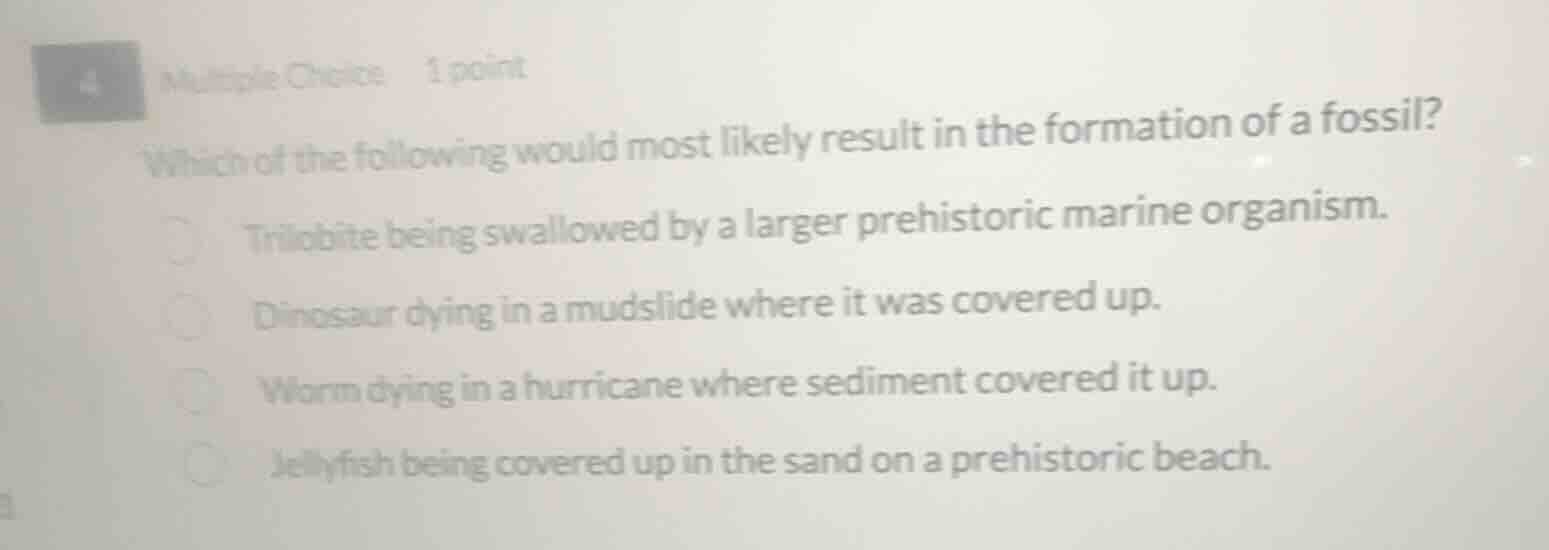
multiple choice 1 point which of the following would most likely result in the formation of a fossil? trilobite being swallowed by a larger prehistoric marine organism. dinosaur dying in a mudslide where it was covered up. worm dying in a hurricane where sediment covered it up. jellyfish being covered up in the sand on a prehistoric beach.
Brief Explanations
To form a fossil, an organism's remains need to be quickly covered by sediment (like mud, sand) to prevent decay, scavenging, or destruction. Let's analyze each option:
- "Trilobite being swallowed by a larger prehistoric marine organism": The trilobite would be digested, so no fossil formation.
- "Dinosaur dying in a mudslide where it was covered up": A mudslide quickly covers the dinosaur with mud (sediment), protecting it from decay/scavenging. Dinosaurs have hard parts (bones) that are more likely to fossilize, and rapid burial is ideal.
- "Worm dying in a hurricane where sediment covered it up": Worms are soft - bodied, and hurricanes are chaotic; the sediment coverage might not be as rapid or effective as a mudslide for a soft - bodied organism. Also, soft - bodied organisms are less likely to fossilize compared to hard - bodied ones like dinosaurs.
- "Jellyfish being covered up in the sand on a prehistoric beach": Jellyfish are soft - bodied, and sand coverage might not be as effective as mud (from a mudslide) in preserving, and soft - bodied organisms have lower fossilization potential.

Snap & solve any problem in the app
Get step-by-step solutions on Sovi AI
Photo-based solutions with guided steps
Explore more problems and detailed explanations
B. Dinosaur dying in a mudslide where it was covered up.