QUESTION IMAGE
Question
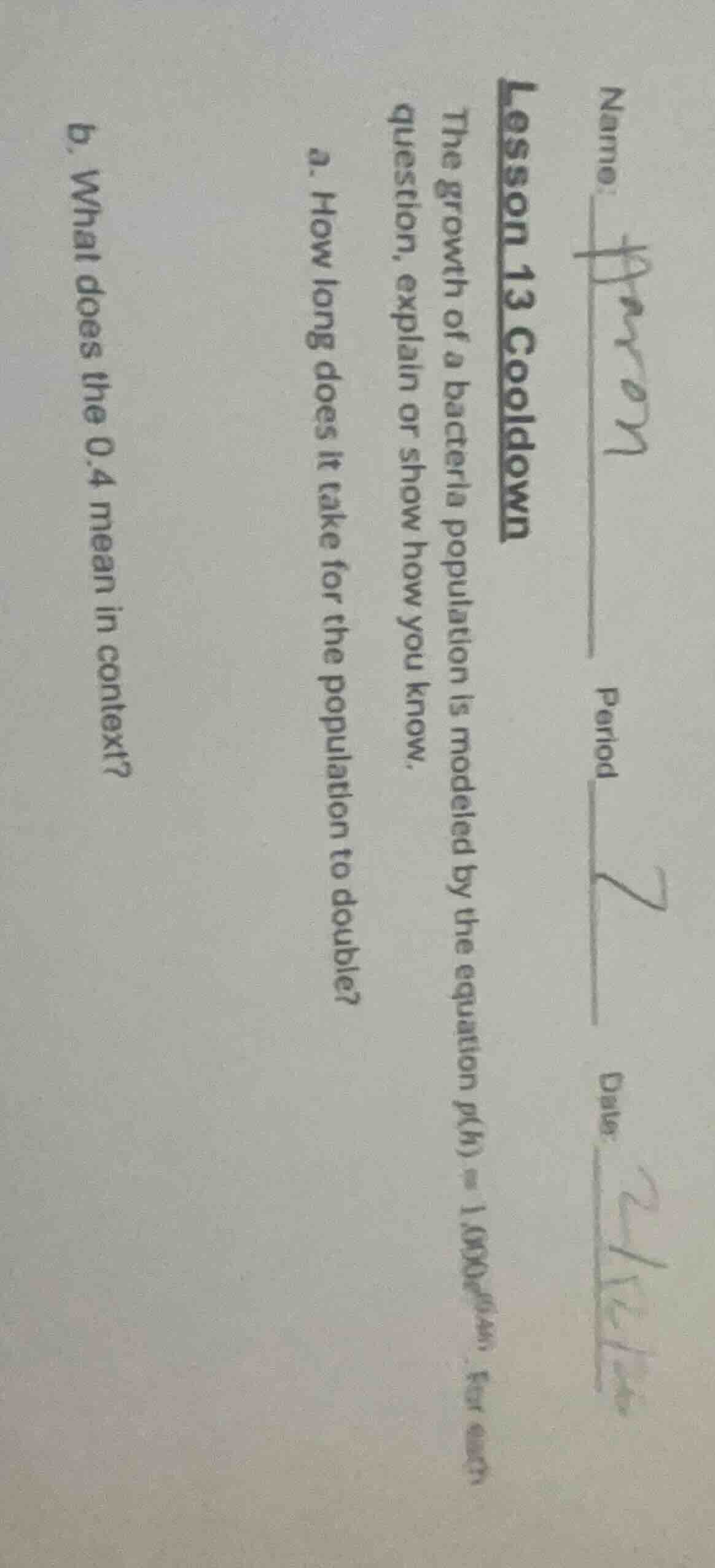
name: aaronperiod: 7date: 2/12/24lesson 13 cooldownthe growth of a bacteria population is modeled by the equation $p(h)=1,000e^{0.4h}$. for each question, explain or show how you know.a. how long does it take for the population to double?b. what does the 0.4 mean in context?
Step1: Set up doubling equation
We start with the population model \(p(h) = 1000e^{0.4h}\). To find when the population doubles, set \(p(h) = 2000\):
$$2000 = 1000e^{0.4h}$$
Step2: Simplify the equation
Divide both sides by 1000:
$$2 = e^{0.4h}$$
Step3: Convert to logarithmic form
Take the natural log of both sides:
$$\ln(2) = 0.4h$$
Step4: Solve for h
Isolate \(h\) by dividing both sides by 0.4:
$$h = \frac{\ln(2)}{0.4}$$
Calculate the value: \(h \approx \frac{0.6931}{0.4} \approx 1.73\)

Snap & solve any problem in the app
Get step-by-step solutions on Sovi AI
Photo-based solutions with guided steps
Explore more problems and detailed explanations
a. Approximately 1.73 hours
b. The 0.4 is the continuous growth rate of the bacteria population, meaning the population grows at an instantaneous rate of 40% per hour.