QUESTION IMAGE
Question
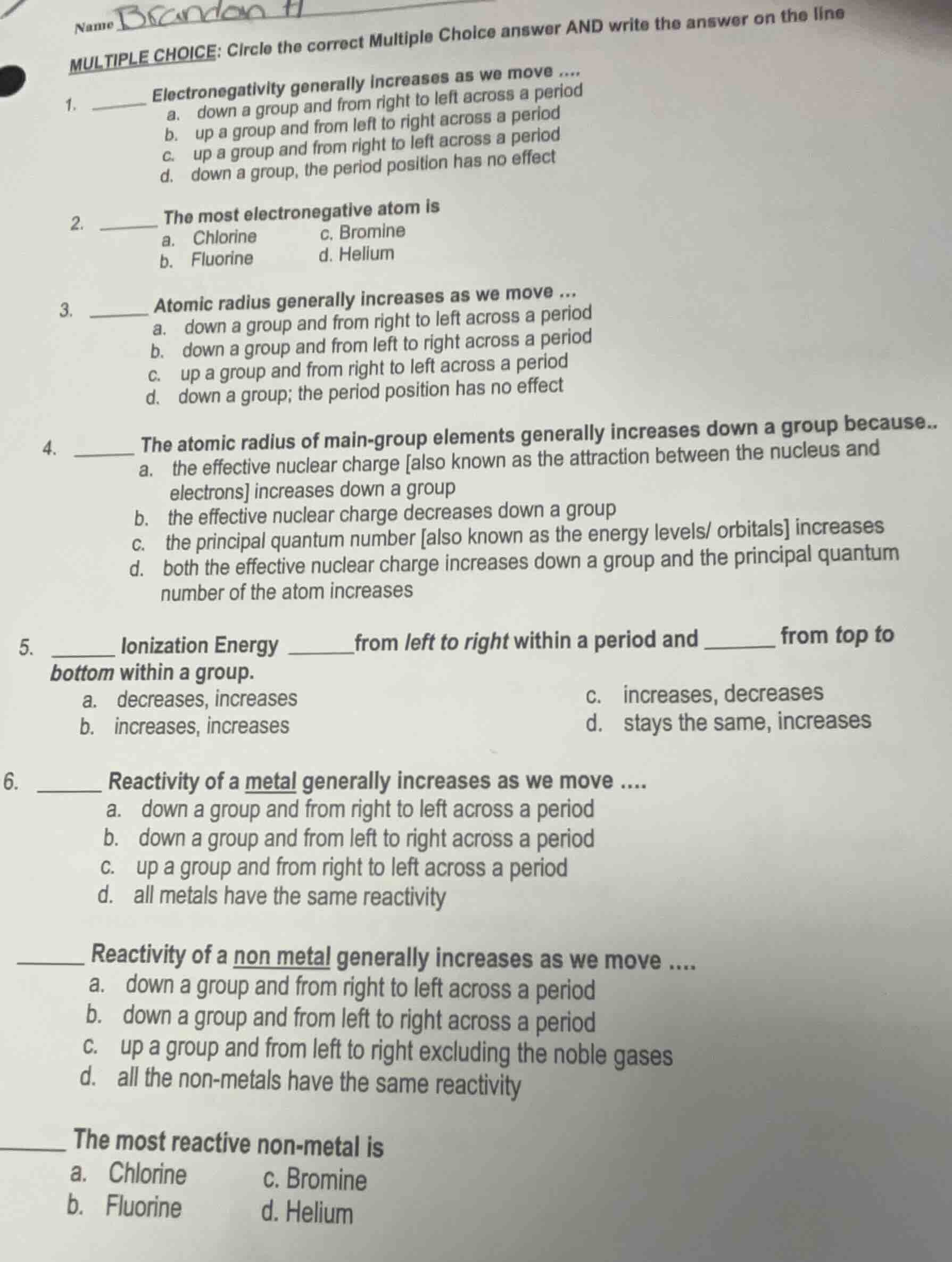
name brandon hmultiple choice: circle the correct multiple choice answer and write the answer on the line1. ____ electronegativity generally increases as we move ....a. down a group and from right to left across a periodb. up a group and from left to right across a periodc. up a group and from right to left across a periodd. down a group, the period position has no effect2. __ the most electronegative atom isa. chlorine c. bromineb. fluorine d. helium3. __ atomic radius generally increases as we move ...a. down a group and from right to left across a periodb. down a group and from left to right across a periodc. up a group and from right to left across a periodd. down a group; the period position has no effect4. __ the atomic radius of main-group elements generally increases down a group because..a. the effective nuclear charge also known as the attraction between the nucleus and electrons increases down a groupb. the effective nuclear charge decreases down a groupc. the principal quantum number also known as the energy levels/ orbitals increasesd. both the effective nuclear charge increases down a group and the principal quantum number of the atom increases5. __ ionization energy __from left to right within a period and __ from top to bottom within a group.a. decreases, increases c. increases, decreasesb. increases, increases d. stays the same, increases6. __ reactivity of a metal generally increases as we move ....a. down a group and from right to left across a periodb. down a group and from left to right across a periodc. up a group and from right to left across a periodd. all metals have the same reactivity__ reactivity of a non metal generally increases as we move ....a. down a group and from right to left across a periodb. down a group and from left to right across a periodc. up a group and from left to right excluding the noble gasesd. all the non-metals have the same reactivity____ the most reactive non-metal isa. chlorine c. bromineb. fluorine d. helium
- Electronegativity rises with higher nuclear charge (left to right across a period) and decreases with larger atomic size (down a group), so it increases up a group and left to right across a period.
- Fluorine has the highest electronegativity value (3.98) on the Pauling scale, making it the most electronegative atom.
- Atomic radius increases down a group (more electron shells) and from right to left across a period (decreasing nuclear charge pulling electrons closer).
- Down a group, the principal quantum number (energy level) increases, adding full electron shells that shield outer electrons from the nucleus, increasing atomic radius.
- Ionization energy increases left to right across a period (higher nuclear charge holds electrons tighter) and decreases down a group (electrons are farther from the nucleus, easier to remove).
- Metal reactivity increases down a group (easier to lose outer electrons) and from right to left across a period (fewer valence electrons to lose).
- Non-metal reactivity increases up a group (stronger attraction for electrons) and left to right across a period (higher electronegativity), excluding noble gases which are inert.
- Fluorine is the most reactive non-metal due to its high electronegativity and small atomic size, allowing it to easily gain electrons.

Snap & solve any problem in the app
Get step-by-step solutions on Sovi AI
Photo-based solutions with guided steps
Explore more problems and detailed explanations
- b. up a group and from left to right across a period
- b. Fluorine
- a. down a group and from right to left across a period
- c. the principal quantum number [also known as the energy levels/ orbitals] increases
- c. increases, decreases
- a. down a group and from right to left across a period
- c. up a group and from left to right excluding the noble gases
- b. Fluorine