QUESTION IMAGE
Question
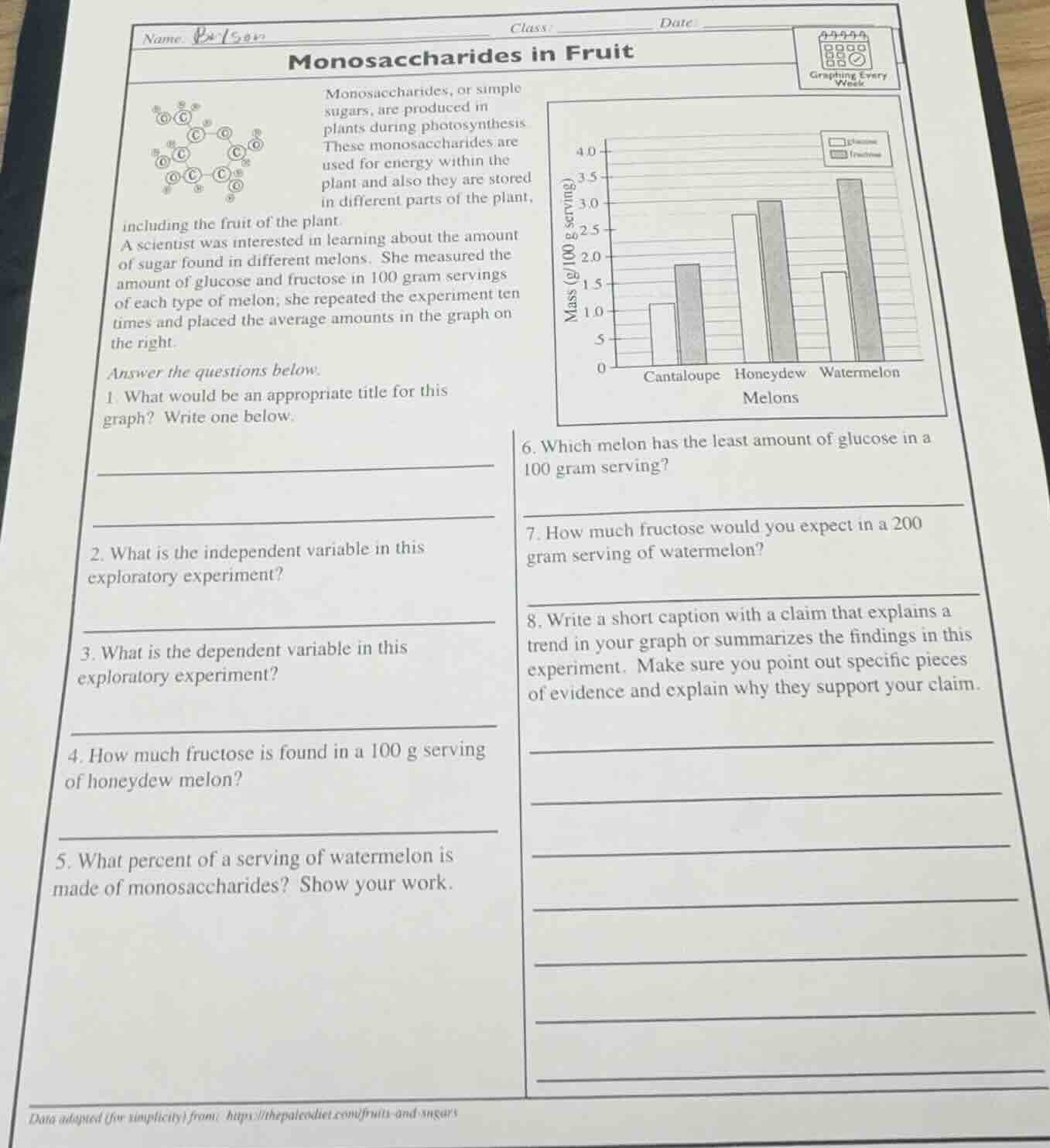
name: class: date:monosaccharides in fruitmonosaccharides, or simple sugars, are produced in plants during photosynthesis. these monosaccharides are used for energy within the plant and also they are stored in different parts of the plant, including the fruit of the plant.a scientist was interested in learning about the amount of sugar found in different melons. she measured the amount of glucose and fructose in 100 gram servings of each type of melon; she repeated the experiment ten times and placed the average amounts in the graph on the right.answer the questions below.1. what would be an appropriate title for this graph? write one below.2. what is the independent variable in this exploratory experiment?3. what is the dependent variable in this exploratory experiment?4. how much fructose is found in a 100 g serving of honeydew melon?5. what percent of a serving of watermelon is made of monosaccharides? show your work.6. which melon has the least amount of glucose in a 100 gram serving?7. how much fructose would you expect in a 200 gram serving of watermelon?8. write a short caption with a claim that explains a trend in your graph or summarizes the findings in this experiment. make sure you point out specific pieces of evidence and explain why they support your claim.data adapted (for simplicity) from: http://thepaleodiet.com/fruits-and-sugars
Step1: Answer graph title question
The title should describe the graph's content: types of melons, their glucose/fructose amounts per 100g.
Step2: Identify independent variable
Independent variable is the tested category: melon type.
Step3: Identify dependent variable
Dependent variable is measured value: mass of monosaccharides.
Step4: Read honeydew fructose value
From bar graph, honeydew fructose = 3.0 g/100g.
Step5: Calculate watermelon monosaccharide %
Sum glucose + fructose for watermelon: $1.5 + 3.5 = 5.0$ g/100g. Percent: $\frac{5.0}{100} \times 100 = 5\%$.
Step6: Find lowest glucose melon
Compare glucose bars: Cantaloupe has the shortest glucose bar.
Step7: Calculate 200g watermelon fructose
100g has 3.5g fructose, so 200g: $3.5 \times 2 = 7$ g.
Step8: Write evidence-based caption
State claim, cite specific bar values to support.

Snap & solve any problem in the app
Get step-by-step solutions on Sovi AI
Photo-based solutions with guided steps
Explore more problems and detailed explanations
- Average Mass of Glucose and Fructose (g) per 100g Serving in Selected Melons
- Type of melon (Cantaloupe, Honeydew, Watermelon)
- Mass of glucose and fructose (in grams per 100g serving)
- 3.0 grams
- 5%
- Cantaloupe
- 7.0 grams
- Claim: Watermelon contains the highest total amount of monosaccharides among the tested melons, with fructose being the dominant simple sugar across all three melon types. Evidence: Watermelon has a total of 5.0g of monosaccharides (1.5g glucose + 3.5g fructose) per 100g serving, which is higher than honeydew (2.8g + 3.0g = 5.8g? No, correction: honeydew glucose is ~2.8g, fructose 3.0g, total 5.8g; watermelon total 5.0g. Revised claim: Fructose is the more abundant monosaccharide in all three tested melons, and honeydew has the highest total monosaccharide content. Evidence: Cantaloupe has 1.1g glucose vs 1.8g fructose, honeydew has ~2.8g glucose vs 3.0g fructose, watermelon has 1.5g glucose vs 3.5g fructose per 100g serving. Honeydew has the highest total monosaccharides at ~5.8g per 100g, followed by watermelon (5.0g) and cantaloupe (2.9g). This shows fructose is the primary simple sugar stored in these melon fruits.