QUESTION IMAGE
Question
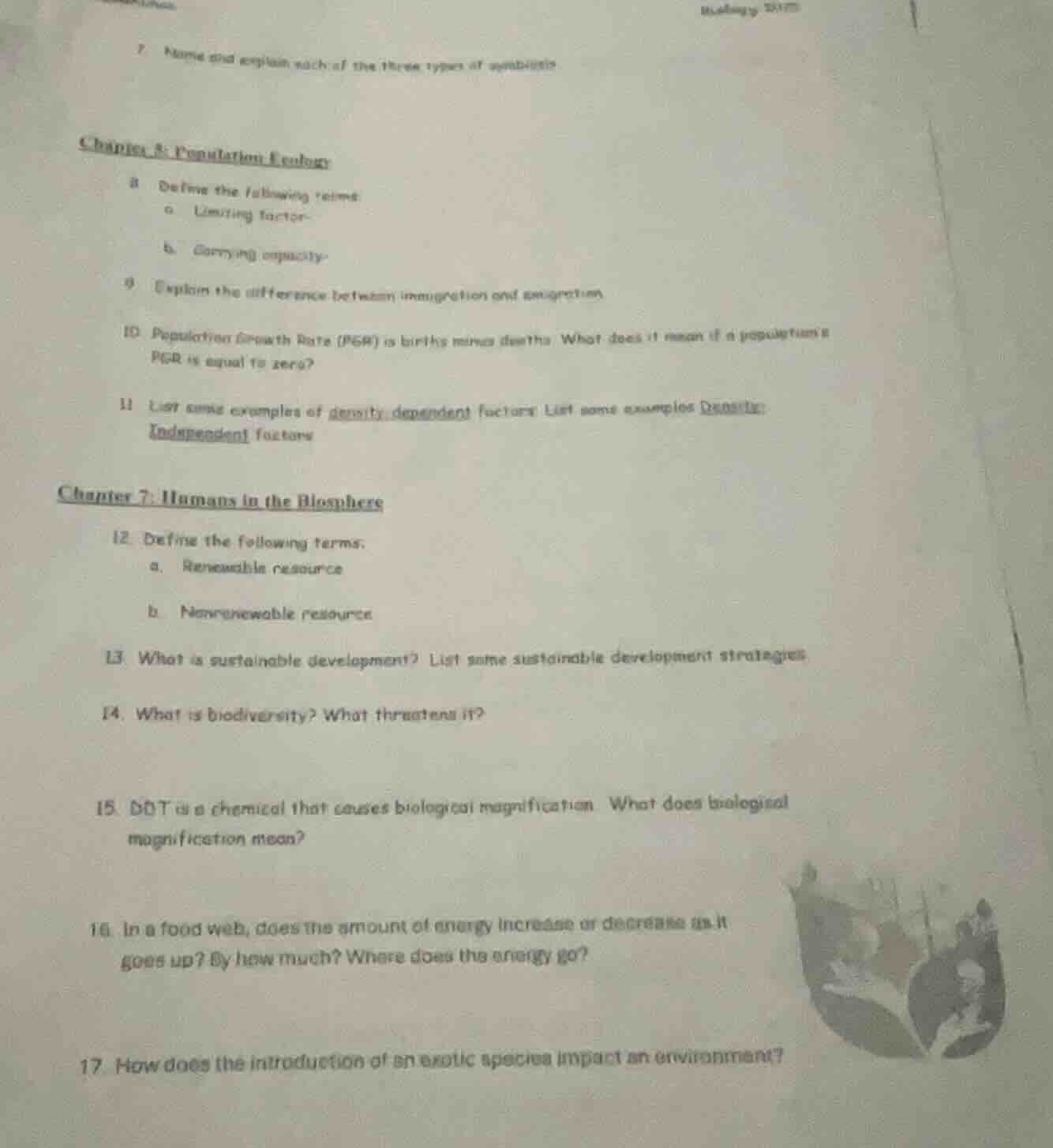
7 name and explain each of the three types of symbiosis
chapter 5: population ecology
8 define the following terms:
a limiting factor
b carrying capacity
9 explain the difference between immigration and emigration
10 population growth rate (pgr) is births minus deaths. what does it mean if a population’s pgr is equal to zero?
11 list some examples of density - dependent factors. list some examples density - independent factors
chapter 7: humans in the biosphere
12 define the following terms:
a renewable resource
b nonrenewable resource
13 what is sustainable development? list some sustainable development strategies.
14 what is biodiversity? what threatens it?
15 ddt is a chemical that causes biological magnification. what does biological magnification mean?
16 in a food web, does the amount of energy increase or decrease as it goes up? by how much? where does the energy go?
17 how does the introduction of an exotic species impact an environment?
Since there are multiple sub - questions, we'll answer them one by one using the Answer - Explanation Format.
Question 8a: Define Limiting factor
A limiting factor is an environmental factor (such as food, water, space, or a particular nutrient) that restricts the growth, abundance, or distribution of a population within an ecosystem. If the amount of this factor is insufficient or exceeds a certain tolerance range for the organisms in the population, it will limit how large the population can grow or where it can live.
Carrying capacity (often denoted as \(K\)) is the maximum number of individuals of a particular species that an ecosystem can support over a long - term period, considering the available resources (like food, water, shelter) and the ability of the ecosystem to absorb the waste produced by the population. When a population reaches the carrying capacity of its environment, its growth rate will typically stabilize (or may start to decline if resources become over - used).
Immigration refers to the movement of individuals into a particular population or geographic area from another area. For example, birds from a different region flying into a forest to join the local bird population. Emigration, on the other hand, is the movement of individuals out of a population or geographic area to another area. For instance, some fish leaving a lake to go to a larger river system. So the key difference is the direction of the movement of individuals relative to a specific population: immigration is moving in, emigration is moving out.

Snap & solve any problem in the app
Get step-by-step solutions on Sovi AI
Photo-based solutions with guided steps
Explore more problems and detailed explanations
A limiting factor is an environmental factor that restricts a population's growth, abundance, or distribution in an ecosystem.