QUESTION IMAGE
Question
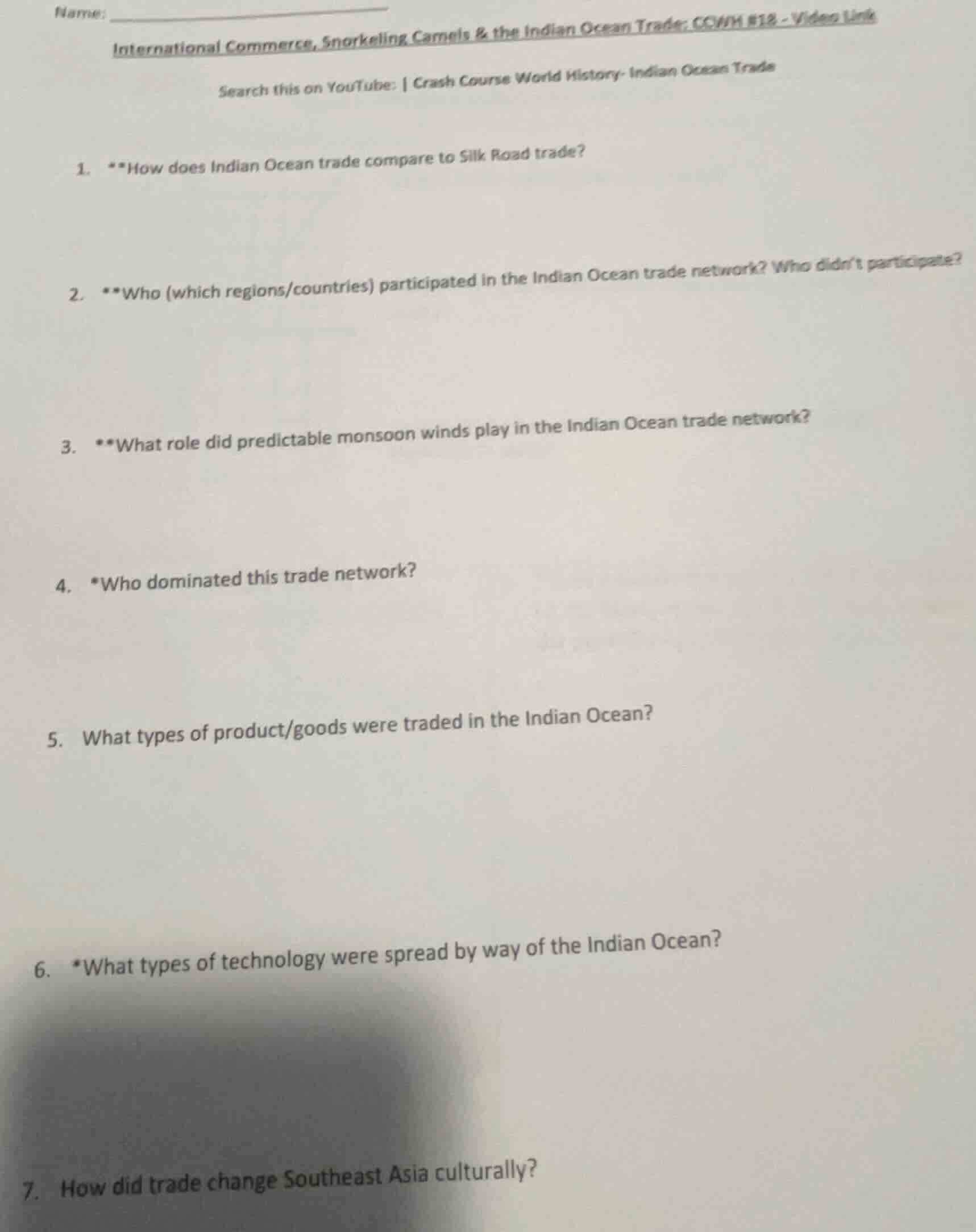
name:
international commerce, snorkeling camels & the indian ocean trade: cwhh #18 - video link
search this on youtube: | crash course world history- indian ocean trade
- **how does indian ocean trade compare to silk road trade?
- **who (which regions/countries) participated in the indian ocean trade network? who didn’t participate?
- **what role did predictable monsoon winds play in the indian ocean trade network?
- *who dominated this trade network?
- what types of product/goods were traded in the indian ocean?
- *what types of technology were spread by way of the indian ocean?
- how did trade change southeast asia culturally?
Brief Explanations
- Compares the two trade networks by scope, transport, goods, and reach.
- Lists participating regions and non-participating distant areas.
- Explains monsoons' role in scheduling and route planning.
- Notes shifting dominance across eras.
- Categorizes traded goods into luxury, staple, and specialty items.
- Identifies maritime and cultural technologies spread via trade.
- Details religious, linguistic, and social cultural shifts in Southeast Asia.

Snap & solve any problem in the app
Get step-by-step solutions on Sovi AI
Photo-based solutions with guided steps
Explore more problems and detailed explanations
- The Indian Ocean trade was primarily maritime (using ships) and focused on bulk goods like spices, grain, and textiles alongside luxury items, while the Silk Road was mostly overland (using camels) and centered on high-value luxury goods like silk, porcelain, and precious metals. The Indian Ocean network connected more coastal regions across Africa, Asia, and the Middle East, while the Silk Road linked Eurasian continental powers. Additionally, the Indian Ocean trade was more seasonal due to monsoons, while the Silk Road faced more land-based barriers like deserts and political instability.
- Participating regions/countries included East Africa (Swahili city-states like Kilwa), the Arabian Peninsula (Arab merchants, Oman), South Asia (India, Sri Lanka), Southeast Asia (Malacca, Srivijaya, Indonesia), East Asia (China, especially during the Tang and Ming dynasties), and Persia. Regions that did not participate included most of Europe (until the Age of Exploration), the Americas, and inland Central Asian groups not connected to coastal trade routes.
- Predictable monsoon winds allowed merchants to plan voyages reliably: they used the southwest monsoons (April-September) to sail east from Africa/Arabia to South/Southeast Asia, and the northeast monsoons (October-March) to sail westward. This predictability reduced risk, enabled consistent trade schedules, and encouraged the growth of permanent trading ports and coastal commercial centers.
- Dominance shifted over time: early on, Indian and Persian merchants were prominent; from the 7th century onward, Arab Muslim traders became major players, establishing trade routes and spreading Islam; later, Chinese fleets (Zheng He's expeditions in the 15th century) dominated temporarily; by the early modern era, Portuguese, Dutch, and European powers seized control of key ports.
- Traded goods included luxury items (spices like pepper, cloves, nutmeg from Southeast Asia; precious stones, ivory from East Africa; silk and porcelain from China), staple goods (grain, rice, cotton textiles from India), and other commodities (slaves, horses, perfumes, and metal goods).
- Technologies spread included maritime innovations like lateen sails, astrolabes, and magnetic compasses (improved navigation); shipbuilding techniques (like the dhow and junk designs); agricultural technologies (such as new crop varieties and irrigation methods); and printing and papermaking from China to other regions.
- Trade brought major cultural changes: Islam and Hinduism spread to Southeast Asia (e.g., the Sultanate of Malacca adopted Islam, while Bali retained Hinduism); linguistic influences led to creole languages (like Swahili in East Africa, and Malay-based trade languages); architectural styles blended (e.g., temple and mosque designs combining local and South Asian/Arab elements); and social structures shifted, with merchant classes gaining power and coastal cities becoming cultural and economic hubs.