QUESTION IMAGE
Question
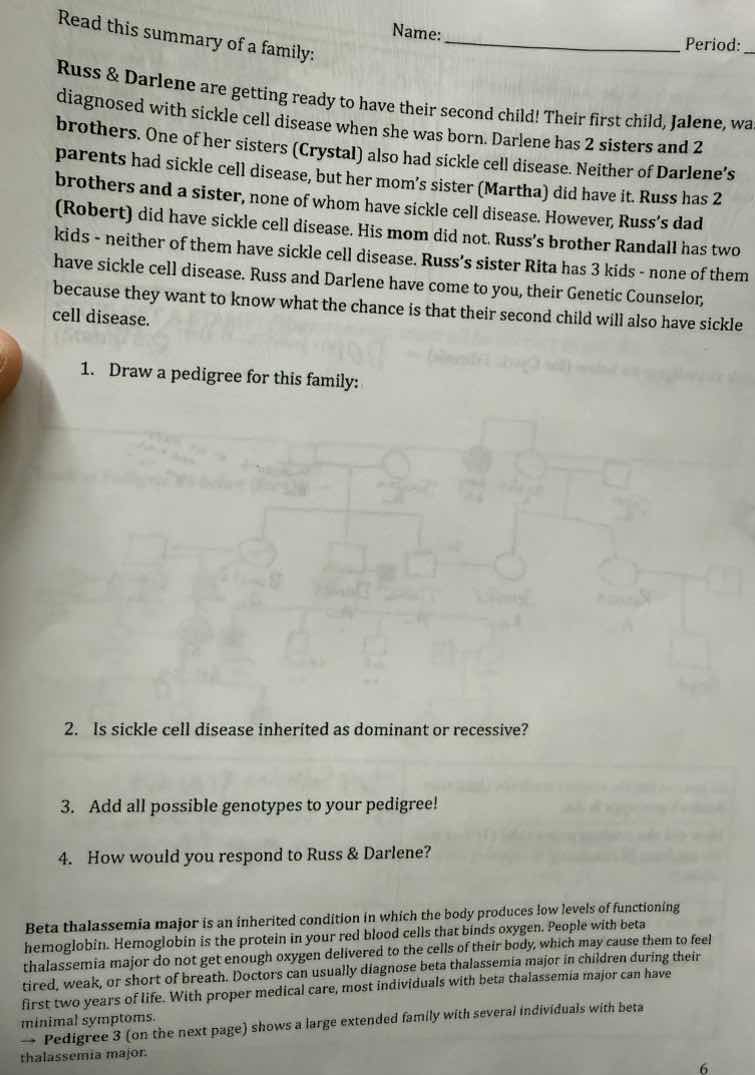
name: _______________ period: _read this summary of a family:russ & darlene are getting ready to have their second child! their first child, jalene, was diagnosed with sickle cell disease when she was born. darlene has 2 sisters and 2 brothers. one of her sisters (crystal) also had sickle cell disease. neither of darlenes parents had sickle cell disease, but her moms sister (martha) did have it. russ has 2 brothers and a sister, none of whom have sickle cell disease. however, russs dad (robert) did have sickle cell disease. his mom did not. russs brother randall has two kids - neither of them have sickle cell disease. russs sister rita has 3 kids - none of them have sickle cell disease. russ and darlene have come to you, their genetic counselor, because they want to know what the chance is that their second child will also have sickle cell disease.1. draw a pedigree for this family:2. is sickle cell disease inherited as dominant or recessive?3. add all possible genotypes to your pedigree!4. how would you respond to russ & darlene?beta thalassemia major is an inherited condition in which the body produces low levels of functioning hemoglobin. hemoglobin is the protein in your red blood cells that binds oxygen. people with beta thalassemia major do not get enough oxygen delivered to the cells of their body, which may cause them to feel tired, weak, or short of breath. doctors can usually diagnose beta thalassemia major in children during their first two years of life. with proper medical care, most individuals with beta thalassemia major can have minimal symptoms.→ pedigree 3 (on the next page) shows a large extended family with several individuals with beta thalassemia major.
Step1: Determine inheritance pattern
Sickle cell disease appears in individuals (Jalene, Crystal, Robert) whose parents do not show the disease, which matches recessive inheritance (carrier parents pass on recessive alleles).
Step2: Assign genotype conventions
Let $S$ = dominant (normal) allele, $s$ = recessive (sickle cell) allele. Affected individuals = $ss$, carriers = $Ss$, normal non-carriers = $SS$.
Step3: Map Darlene's family genotypes
- Darlene's parents: Both are $Ss$ (they had affected children but were unaffected).
- Darlene: $Ss$ (she had an affected child Jalene, $ss$).
- Jalene/Crystal: $ss$.
- Darlene's siblings (unaffected): $SS$ or $Ss$.
- Martha (Darlene's mom's sister): $SS$ (no disease, no affected children noted).
Step4: Map Russ's family genotypes
- Russ's dad (Robert): $ss$. Russ's mom: $SS$ (no disease, and Russ is unaffected).
- Russ: $Ss$ (inherited $s$ from dad, $S$ from mom).
- Russ's siblings (Randall, Rita, and other brother): $Ss$ (inherited $s$ from dad, $S$ from mom; their unaffected kids do not change this, as they can pass $S$ to children).
Step5: Calculate child's risk
Russ ($Ss$) × Darlene ($Ss$):
Chance of $ss$ (sickle cell) = $\frac{1}{4}$
Step6: Construct pedigree
- Generation 1: Darlene's parents ($Ss$, $Ss$); Russ's parents ($ss$, $SS$); Martha ($SS$)
- Generation 2: Darlene ($Ss$), her 2 sisters (1 $ss$, 1 $SS/Ss$), 2 brothers ($SS/Ss$); Russ ($Ss$), his 2 brothers ($Ss$), 1 sister ($Ss$)
- Generation 3: Jalene ($ss$); Russ/Randall/Rita's kids ($SS$ or $Ss$)
---

Snap & solve any problem in the app
Get step-by-step solutions on Sovi AI
Photo-based solutions with guided steps
Explore more problems and detailed explanations
s:
- (Pedigree structure):
- Generation 1:
- Square (Darlene's dad): $Ss$, Circle (Darlene's mom): $Ss$; Square (Russ's dad/Robert): $ss$, Circle (Russ's mom): $SS$; Circle (Martha): $SS$
- Generation 2:
- Circle (Darlene): $Ss$, Circle (Crystal): $ss$, 1 Circle/2 Squares (Darlene's other siblings): $SS/Ss$; Square (Russ): $Ss$, 2 Squares (Russ's brothers): $Ss$, Circle (Rita): $Ss$
- Generation 3:
- Circle (Jalene): $ss$; Squares/Circles (Russ/Randall/Rita's kids): $SS/Ss$
(Use standard pedigree symbols: shaded = affected, unshaded = unaffected; horizontal lines = matings, vertical lines = parent-child links)
- Sickle cell disease is inherited as recessive.
- Genotypes are assigned as mapped in Step3 and Step4 above, added to the pedigree as noted.
- "Russ and Darlene, since both of you are carriers of the sickle cell allele, there is a 25% (1 in 4) chance that your second child will have sickle cell disease. Genetic testing can confirm carrier status if needed, and we can discuss additional screening options for the pregnancy."