QUESTION IMAGE
Question
name
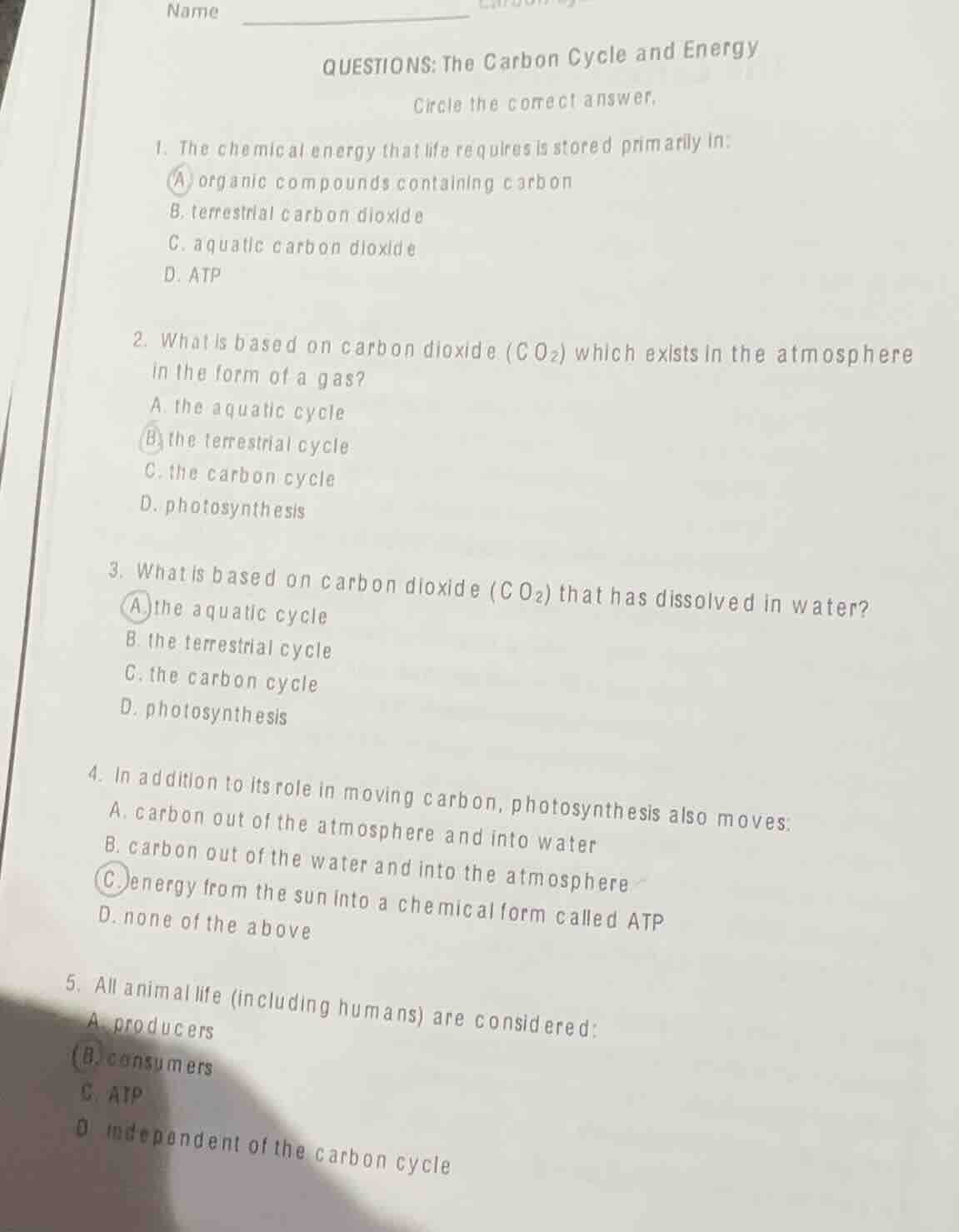
questions: the carbon cycle and energy
circle the correct answer.
- the chemical energy that life requires is stored primarily in:
a. organic compounds containing carbon
b. terrestrial carbon dioxide
c. aquatic carbon dioxide
d. atp
- what is based on carbon dioxide (co₂) which exists in the atmosphere in the form of a gas?
a. the aquatic cycle
b. the terrestrial cycle
c. the carbon cycle
d. photosynthesis
- what is based on carbon dioxide (co₂) that has dissolved in water?
a. the aquatic cycle
b. the terrestrial cycle
c. the carbon cycle
d. photosynthesis
- in addition to its role in moving carbon, photosynthesis also moves:
a. carbon out of the atmosphere and into water
b. carbon out of the water and into the atmosphere
c. energy from the sun into a chemical form called atp
d. none of the above
- all animal life (including humans) are considered:
a. producers
b. consumers
c. atp
d. independent of the carbon cycle
Question 1
Life's chemical energy is mainly stored in organic compounds with carbon (like carbohydrates, lipids, proteins). Terrestrial/aquatic CO₂ are inorganic and not energy storage, ATP is an energy carrier but not primary storage of life - required energy in the way organic carbon compounds are.
The terrestrial cycle (part of carbon cycle) uses atmospheric gaseous CO₂. The aquatic cycle uses dissolved CO₂, the carbon cycle is the overall cycle, photosynthesis uses CO₂ but the question is about what is based on gaseous atmospheric CO₂, so terrestrial cycle.
The aquatic cycle is based on CO₂ dissolved in water (aquatic environments). Terrestrial cycle uses gaseous CO₂, carbon cycle is overall, photosynthesis is a process, so aquatic cycle matches dissolved CO₂ in water.

Snap & solve any problem in the app
Get step-by-step solutions on Sovi AI
Photo-based solutions with guided steps
Explore more problems and detailed explanations
A. organic compounds containing carbon