QUESTION IMAGE
Question
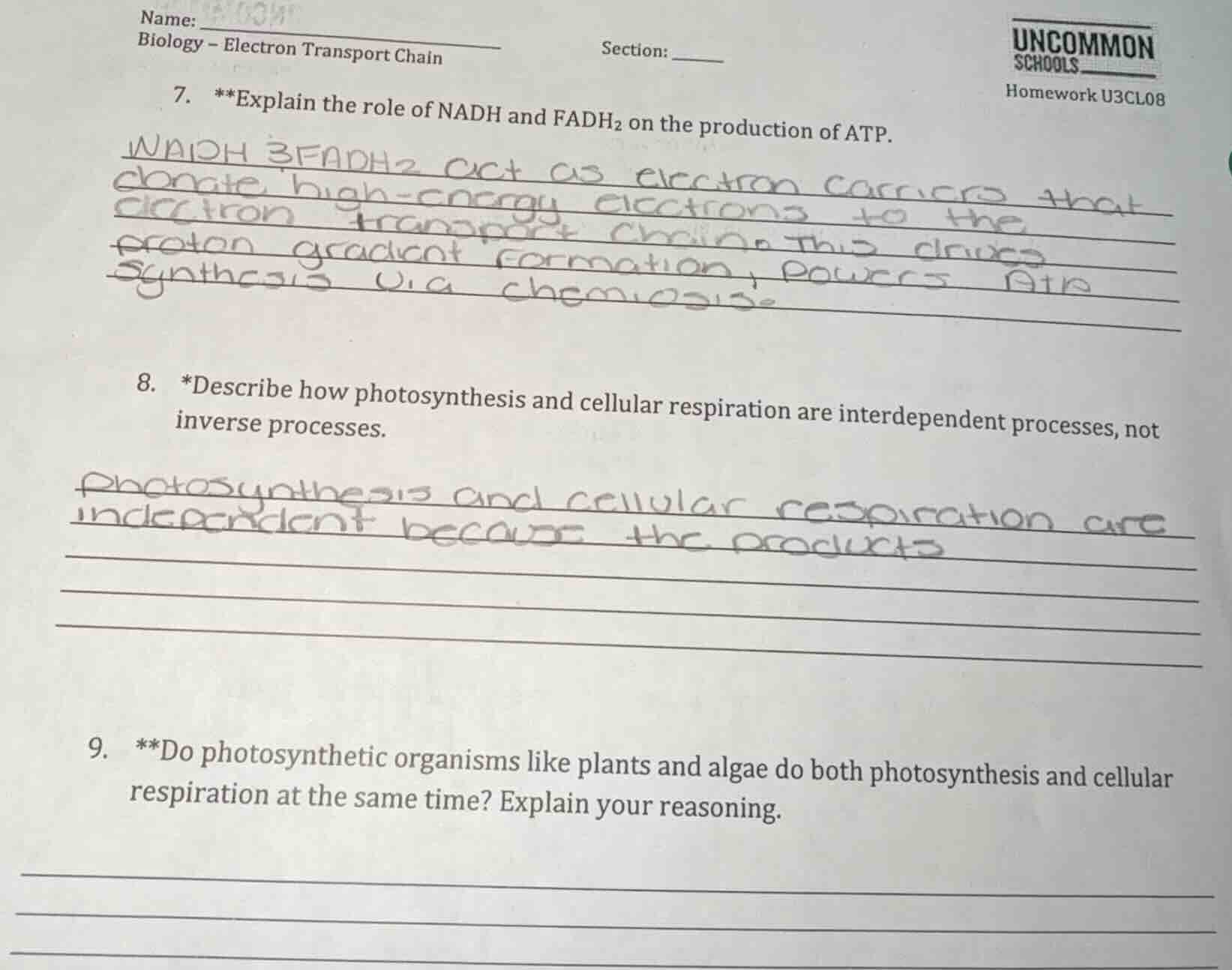
name: _____________section:____biology - electron transport chainuncommon schoolshomework u3cl087. *explain the role of nadh and fadh₂ on the production of atp.nadh & fadh2 act as electron carriers that donate high-energy electrons to the electron transport chain. this drives proton gradient formation, powers atp synthesis via chemiosmosis.8. describe how photosynthesis and cellular respiration are interdependent processes, not inverse processes.photosynthesis and cellular respiration are independent because the products9. **do photosynthetic organisms like plants and algae do both photosynthesis and cellular respiration at the same time? explain your reasoning.
For Question 7:
NADH and FADH₂ are electron carriers generated in earlier cellular respiration stages (glycolysis, pyruvate oxidation, Krebs cycle). They donate high-energy electrons to the electron transport chain (ETC). As electrons move through the ETC, energy is released to pump protons ($H^+$) across the inner mitochondrial membrane, creating a proton gradient. This gradient drives ATP synthesis via chemiosmosis, where protons flow back through ATP synthase to power ATP production. NADH provides more energy (yields ~3 ATP) than FADH₂ (yields ~2 ATP) because it enters the ETC at an earlier, higher-energy complex.
For Question 8:
The two processes are interdependent because the products of one are the reactants of the other: photosynthesis uses carbon dioxide ($CO_2$) and water ($H_2O$) (waste/inputs from cellular respiration) to make glucose ($C_6H_{12}O_6$) and oxygen ($O_2$), while cellular respiration uses glucose and oxygen (products of photosynthesis) to make $CO_2$, $H_2O$, and ATP. They are not inverse because they occur in different organelles (chloroplasts vs. mitochondria), use different energy sources (sunlight vs. glucose), and have distinct intermediate reactions and enzyme systems. Photosynthesis stores energy, while cellular respiration releases it.
For Question 9:
Yes, photosynthetic organisms perform both processes simultaneously during daylight hours. Photosynthesis produces glucose and oxygen to fuel cellular respiration, which generates ATP needed for the organism's metabolic functions (like growth, nutrient transport, and repair). Even with active photosynthesis, cells require a constant supply of ATP that cannot be directly provided by photosynthesis itself. At night, photosynthesis stops, but cellular respiration continues to sustain the organism using stored glucose.

Snap & solve any problem in the app
Get step-by-step solutions on Sovi AI
Photo-based solutions with guided steps
Explore more problems and detailed explanations
Question 7:
NADH and FADH₂ act as electron carriers that donate high-energy electrons to the electron transport chain. This powers the formation of a proton gradient, which drives ATP synthesis via chemiosmosis (NADH yields ~3 ATP, FADH₂ yields ~2 ATP due to entering the ETC at a later complex).
Question 8:
Photosynthesis and cellular respiration are interdependent because the products of one are the reactants of the other: photosynthesis uses $CO_2$ and $H_2O$ (from respiration) to make glucose and $O_2$, while respiration uses glucose and $O_2$ (from photosynthesis) to make $CO_2$, $H_2O$, and ATP. They are not inverse because they occur in different organelles, use different energy sources (sunlight vs. glucose), and have distinct biochemical pathways: photosynthesis stores energy, while respiration releases it.
Question 9:
Yes, photosynthetic organisms like plants and algae perform both processes at the same time (during daylight). Photosynthesis produces glucose and oxygen to fuel cellular respiration, which generates the constant supply of ATP the organism needs for metabolic functions (e.g., growth, transport). At night, photosynthesis ceases, but cellular respiration continues using stored glucose reserves.