QUESTION IMAGE
Question
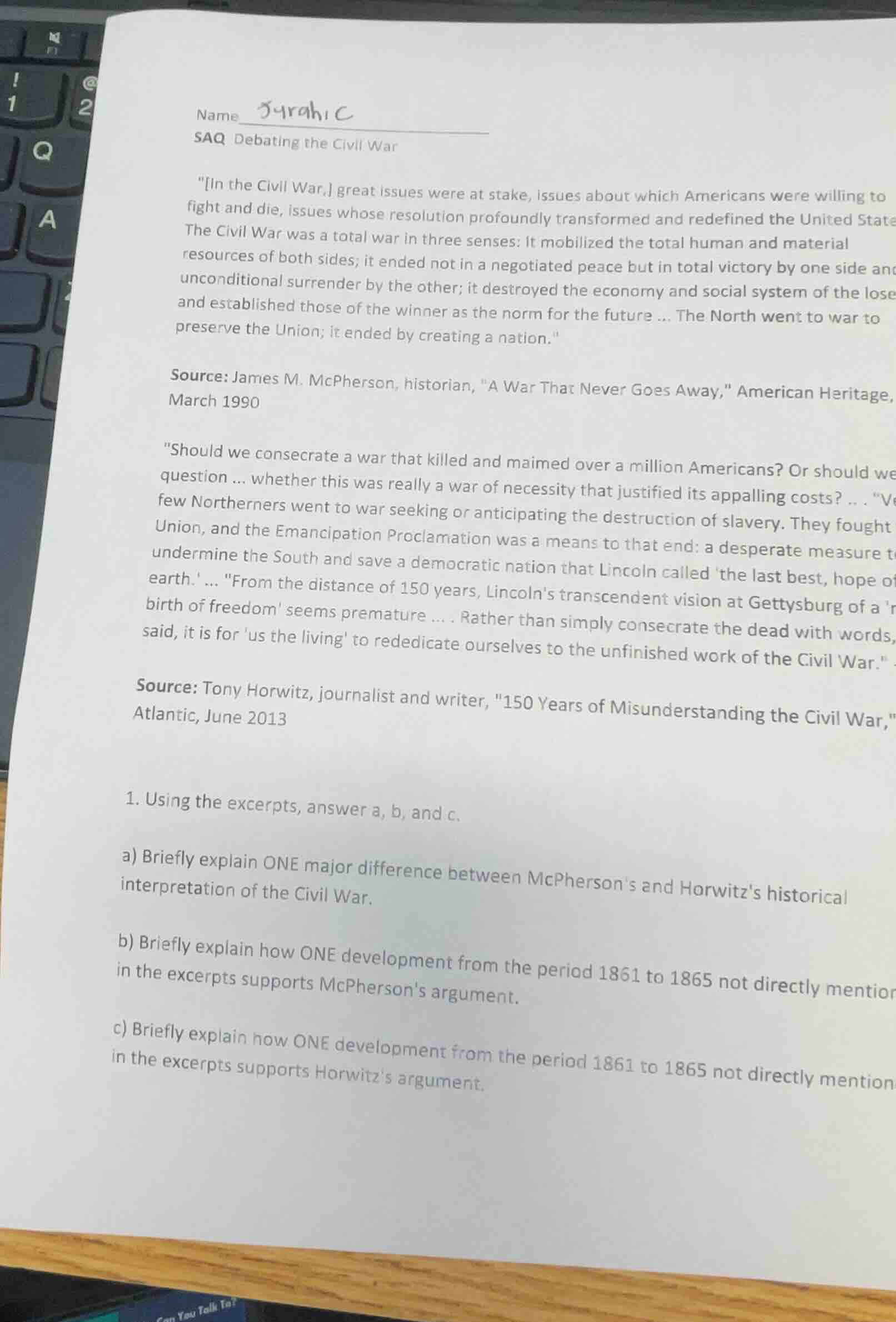
name syrah c
saq debating the civil war
\in the civil war, great issues were at stake, issues about which americans were willing to fight and die, issues whose resolution profoundly transformed and redefined the united state
the civil war was a total war in three senses: it mobilized the total human and material resources of both sides; it ended not in a negotiated peace but in total victory by one side an unconditional surrender by the other; it destroyed the economy and social system of the lose and established those of the winner as the norm for the future ... the north went to war to preserve the union; it ended by creating a nation.\
source: james m. mcpherson, historian, \a war that never goes away,\ american heritage, march 1990
\should we consecrate a war that killed and maimed over a million americans? or should we question ... whether this was really a war of necessity that justified its appalling costs? ... \ve few northerners went to war seeking or anticipating the destruction of slavery. they fought union, and the emancipation proclamation was a means to that end: a desperate measure t undermine the south and save a democratic nation that lincoln called the last best, hope of earth. ... \from the distance of 150 years, lincolns transcendent vision at gettysburg of a r birth of freedom seems premature ... . rather than simply consecrate the dead with words, said, it is for us the living to rededicate ourselves to the unfinished work of the civil war.\
source: tony horwitz, journalist and writer, \150 years of misunderstanding the civil war,\ atlantic, june 2013
- using the excerpts, answer a, b, and c.
a) briefly explain one major difference between mcphersons and horwitzs historical interpretation of the civil war.
b) briefly explain how one development from the period 1861 to 1865 not directly mention in the excerpts supports mcphersons argument.
c) briefly explain how one development from the period 1861 to 1865 not directly mention in the excerpts supports horwitzs argument.
a) McPherson frames the Civil War as a transformative, necessary total war that redefined the U.S. from a union to a nation, while Horwitz questions its necessity, critiques the glorification of the war, and argues that the North's initial goal was not ending slavery.
b) The passage of the 13th Amendment (1865) supports McPherson's argument: it destroyed the South's slave-based social and economic system, establishing the North's free-labor system as the national norm, which aligns with his claim that the war redefined the U.S. and imposed the winner's systems as the future standard.
c) The 1862 Militia Act supports Horwitz's argument: this law allowed the Union to use African American labor and later enlist Black soldiers, which was a pragmatic measure to bolster Union forces (undermine the South) rather than a primary push for emancipation, matching Horwitz's claim that emancipation was a desperate means to save the Union, not an initial Northern war goal.

Snap & solve any problem in the app
Get step-by-step solutions on Sovi AI
Photo-based solutions with guided steps
Explore more problems and detailed explanations
a) McPherson views the Civil War as a transformative, necessary total war that turned the U.S. from a union into a nation, while Horwitz questions the war's necessity, pushes back against its glorification, and notes the North did not initially fight to end slavery.
b) The 13th Amendment (1865), which abolished slavery nationwide, destroyed the South's slave-based social and economic system, entrenching the North's free-labor system as the national norm—supporting McPherson's claim that the war redefined the U.S. with the winner's systems as the future standard.
c) The 1862 Militia Act, which authorized the Union to employ African American labor and later enlist Black soldiers, was a pragmatic step to strengthen Union forces and weaken the South, not a core push for emancipation—supporting Horwitz's argument that emancipation was a desperate means to save the Union, not an initial Northern war aim.