QUESTION IMAGE
Question
name
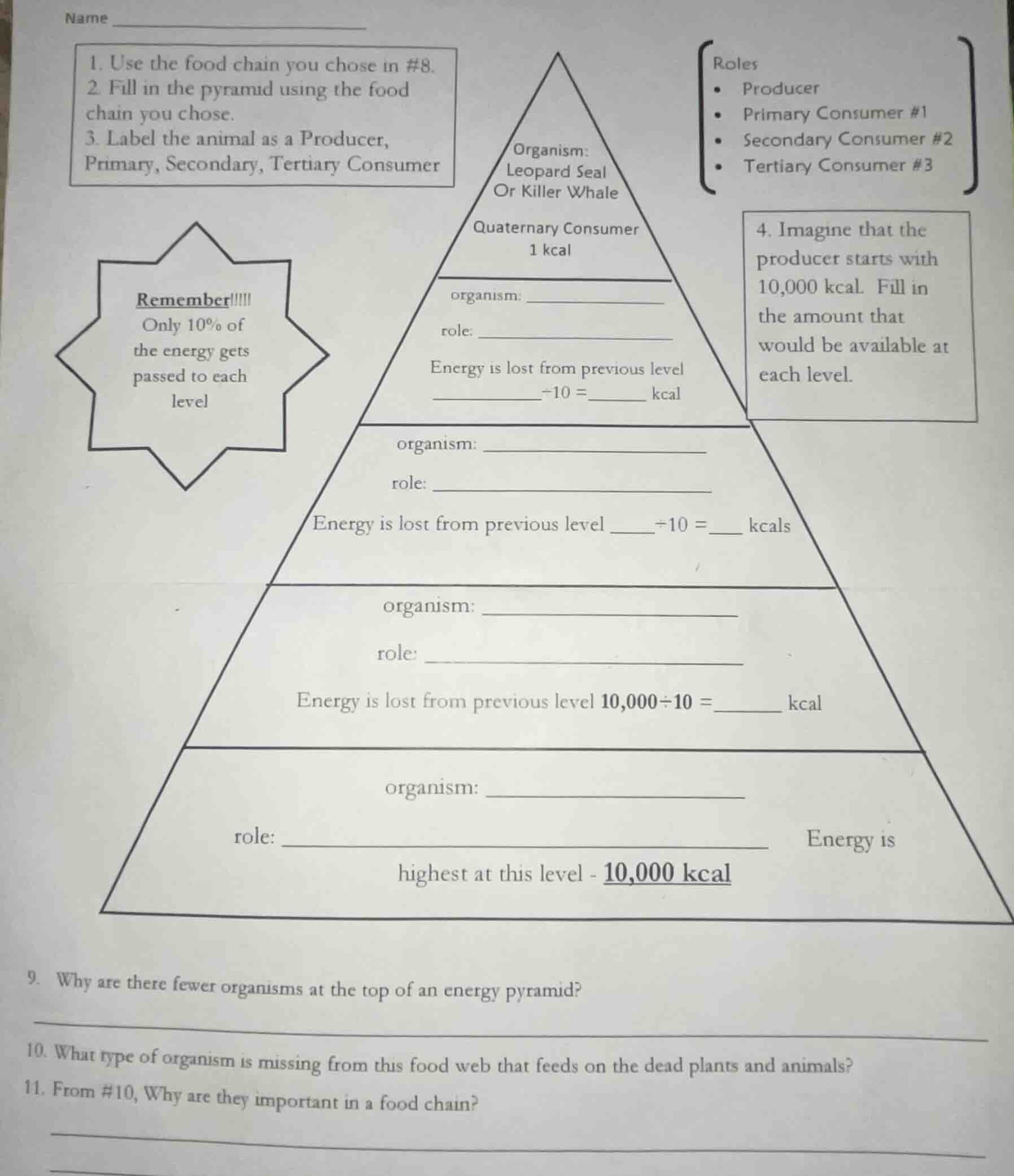
- use the food chain you chose in #8.
- fill in the pyramid using the food
chain you chose.
- label the animal as a producer,
primary, secondary, tertiary consumer
remember!!!!!
only 10% of
the energy gets
passed to each
level
organism:
leopard seal
or killer whale
quaternary consumer
1 kcal
organism:
role:
energy is lost from previous level
____÷10 =____ kcal
organism:
role:
energy is lost from previous level __÷10 =__ kcals
organism:
role:
energy is lost from previous level 10,000÷10 =______ kcal
organism:
role:
energy is
highest at this level - 10,000 kcal
roles
- producer
- primary consumer #1
- secondary consumer #2
- tertiary consumer #3
- imagine that the
producer starts with
10,000 kcal. fill in
the amount that
would be available at
each level.
- why are there fewer organisms at the top of an energy pyramid?
- what type of organism is missing from this food web that feeds on the dead plants and animals?
- from #10, why are they important in a food chain?
For the energy pyramid filling (assuming a marine food chain example like Phytoplankton → Krill → Penguin → Leopard Seal):
Step 1: Producer Level (Bottom)
- Organism: Phytoplankton (or other marine producers like algae)
- Role: Producer
- Energy: 10,000 kcal (given as highest at this level)
Step 2: Primary Consumer Level
- Organism: Krill (or other primary consumers that eat producers)
- Role: Primary Consumer #1
- Energy Calculation: Since only 10% of energy is passed, we take the previous level's energy (10,000 kcal) and divide by 10.
$10,000 \div 10 = 1000$ kcal
Step 3: Secondary Consumer Level
- Organism: Penguin (or other secondary consumers that eat primary consumers)
- Role: Secondary Consumer #2
- Energy Calculation: Take the previous level's energy (1000 kcal) and divide by 10.
$1000 \div 10 = 100$ kcal
Step 4: Tertiary Consumer Level
- Organism: Leopard Seal (or Killer Whale, as an example)
- Role: Tertiary Consumer #3
- Energy Calculation: Take the previous level's energy (100 kcal) and divide by 10.
$100 \div 10 = 10$ kcal
Step 5: Quaternary Consumer Level (Top, if applicable; in the given pyramid, it's Leopard Seal or Killer Whale as Quaternary? Wait, the top has "Quaternary Consumer 1 kcal"—let's adjust. Wait, the top level in the pyramid is labeled "Quaternary Consumer 1 kcal". So let's trace back:
- Quaternary Consumer: 1 kcal
So the level below (Tertiary) would have energy $1 \times 10 = 10$ kcal (since energy is passed up as 10%, so to find the lower level, we multiply by 10).
Then Secondary: $10 \times 10 = 100$ kcal
Primary: $100 \times 10 = 1000$ kcal
Producer: $1000 \times 10 = 10,000$ kcal (matches the given highest energy).
So filling the pyramid:
- Bottom level (Producer):
Organism: Phytoplankton (example)
Role: Producer
Energy: 10,000 kcal (given)
- Next level (Primary Consumer #1):
Organism: Krill (example)
Role: Primary Consumer #1
Energy: $10,000 \div 10 = 1000$ kcal
- Next level (Secondary Consumer #2):
Organism: Penguin (example)
Role: Secondary Consumer #2
Energy: $1000 \div 10 = 100$ kcal
- Next level (Tertiary Consumer #3):
Organism: Leopard Seal (example)
Role: Tertiary Consumer #3
Energy: $100 \div 10 = 10$ kcal
- Top level (Quaternary Consumer):
Organism: Killer Whale (example, if Leopard Seal is Tertiary, then Killer Whale is Quaternary)
Role: Quaternary Consumer
Energy: $10 \div 10 = 1$ kcal (matches the given 1 kcal)
For Question 9: "Why are there fewer organisms at the top of an energy pyramid?"
At each trophic level, only 10% of energy is passed to the next level. The top levels (like tertiary/quaternary consumers) have the least available energy. Since organisms need energy to survive, there’s not enough energy to support a large number of organisms at the top.
For Question 10: "What type of organism is missing from this food web that feeds on the dead plants and animals?"
Decomposers (like bacteria, fungi, or detritivores) are missing. They break down dead organic matter.
For Question 11: "From #10, Why are they important in a food chain?"
Decomposers recycle nutrients (like carbon, nitrogen) back into the ecosystem by breaking down dead organisms and waste. This allows producers to use these nutrients to grow, restarting the food chain.
Filled Pyramid (Example):
| Level | Organism | Role | Energy (kcal) | Calculation (from previous level) |
|---|---|---|---|---|
| Primary | Krill | Primary Consumer #1 | 1000 | $10,000 \div 10$ |
| Secondary | Penguin | Secondary Consumer #2 | 100 | $1000 \div 10$ |
| Tertiary | Leopard Seal | Tertiary Consumer #3 | 10 | $100 \div 10$ |
| Quaternary | Killer Whale | Quaternary Consumer | 1 | $10 \div 10$ |
(Note: The exact organisms can vary based on the chosen food chain, but the energy flow follows the 10% rule.)

Snap & solve any problem in the app
Get step-by-step solutions on Sovi AI
Photo-based solutions with guided steps
Explore more problems and detailed explanations
Decomposers recycle nutrients (like carbon, nitrogen) back into the ecosystem by breaking down dead organisms and waste. This allows producers to use these nutrients to grow, restarting the food chain.
Filled Pyramid (Example):
| Level | Organism | Role | Energy (kcal) | Calculation (from previous level) |
|---|---|---|---|---|
| Primary | Krill | Primary Consumer #1 | 1000 | $10,000 \div 10$ |
| Secondary | Penguin | Secondary Consumer #2 | 100 | $1000 \div 10$ |
| Tertiary | Leopard Seal | Tertiary Consumer #3 | 10 | $100 \div 10$ |
| Quaternary | Killer Whale | Quaternary Consumer | 1 | $10 \div 10$ |
(Note: The exact organisms can vary based on the chosen food chain, but the energy flow follows the 10% rule.)