QUESTION IMAGE
Question
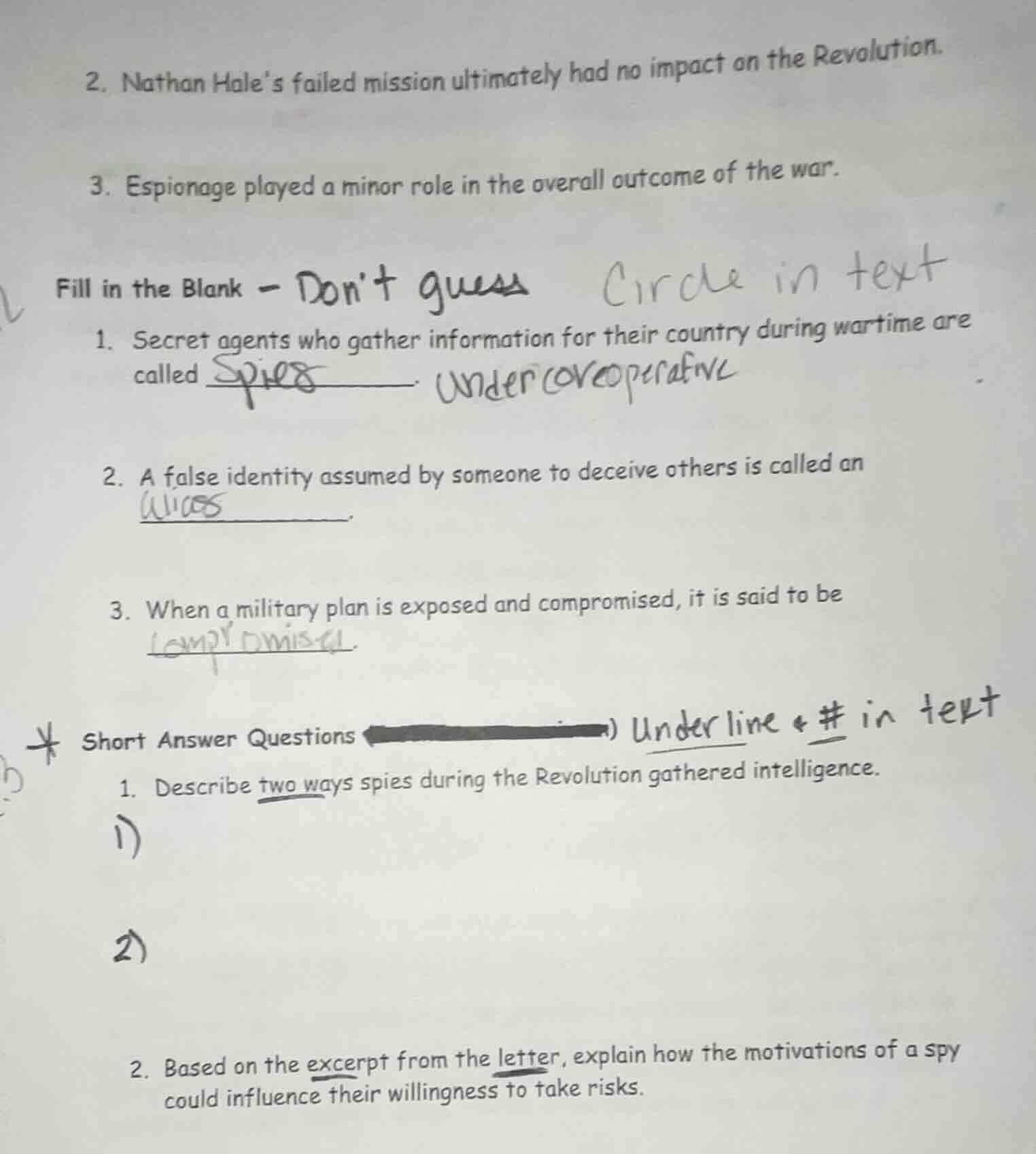
- nathan hales failed mission ultimately had no impact on the revolution.
- espionage played a minor role in the overall outcome of the war.
fill in the blank
- secret agents who gather information for their country during wartime are called ______.
- a false identity assumed by someone to deceive others is called an ______.
- when a military plan is exposed and compromised, it is said to be ______.
short answer questions
- describe two ways spies during the revolution gathered intelligence.
1)
2)
- based on the excerpt from the letter, explain how the motivations of a spy could influence their willingness to take risks.
Brief Explanations
First, address the true/false, fill-in-the-blank, and short answer questions with historical context of American Revolutionary War espionage:
- For true/false: Nathan Hale's legacy boosted Patriot morale, so his mission had impact. Espionage (e.g., Culper Ring) directly influenced war outcomes.
- For fill-in-the-blank: Use standard espionage terminology matching the definitions.
- For short answer: Cite documented intelligence-gathering methods from the Revolutionary War, and link common spy motivations to risk-taking.

Snap & solve any problem in the app
Get step-by-step solutions on Sovi AI
Photo-based solutions with guided steps
Explore more problems and detailed explanations
True/False (Corrected):
- False
- False
Fill in the Blank (Corrected):
- Secret agents who gather information for their country during wartime are called spies
- A false identity assumed by someone to deceive others is called an alias
- When a military plan is exposed and compromised, it is said to be compromised
Short Answer Questions:
1.
- Some spies posed as civilian workers (like tavern keepers or servants) behind enemy lines to overhear military conversations and observe troop movements.
- Spy networks (such as the Culper Ring) used coded letters and hidden messages (like invisible ink) to pass gathered intelligence to Patriot leaders.
- Spies motivated by deep loyalty to their country (e.g., Patriot spies fighting for independence) were often more willing to take extreme risks, such as sneaking into enemy camps or carrying sensitive messages, because they prioritized their cause over personal safety. In contrast, spies motivated by money might avoid high-risk missions to protect their own life and ability to collect payment.