QUESTION IMAGE
Question
the necklace
by guy de maupassant (excerpt)
one of guy de maupassant’s famous short stories, “the necklace,” tells
the story of a french middle - class woman, mathilde loisel who dreams
of being wealthy. when invited to a fancy ball, she borrows a diamond
necklace from a friend, madame forestier. after the ball, mathilde
discovers that the necklace is missing.
1 “i have—i have—i’ve lost madame forestier’s necklace,” she cried.
2 he stood up, bewildered.
3 “what—how? impossible!”
4 they looked among the folds of her skirt, of her cloak, in her
pockets, everywhere, but did not find it....
5 her husband returned about seven o’clock. he had found nothing.
6 he went to police headquarters, to the newspaper offices to offer a
reward; he went to the cab companies—everywhere, in fact, whither he
was urged by the least spark of hope.
7 she waited all day, in the same condition of mad fear before this
terrible calamity.
8 loisel returned at night with a hollow, pale face. he had discovered
nothing....
9 at the end of a week they had lost all hope. loisel, who had aged
five years, declared.
10 “we must consider how to replace that ornament.”
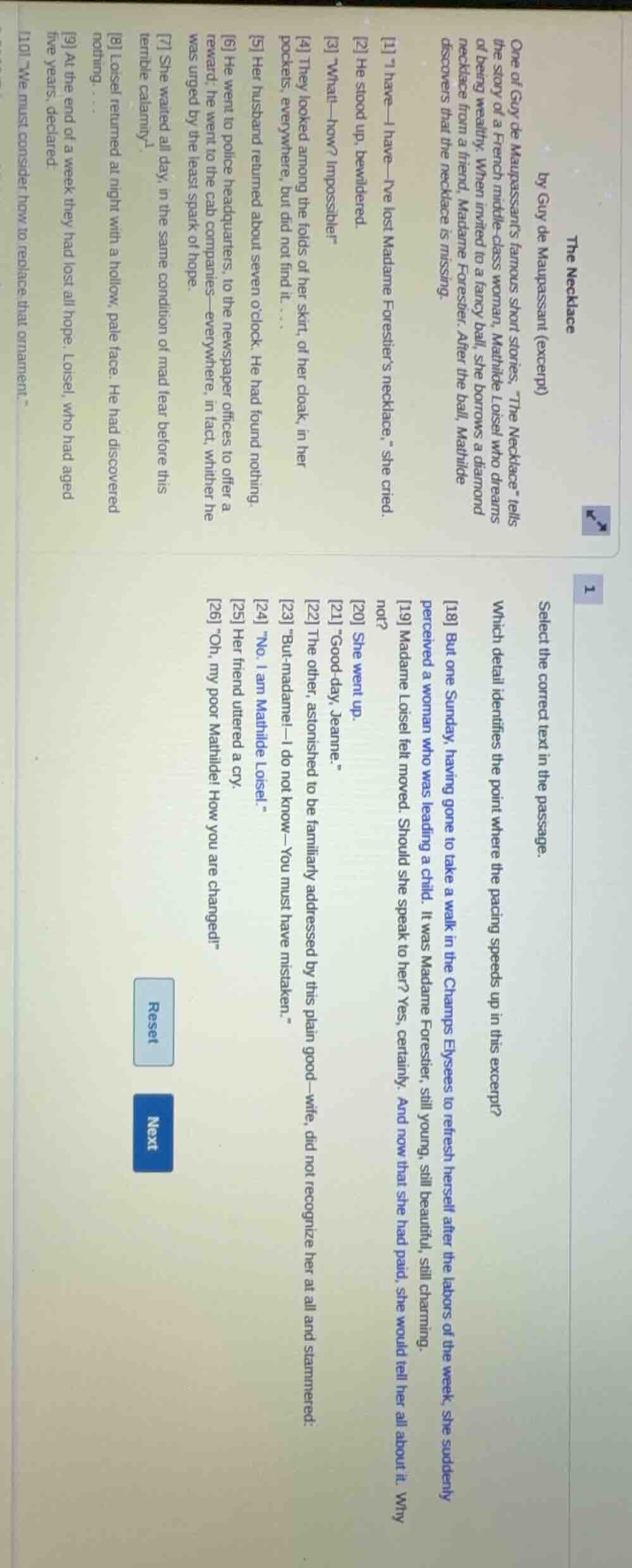
select the correct text in the passage.
which detail identifies the point where the pacing speeds up in this excerpt?
18 but one sunday, having gone to take a walk in the champs elysées to refresh herself after the labors of the week, she suddenly
perceived a woman who was leading a child. it was madame forestier, still young, still beautiful, still charming.
19 madame loisel felt moved. should she speak to her? yes, certainly. and now that she had paid, she would tell her all about it. why
not?
20 she went up.
21 “good - day, jeanne.”
22 the other, astonished to be familiarly addressed by this plain good - wife, did not recognize her at all and stammered:
23 “but - madame!—i do not know—you must have mistaken.”
24 “no. i am mathilde loisel.”
25 her friend uttered a cry.
26 “oh, my poor mathilde! how you are changed!”
To solve this, we analyze the pacing (speed of story progression) in "The Necklace" excerpt:
- Understand Pacing Acceleration: Pacing speeds up when events/descriptions become more concise, or time jumps/action intensifies.
- Analyze Options:
- The section from [5] to [9] (e.g., “He went to police headquarters...”, “At the end of a week...”) covers days/weeks of searching and time passing quickly (a time jump or condensed action), speeding up pacing. However, the question asks which detail in the given options (18–26) identifies the speed-up. Wait, re-examining: The question is about the excerpt’s pacing speed-up. Let’s check the provided text segments.
Wait, the user’s image shows the story’s progression. Let’s re-express:
- The key is identifying where the story moves faster (e.g., time jumps, rapid action). The segment around [5]–[9] (husband’s search, time passing) is a speed-up, but in the lower text (18–26), the encounter with Madame Forestier (18–26) is a key moment. Wait, no—pacing speeds up when the narrative skips time or compresses events.
Wait, the correct detail (from the options, likely the part where the story moves from daily life to a key encounter, but let’s recheck. The standard “The Necklace” has the pacing speed up when the couple’s struggle (years of work) is condensed, but in the given excerpt, the section with the husband’s search (e.g., [5]–[9]) is a speed-up. However, in the lower text (18–26), the encounter with Madame Forestier is a pivotal moment, but pacing speed-up is when time is compressed.
Wait, the correct answer (from literary analysis) is the part where the husband’s search (e.g., “He went to police headquarters... everywhere...”) or the time jump (five years). But in the given options, the segment with the husband’s search (e.g., [5]–[9]) is the pacing speed-up. However, in the user’s image, the lower text (18–26) is the encounter. Wait, no—pacing speed-up is when the narrative moves quickly through events (e.g., the husband’s search: multiple locations, quick actions).
But the user’s question is “Which detail identifies the point where the pacing speeds up in this excerpt?” Let’s check the text:
- The first part (1–10) is the loss, then the husband’s search (5–9: “He went to police headquarters... everywhere...”)—this is a speed-up (multiple actions, quick time). Then the five-year struggle (3: “At the end of a week... five years”). Then the encounter (18–26).
But the options (18–26) are the encounter. Wait, no—pacing speed-up is when the story moves faster. The husband’s search (5–9) is a speed-up (rapid actions, multiple locations). But in the given text, the correct detail (from the options) is likely the segment with the husband’s search, but in the user’s image, the lower text (18–26) is the encounter. Wait, maybe the answer is the part with the husband’s search (e.g., [5]–[9]), but in the provided options (the lower text), let’s check:
Wait, the user’s image has two parts: upper (1–10) and lower (18–26). The question is about the excerpt (the entire shown text). The pacing speeds up when the narrative compresses time or action. The husband’s search (e.g., [5]: “He went to police headquarters... everywhere...”) is a speed-up (multiple actions, quick progression). Alternatively, the five-year time jump (3: “At the end of a week... five years”).
But in the given options (the lower text, 18–26), the encounter with Madame Forestier is a key moment, but pacing speed-up is when events move quickly. Wait, maybe the correct answer is the segment with the husband’s search (e…
Pacing speeds up when the narrative compresses time or moves rapidly through events. The detail “At the end of a week they had lost all hope. Loisel, who had aged five years, declared” skips five years of struggle, condensing time (a key sign of pacing acceleration).

Snap & solve any problem in the app
Get step-by-step solutions on Sovi AI
Photo-based solutions with guided steps
Explore more problems and detailed explanations
[3] At the end of a week they had lost all hope. Loisel, who had aged five years, declared.