QUESTION IMAGE
Question
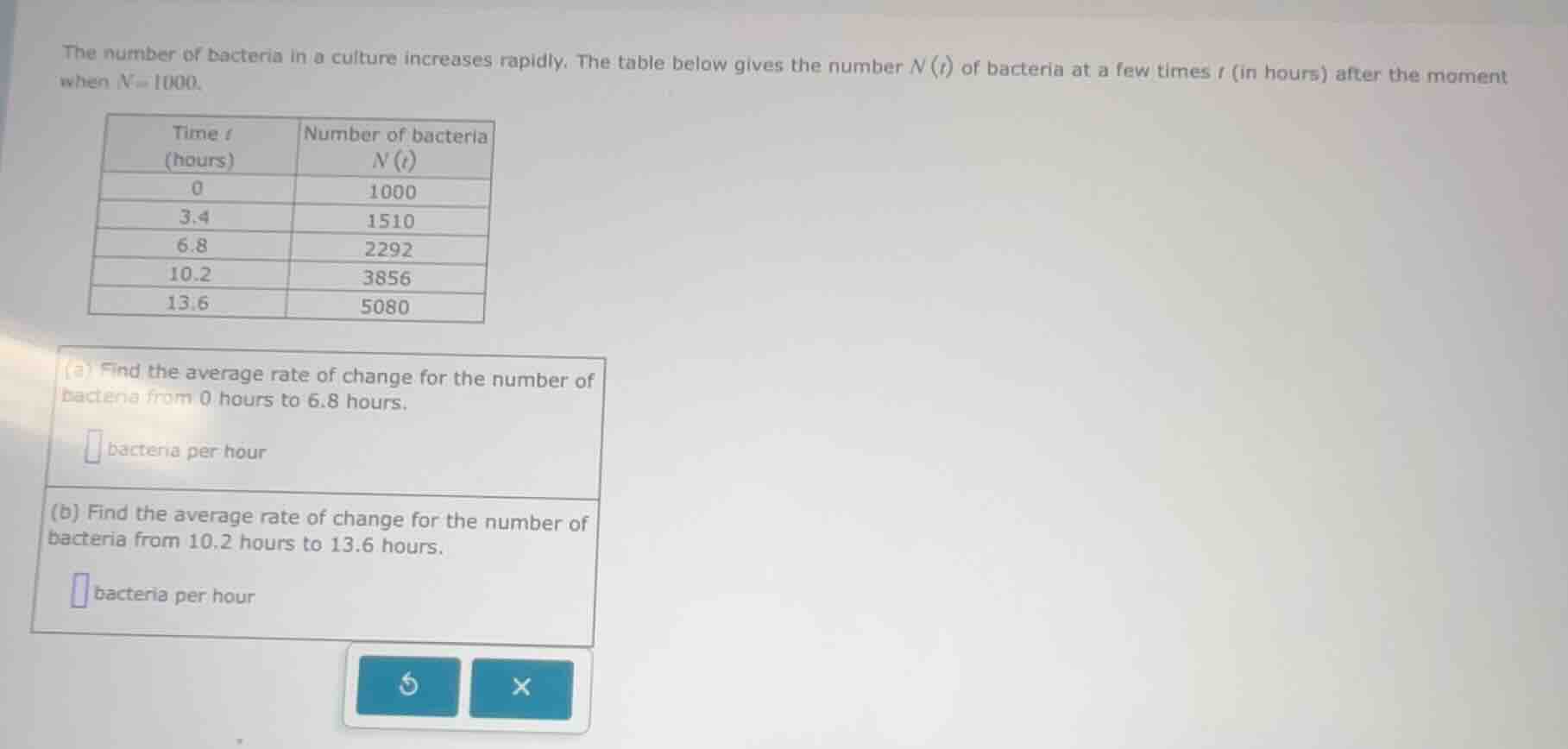
the number of bacteria in a culture increases rapidly. the table below gives the number ( n(t) ) of bacteria at a few times ( t ) (in hours) after the moment when ( n = 1000 ).
| time ( t ) (hours) | number of bacteria ( n(t) ) |
|---|---|
| 3.4 | 1510 |
| 6.8 | 2292 |
| 10.2 | 3856 |
| 13.6 | 5080 |
(a) find the average rate of change for the number of bacteria from 0 hours to 6.8 hours.
bacteria per hour
(b) find the average rate of change for the number of bacteria from 10.2 hours to 13.6 hours.
bacteria per hour
Part (a)
Step1: Recall the formula for average rate of change
The average rate of change of a function \( N(t) \) from \( t = a \) to \( t = b \) is given by \(\frac{N(b)-N(a)}{b - a}\).
Step2: Identify the values from the table
For \( t = 0 \) hours, \( N(0)=1000 \) and for \( t = 6.8 \) hours, \( N(6.8)=2292 \). Here, \( a = 0 \) and \( b = 6.8 \).
Step3: Substitute the values into the formula
Substitute \( N(6.8) = 2292 \), \( N(0)=1000 \), \( b = 6.8 \) and \( a = 0 \) into the formula \(\frac{N(b)-N(a)}{b - a}\).
We get \(\frac{2292 - 1000}{6.8-0}=\frac{1292}{6.8}\).
Step4: Calculate the value
\(\frac{1292}{6.8}=190\) (after performing the division: \(1292\div6.8 = 190\)).
Step1: Recall the formula for average rate of change
The average rate of change of a function \( N(t) \) from \( t = a \) to \( t = b \) is given by \(\frac{N(b)-N(a)}{b - a}\).
Step2: Identify the values from the table
For \( t = 10.2 \) hours, \( N(10.2)=3856 \) and for \( t = 13.6 \) hours, \( N(13.6)=5080 \). Here, \( a = 10.2 \) and \( b = 13.6 \).
Step3: Substitute the values into the formula
Substitute \( N(13.6) = 5080 \), \( N(10.2)=3856 \), \( b = 13.6 \) and \( a = 10.2 \) into the formula \(\frac{N(b)-N(a)}{b - a}\).
We get \(\frac{5080 - 3856}{13.6 - 10.2}=\frac{1224}{3.4}\).
Step4: Calculate the value
\(\frac{1224}{3.4} = 360\) (after performing the division: \(1224\div3.4=360\)).

Snap & solve any problem in the app
Get step-by-step solutions on Sovi AI
Photo-based solutions with guided steps
Explore more problems and detailed explanations
\(190\)