QUESTION IMAGE
Question
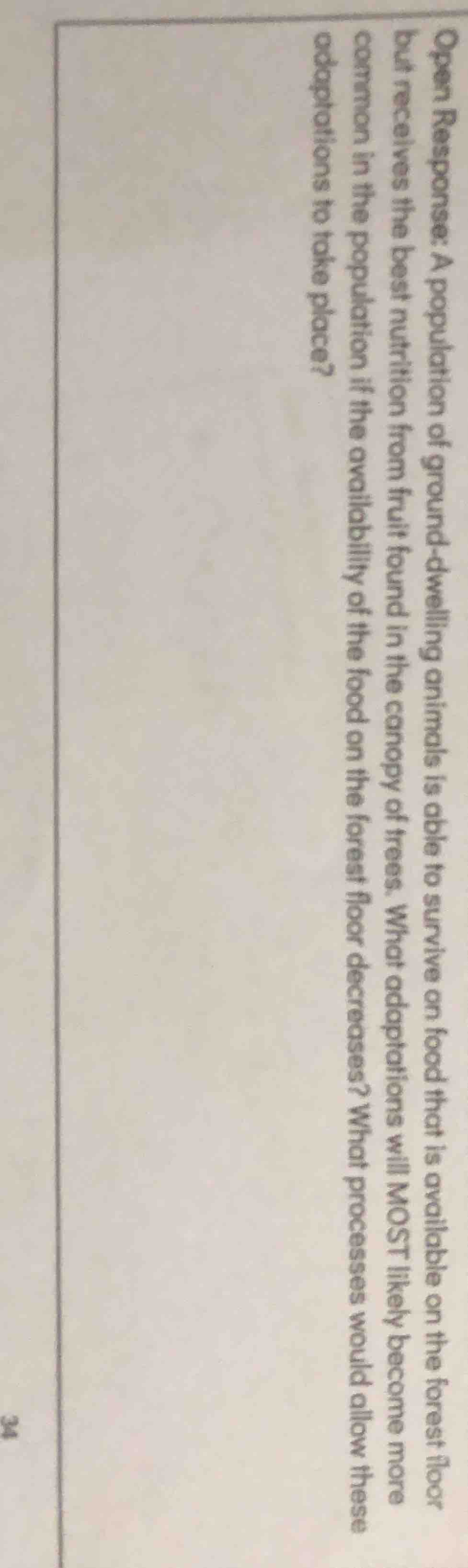
open response: a population of ground - dwelling animals is able to survive on food that is available on the forest floor but receives the best nutrition from fruit found in the canopy of trees. what adaptations will most likely become more common in the population if the availability of the food on the forest floor decreases? what processes would allow these adaptations to take place?
The problem is about animal adaptations and evolutionary processes in response to food availability changes. In Biology (a subfield of Natural Science), we study how organisms adapt to environmental changes. When forest - floor food decreases, animals may develop adaptations to access canopy fruit, like better climbing abilities or altered digestive systems. The process driving this is natural selection: animals with traits (e.g., longer limbs for climbing) that help access canopy food are more likely to survive and reproduce, passing on those traits. Over generations, these adaptive traits become more common in the population.

Snap & solve any problem in the app
Get step-by-step solutions on Sovi AI
Photo-based solutions with guided steps
Explore more problems and detailed explanations
Adaptations:
Animals may develop better climbing abilities (e.g., stronger limbs, more prehensile tails in some species), improved visual acuity to locate fruit in the canopy, or changes in digestive systems to better process the new fruit - based diet. Some might also evolve behaviors like group foraging to more effectively search for and access canopy fruit.
Process (Natural Selection):
- Variation: Within the population of ground - dwelling animals, there is natural genetic and phenotypic variation. Some individuals may have slightly better climbing skills, better eyesight, or different digestive capabilities due to genetic differences or random mutations.
- Selection Pressure: The decrease in forest - floor food creates a selection pressure. Animals that can't access the canopy fruit will struggle to find enough food, reducing their chances of survival and reproduction.
- Differential Survival and Reproduction: Animals with traits that allow them to access the canopy fruit (e.g., better climbers) are more likely to survive, find mates, and reproduce. They pass on the genes associated with these beneficial traits to their offspring.
- Adaptation Over Time: Over many generations, the frequency of the genes for these adaptive traits (e.g., genes related to improved climbing) increases in the population. This leads to the adaptation becoming more common, as the population evolves to better suit the new food - availability scenario.