QUESTION IMAGE
Question
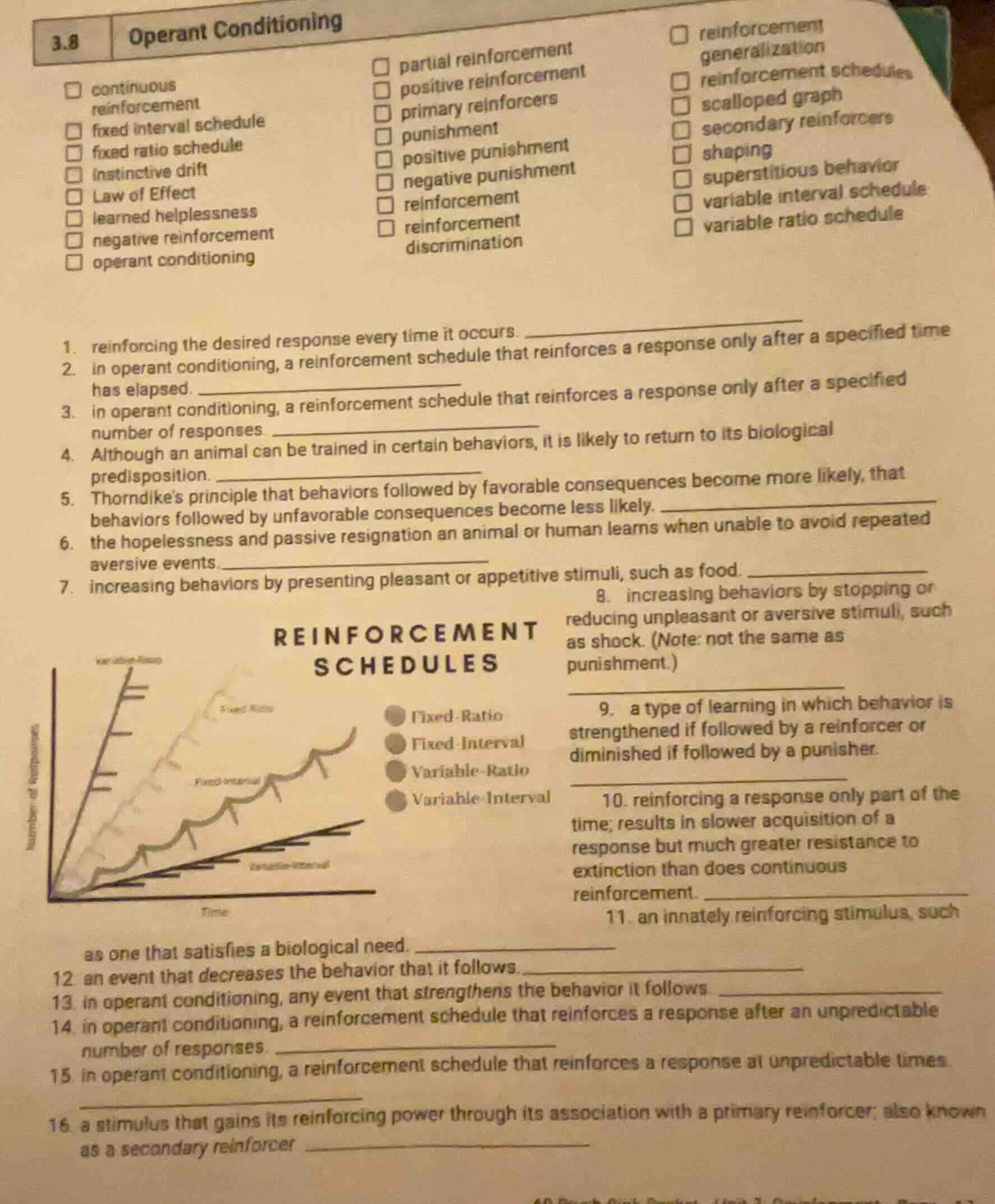
3.8 operant conditioning
continuous reinforcement
fixed interval schedule
fixed ratio schedule
instinctive drift
law of effect
learned helplessness
negative reinforcement
operant conditioning
partial reinforcement
positive reinforcement
primary reinforcers
punishment
positive punishment
negative punishment
reinforcement
reinforcement discrimination
reinforcement generalization
reinforcement schedules
scalloped graph
secondary reinforcers
shaping
superstitious behavior
variable interval schedule
variable ratio schedule
- reinforcing the desired response every time it occurs.
- in operant conditioning, a reinforcement schedule that reinforces a response only after a specified time has elapsed.
- in operant conditioning, a reinforcement schedule that reinforces a response only after a specified number of responses
- although an animal can be trained in certain behaviors, it is likely to return to its biological predisposition.
- thorndike’s principle that behaviors followed by favorable consequences become more likely, that behaviors followed by unfavorable consequences become less likely.
- the hopelessness and passive resignation an animal or human learns when unable to avoid repeated aversive events.
- increasing behaviors by presenting pleasant or appetitive stimuli, such as food.
- increasing behaviors by stopping or reducing unpleasant or aversive stimuli, such as shock. (note: not the same as punishment.)
- a type of learning in which behavior is strengthened if followed by a reinforcer or diminished if followed by a punisher.
- reinforcing a response only part of the time; results in slower acquisition of a response but much greater resistance to extinction than does continuous reinforcement.
- an innately reinforcing stimulus, such as one that satisfies a biological need.
- an event that decreases the behavior that it follows.
- in operant conditioning, any event that strengthens the behavior it follows.
- in operant conditioning, a reinforcement schedule that reinforces a response after an unpredictable number of responses.
- in operant conditioning, a reinforcement schedule that reinforces a response at unpredictable times.
- a stimulus that gains its reinforcing power through its association with a primary reinforcer; also known as a secondary reinforcer
reinforcement schedules
fixed - ratio
fixed - interval
variable - ratio
variable - interval
Each term is matched to its definition based on core operant conditioning concepts:
- Defines reinforcing every occurrence of a response.
- Defines a schedule based on set time intervals.
- Defines a schedule based on set response counts.
- Describes the return to innate behaviors post-training.
- Is Thorndike's core principle of consequence-based behavior change.
- Defines the passive despair from unavoidable negative events.
- Defines adding pleasant stimuli to increase behavior.
- Defines removing unpleasant stimuli to increase behavior.
- Defines the core learning framework of operant conditioning.
- Defines reinforcing responses only some of the time.
- Defines stimuli that meet innate biological needs.
- Defines a consequence that reduces behavior frequency.
- Defines a consequence that increases behavior frequency.
- Defines a schedule based on random response counts.
- Defines a schedule based on random time intervals.
- Defines stimuli that gain value from association with primary reinforcers.

Snap & solve any problem in the app
Get step-by-step solutions on Sovi AI
Photo-based solutions with guided steps
Explore more problems and detailed explanations
- continuous reinforcement
- fixed interval schedule
- fixed ratio schedule
- instinctive drift
- Law of Effect
- learned helplessness
- positive reinforcement
- negative reinforcement
- operant conditioning
- partial reinforcement
- primary reinforcers
- punishment
- reinforcement
- variable ratio schedule
- variable interval schedule
- secondary reinforcers