QUESTION IMAGE
Question
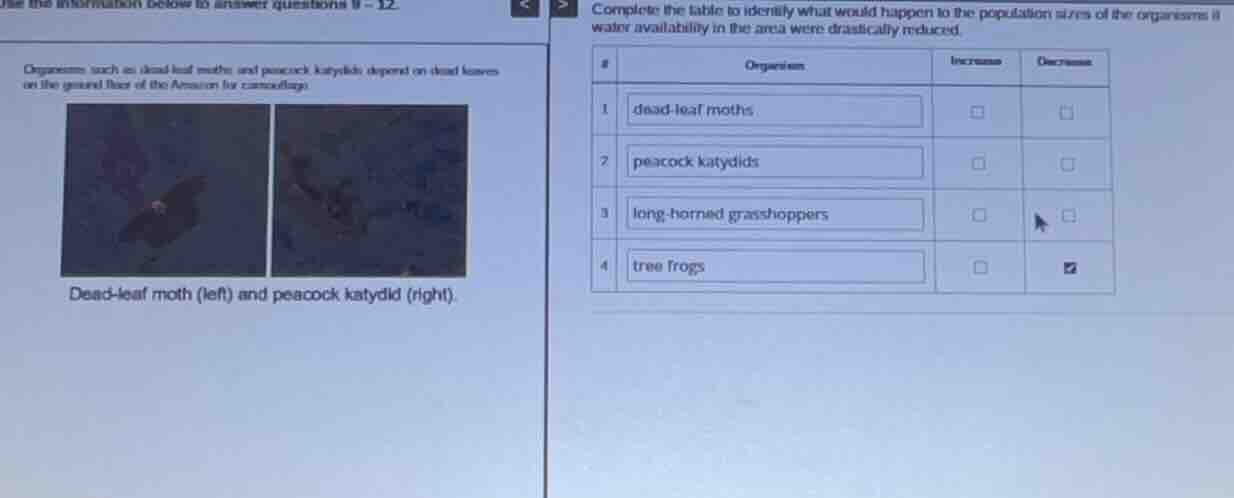
organisms such as dead - leaf moths and peacock katydids depend on dead leaves on the ground floor of the amazon for camouflage.
dead - leaf moth (left) and peacock katydid (right).
complete the table to identify what would happen to the population sizes of the organisms if water availability in the area were drastically reduced
| # | organism | increase | decrease |
|---|---|---|---|
| 2 | peacock katydids | □ | □ |
| 3 | long - horned grasshoppers | □ | □ |
| 4 | tree frogs | □ | ☑ |
To solve this, we analyze the impact of reduced water availability on each organism:
1. Dead - leaf moths
Dead - leaf moths depend on dead leaves on the ground (which are less directly affected by water availability compared to organisms that need more water - dependent resources like live plants or aquatic habitats). But if water availability drops, the plants (even dead leaves come from plants) might have less growth overall, and the ecosystem balance could shift. However, compared to more water - reliant organisms, their population is more likely to decrease as the overall ecosystem productivity (related to water) drops. So we check the “Decrease” box.
2. Peacock katydids
Peacock katydids also depend on plant matter (like dead leaves or live plants). With reduced water, plant growth and health decline, so their food source is affected. Their population will decrease. So we check the “Decrease” box.
3. Long - horned grasshoppers
Grasshoppers rely on grass and other plants for food. Reduced water availability will lead to less plant growth, reducing their food supply. So their population will decrease. So we check the “Decrease” box.
4. Tree frogs (already marked as decrease)
Tree frogs need water for reproduction (e.g., laying eggs in water - filled areas) and for their moist skin. Drastically reduced water availability will severely impact their habitat and survival, so their population decreases (which is already marked correctly).
Filled Table:
| # | Organism | Increase | Decrease |
|---|---|---|---|
| 2 | peacock katydids | $\boldsymbol{\checkmark}$ | |
| 3 | long - horned grasshoppers | $\boldsymbol{\checkmark}$ | |
| 4 | tree frogs | $\boldsymbol{\checkmark}$ (already marked) |
(Note: For each of the first three, we mark the “Decrease” box as explained by the reduction in water affecting their food sources or habitats.)

Snap & solve any problem in the app
Get step-by-step solutions on Sovi AI
Photo-based solutions with guided steps
Explore more problems and detailed explanations
To solve this, we analyze the impact of reduced water availability on each organism:
1. Dead - leaf moths
Dead - leaf moths depend on dead leaves on the ground (which are less directly affected by water availability compared to organisms that need more water - dependent resources like live plants or aquatic habitats). But if water availability drops, the plants (even dead leaves come from plants) might have less growth overall, and the ecosystem balance could shift. However, compared to more water - reliant organisms, their population is more likely to decrease as the overall ecosystem productivity (related to water) drops. So we check the “Decrease” box.
2. Peacock katydids
Peacock katydids also depend on plant matter (like dead leaves or live plants). With reduced water, plant growth and health decline, so their food source is affected. Their population will decrease. So we check the “Decrease” box.
3. Long - horned grasshoppers
Grasshoppers rely on grass and other plants for food. Reduced water availability will lead to less plant growth, reducing their food supply. So their population will decrease. So we check the “Decrease” box.
4. Tree frogs (already marked as decrease)
Tree frogs need water for reproduction (e.g., laying eggs in water - filled areas) and for their moist skin. Drastically reduced water availability will severely impact their habitat and survival, so their population decreases (which is already marked correctly).
Filled Table:
| # | Organism | Increase | Decrease |
|---|---|---|---|
| 2 | peacock katydids | $\boldsymbol{\checkmark}$ | |
| 3 | long - horned grasshoppers | $\boldsymbol{\checkmark}$ | |
| 4 | tree frogs | $\boldsymbol{\checkmark}$ (already marked) |
(Note: For each of the first three, we mark the “Decrease” box as explained by the reduction in water affecting their food sources or habitats.)