QUESTION IMAGE
Question
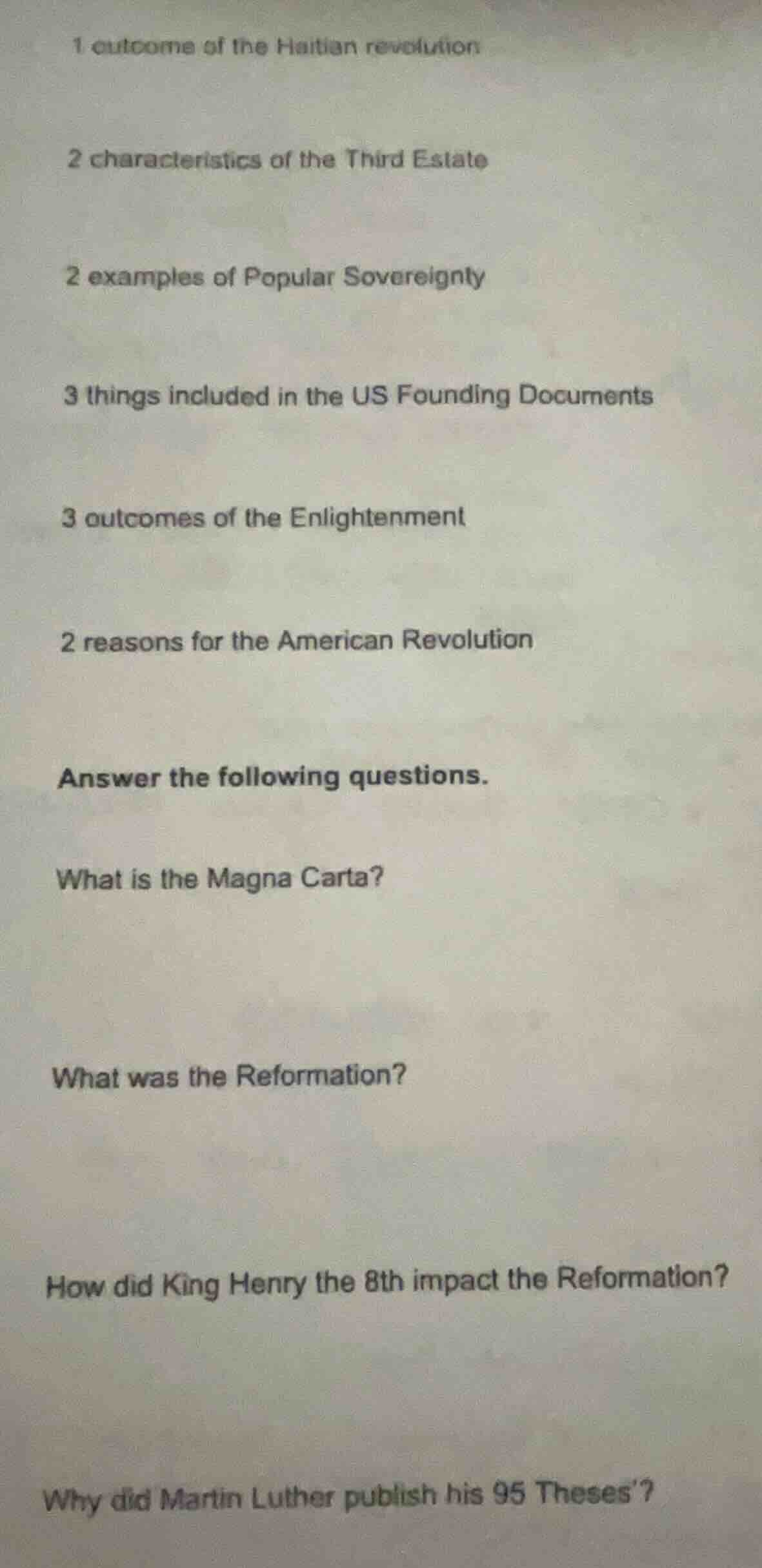
1 outcome of the haitian revolution
2 characteristics of the third estate
2 examples of popular sovereignty
3 things included in the us founding documents
3 outcomes of the enlightenment
2 reasons for the american revolution
answer the following questions.
what is the magna carta?
what was the reformation?
how did king henry the 8th impact the reformation?
why did martin luther publish his 95 theses?
Brief Explanations
- Outcome of the Haitian Revolution: Established the first independent Black republic in the Americas, ending chattel slavery in Haiti.
- Characteristics of the Third Estate: Made up 98% of France's population; bore all the nation's tax burden.
- Examples of Popular Sovereignty: U.S. citizens voting for Congress; Swiss direct democracy referendums.
- US Founding Documents Content: The Declaration of Independence's self-governance ideals; the U.S. Constitution's separation of powers; the Bill of Rights' individual liberties.
- Outcomes of the Enlightenment: Spread ideals of individual rights; inspired democratic revolutions; challenged traditional religious authority.
- Reasons for the American Revolution: British imposition of unfair taxes (e.g., Stamp Act) without colonial representation; British restriction of colonial self-governance.
- Magna Carta: A 1215 English legal charter that limited the monarch's power, establishing the principle that rulers are subject to law.
- The Reformation: A 16th-century religious movement that split Western Christianity, challenging the Catholic Church's authority and leading to Protestant denominations.
- King Henry VIII's Impact on the Reformation: Broke England from the Catholic Church to form the Church of England, expanding Protestant influence in Britain.
- Martin Luther's 95 Theses: Published in 1517 to criticize the Catholic Church's sale of indulgences and call for religious reform.

Snap & solve any problem in the app
Get step-by-step solutions on Sovi AI
Photo-based solutions with guided steps
Explore more problems and detailed explanations
- Outcome of the Haitian Revolution: The creation of the first independent Black sovereign state (Haiti) and the permanent abolition of slavery in the territory.
- Characteristics of the Third Estate:
- Composed of the vast majority of France's population (peasants, urban workers, and the bourgeoisie)
- Forced to pay all direct and indirect taxes while having no meaningful political power
- Examples of Popular Sovereignty:
- The U.S. House of Representatives, where members are directly elected by voters to represent their interests
- The French Revolution's Declaration of the Rights of Man and of the Citizen, which asserts that national sovereignty resides in the people
- Things included in the US Founding Documents:
- The Declaration of Independence's assertion of natural rights (life, liberty, pursuit of happiness)
- The U.S. Constitution's framework for a federal, separation-of-powers government
- The Bill of Rights' protections for individual freedoms (e.g., freedom of speech, religion)
- Outcomes of the Enlightenment:
- Popularization of liberal ideals like individual liberty and equality before the law
- Inspiration for revolutionary movements in America, France, and Latin America
- Promotion of secularism and scientific reasoning over religious dogma
- Reasons for the American Revolution:
- British Parliament's implementation of "taxation without representation" (e.g., Stamp Act, Tea Act)
- British enforcement of restrictive trade policies that limited colonial economic autonomy
- What is the Magna Carta? A 1215 English legal document that restricted the absolute power of the monarch, establishing the principle that all people (including rulers) are subject to the law, and laying early groundwork for modern constitutional rights.
- What was the Reformation? A 16th-century European religious movement that challenged the authority and practices of the Roman Catholic Church, leading to the formation of Protestant denominations and widespread religious, political, and social change.
- How did King Henry the 8th impact the Reformation? He broke England's official ties to the Roman Catholic Church, establishing the Church of England (Anglican Church) with himself as its head, expanding Protestant influence in Britain and altering the religious landscape of Europe.
- Why did Martin Luther publish his 95 Theses? To publicly criticize the Catholic Church's practice of selling indulgences (payments for the forgiveness of sins) and to call for a debate on reforming corrupt religious practices and returning to biblical principles.