QUESTION IMAGE
Question
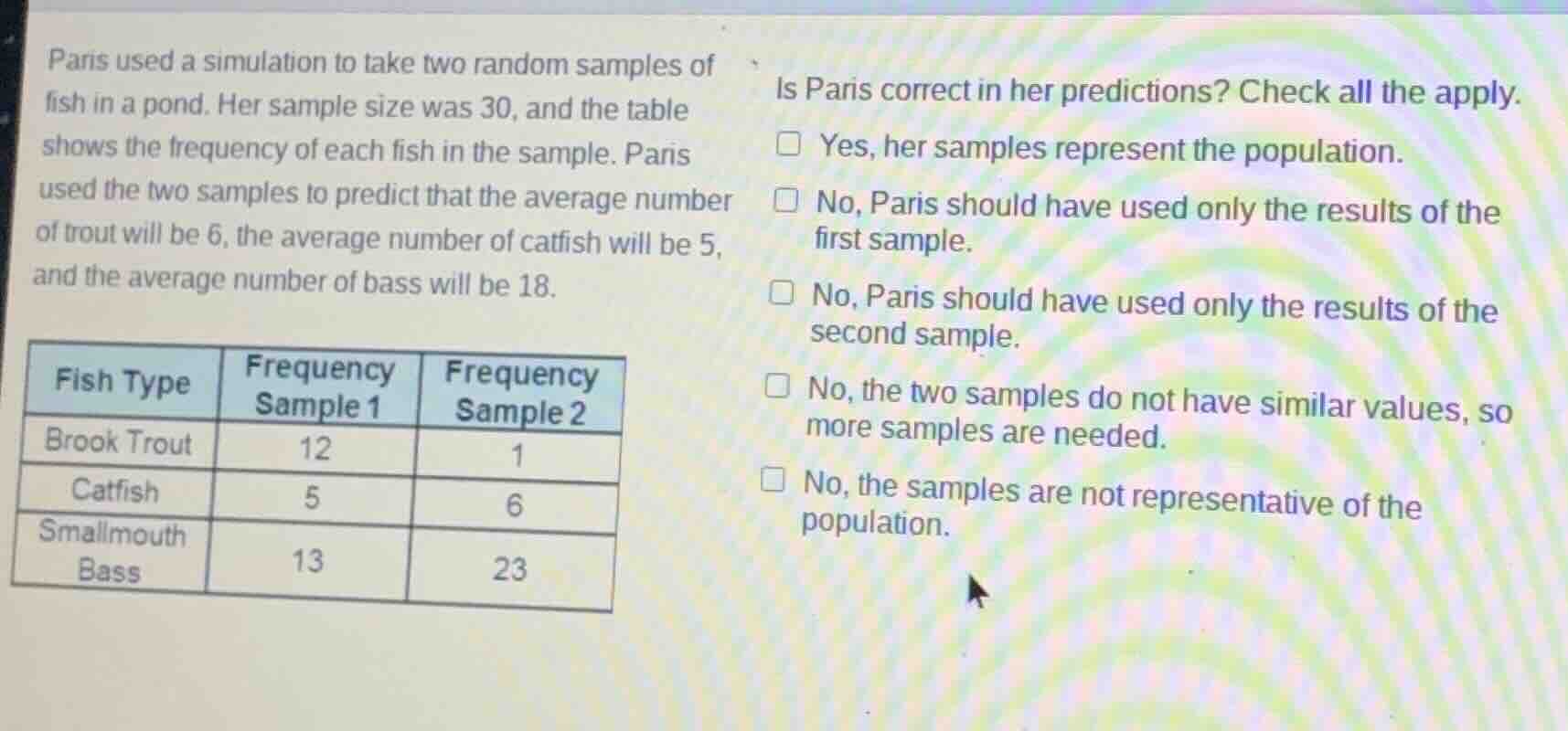
paris used a simulation to take two random samples of fish in a pond. her sample size was 30, and the table shows the frequency of each fish in the sample. paris used the two samples to predict that the average number of trout will be 6, the average number of catfish will be 5, and the average number of bass will be 18.
| fish type | frequency sample 1 | frequency sample 2 |
|---|---|---|
| catfish | 5 | 6 |
| smallmouth bass | 13 | 23 |
is paris correct in her predictions? check all the apply.
- ☐ yes, her samples represent the population.
- ☐ no, paris should have used only the results of the first sample.
- ☐ no, paris should have used only the results of the second sample.
- ☐ no, the two samples do not have similar values, so more samples are needed.
- ☐ no, the samples are not representative of the population.
Brief Explanations
First, calculate the actual averages from the samples:
- For Brook Trout: $\frac{12+1}{2}=6.5$, not 6.
- For Smallmouth Bass: $\frac{13+23}{2}=18$, which matches, but the trout counts (12 vs 1) and bass counts (13 vs 23) have large discrepancies between the two samples. This means the samples are inconsistent and not reliable representations of the population. Using a single sample is also not better than using inconsistent ones; instead, more samples are needed to get a reliable estimate, and the current samples do not properly represent the population.

Snap & solve any problem in the app
Get step-by-step solutions on Sovi AI
Photo-based solutions with guided steps
Explore more problems and detailed explanations
No, the two samples do not have similar values, so more samples are needed.
No, the samples are not representative of the population.