QUESTION IMAGE
Question
part g
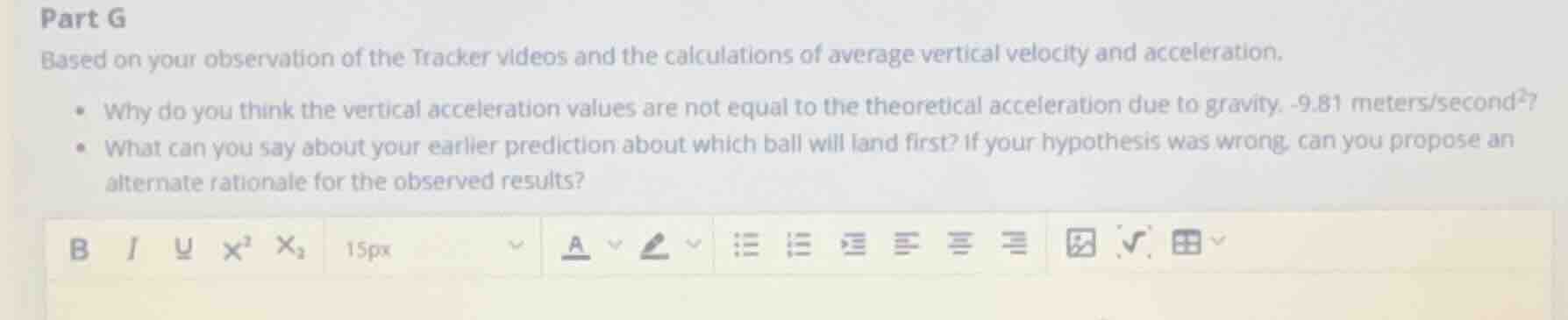
based on your observation of the tracker videos and the calculations of average vertical velocity and acceleration,
- why do you think the vertical acceleration values are not equal to the theoretical acceleration due to gravity, -9.81 meters/second²?
- what can you say about your earlier prediction about which ball will land first? if your hypothesis was wrong, can you propose an alternate rationale for the observed results?
For the first question (Why vertical acceleration ≠ -9.81 m/s²):
- Air Resistance: The theoretical value (-9.81 m/s²) assumes a vacuum. In reality, the ball experiences air resistance, which opposes motion and reduces the net downward acceleration (since \( F_{\text{net}} = F_g - F_{\text{air}} \), so \( a=\frac{F_{\text{net}}}{m}=\ g-\frac{F_{\text{air}}}{m} \), making \( |a| < 9.81 \, \text{m/s}^2 \)).
- Experimental Errors: Tracker video analysis may have errors:
- Position Tracking: Inaccurate marking of the ball’s position in frames (e.g., blurry video, misaligned markers) introduces errors in calculated velocity/acceleration.
- Frame Rate: If the video’s frame rate is not precisely known, time intervals (\( \Delta t \)) for velocity calculation (\( v=\frac{\Delta y}{\Delta t} \)) and acceleration (\( a=\frac{\Delta v}{\Delta t} \)) are miscalculated.
- Calibration: The video’s scale (converting pixel distance to real - world meters) may be incorrectly calibrated, distorting displacement values.
For the second question (Prediction about which ball lands first):
Case 1: Prediction was correct
If your hypothesis (e.g., “Both balls land simultaneously” for a free - fall vs. projectile with same initial vertical conditions) matched, it confirms that vertical motion (governed by \( y = y_0+v_{0y}t-\frac{1}{2}gt^2 \)) is independent of horizontal motion (for projectiles). The time to land depends only on initial vertical position (\( y_0 \)), initial vertical velocity (\( v_{0y} \)), and gravity—horizontal velocity (\( v_{0x} \)) does not affect the time to fall.
Case 2: Prediction was wrong
If you predicted, say, “The horizontally launched ball lands later” (wrong), the alternate rationale is the same as above: vertical motion is independent of horizontal motion. For two balls with the same \( y_0 \) and \( v_{0y} = 0 \) (or same \( v_{0y} \)), their vertical displacement equations (\( y - y_0=v_{0y}t-\frac{1}{2}gt^2 \)) are identical. So time to land (\( t \)) depends only on \( y_0 \), \( v_{0y} \), and \( g \)—not \( v_{0x} \). If the error was in assuming horizontal motion affects fall time, this corrects that misunderstanding.

Snap & solve any problem in the app
Get step-by-step solutions on Sovi AI
Photo-based solutions with guided steps
Explore more problems and detailed explanations
s:
- Vertical acceleration differs from \(-9.81\ \text{m/s}^2\) due to air resistance (opposing motion, reducing net acceleration) and experimental errors (position tracking, frame rate, calibration).
- If prediction was correct: Confirms vertical motion is independent of horizontal motion. If wrong: Vertical motion (fall time) depends on \( y_0 \), \( v_{0y} \), \( g \)—not horizontal velocity (\( v_{0x} \)), so balls with same vertical conditions land simultaneously.