QUESTION IMAGE
Question
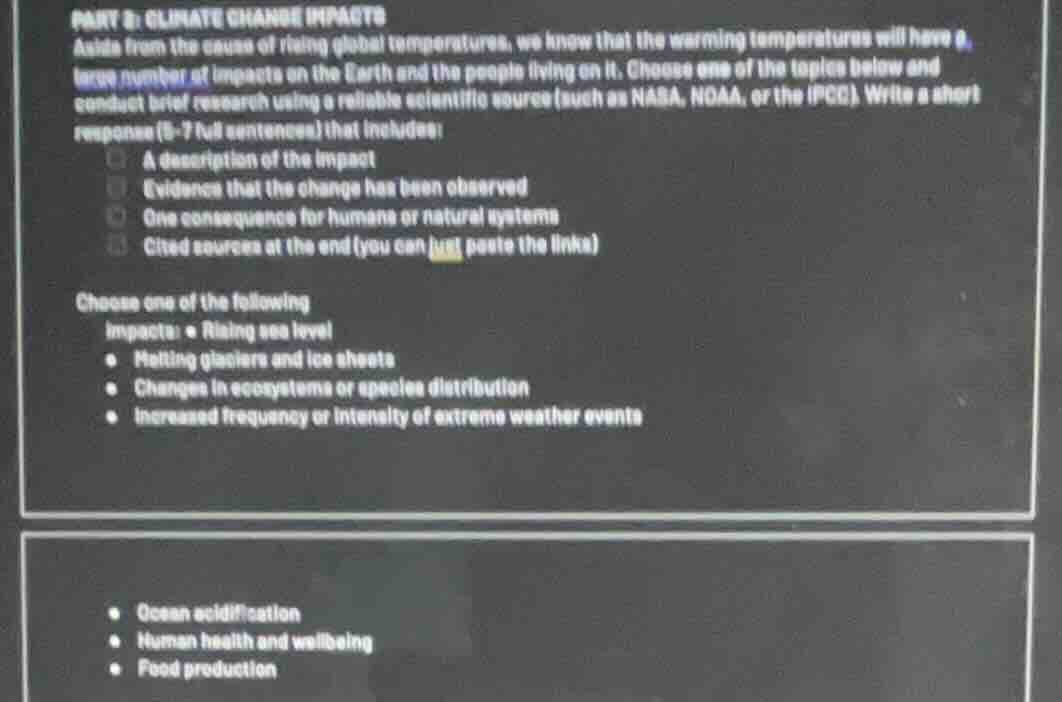
part 6: climate change impacts aside from the causes of rising global temperatures, we know that the warming temperatures will have a large number of impacts on the earth and the people living on it. choose one of the topics below and conduct brief research using a reliable scientific source (such as nasa, noaa, or the ipcc). write a short response (5 - 7 full sentences) that includes: a description of the impact evidence that the change has been observed one consequence for humans or natural systems cited sources at the end (you can just paste the links) choose one of the following impacts: • rising sea level • melting glaciers and ice sheets • change in ecosystems or species distribution • increased frequency or intensity of extreme weather events • ocean acidification • human health and wellbeing • food production
Rising sea level refers to the long-term increase in global average sea height driven by thermal expansion of ocean water and melting land-based ice. NASA data confirms global sea levels have risen ~20 cm since 1900, accelerating to 4.5 mm/year in recent decades. This threatens coastal communities: over 1 billion people live within 10 meters of sea level, facing increased flooding, erosion, and saltwater intrusion into freshwater supplies, which disrupts drinking water and agriculture.

Snap & solve any problem in the app
Get step-by-step solutions on Sovi AI
Photo-based solutions with guided steps
Explore more problems and detailed explanations
Description of the Impact:
Rising sea level is the gradual increase in the average global height of the ocean surface, caused primarily by the thermal expansion of seawater as it warms and the melting of land-based ice (glaciers, ice sheets, and polar ice caps) due to rising global temperatures. This is not a uniform rise across all coasts, with some regions experiencing higher rates due to local ocean currents, land subsidence, and gravitational effects from melting ice.
Evidence that the change has been observed:
According to NASA's Sea Level Change Team, global sea levels have risen approximately 20 centimeters (8 inches) since 1900, with the rate of rise accelerating dramatically in recent decades. Since 2006, the average rate of sea level rise has been about 4.5 millimeters per year, nearly double the rate observed between 1900 and 1990. Satellite data from the Jason series of missions has provided precise, continuous measurements of global sea level change since 1992, confirming this accelerating trend.
One consequence for humans or natural systems:
A critical human consequence of rising sea levels is the increased risk of chronic and catastrophic flooding for coastal communities. Over 1 billion people worldwide live within 10 meters of sea level, and many low-lying island nations and coastal cities (such as Miami, Shanghai, and small island states like Tuvalu) face the threat of regular inundation of residential areas, infrastructure, and farmland. Saltwater intrusion into coastal freshwater aquifers also contaminates drinking water supplies and reduces soil fertility, threatening food security for millions of people who rely on coastal agriculture.
Cited sources:
https://sealevel.nasa.gov/
https://www.ipcc.ch/report/ar6/wg1/downloads/report/IPCC_AR6_WGI_SummaryForPolicymakers.pdf