QUESTION IMAGE
Question
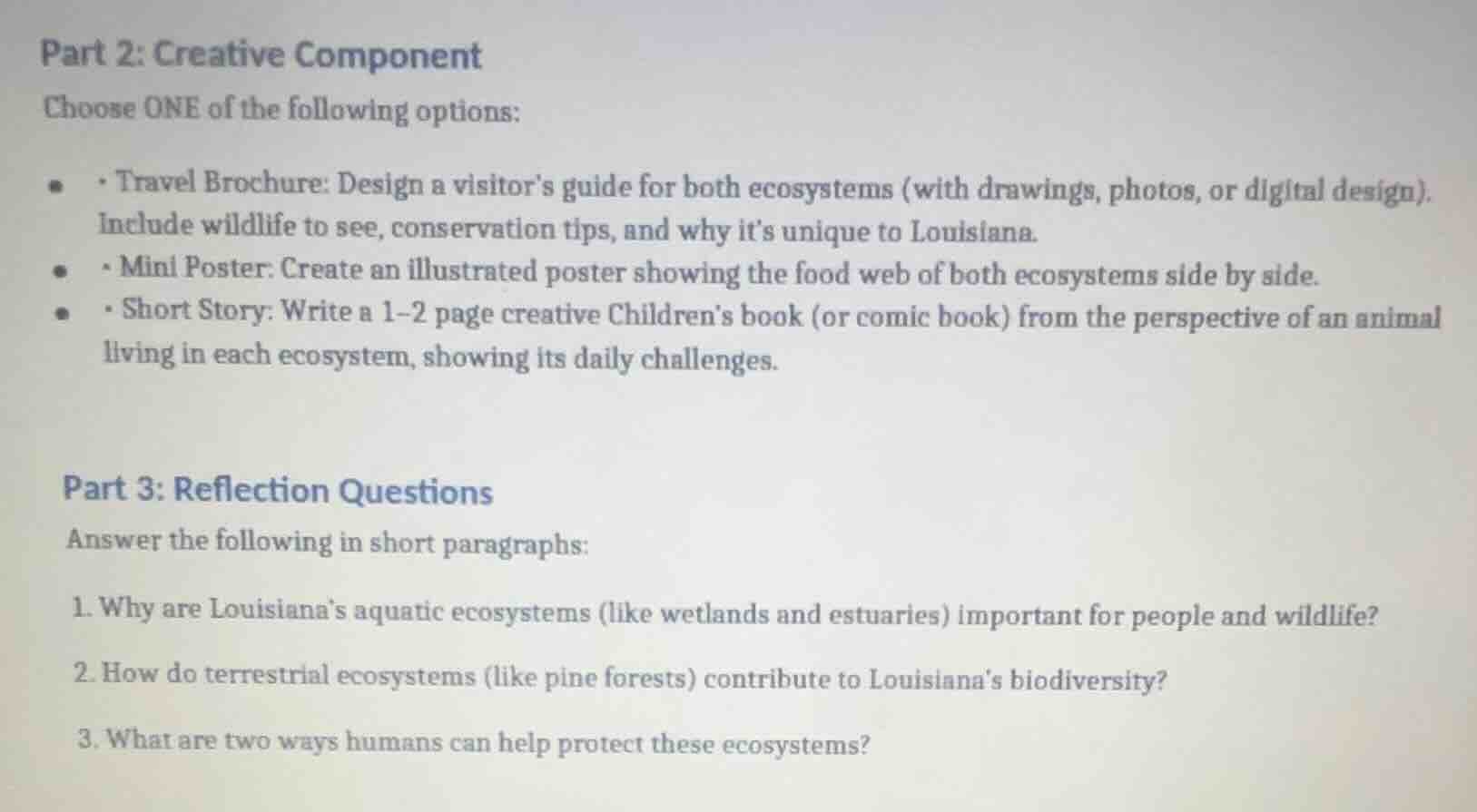
part 2: creative component
choose one of the following options:
- travel brochure: design a visitors guide for both ecosystems (with drawings, photos, or digital design). include wildlife to see, conservation tips, and why its unique to louisiana.
- mini poster: create an illustrated poster showing the food web of both ecosystems side by side.
- short story: write a 1 - 2 page creative childrens book (or comic book) from the perspective of an animal living in each ecosystem, showing its daily challenges.
part 3: reflection questions
answer the following in short paragraphs:
- why are louisianas aquatic ecosystems (like wetlands and estuaries) important for people and wildlife?
- how do terrestrial ecosystems (like pine forests) contribute to louisianas biodiversity?
- what are two ways humans can help protect these ecosystems?
Brief Explanations
- For the first question: Louisiana's aquatic ecosystems provide critical flood control by absorbing excess water from storms, filter pollutants to improve water quality, and serve as nurseries for commercial and recreational fish species that support local economies. For wildlife, they are unique habitats for specialized species like alligators, herons, and marsh rabbits, and act as stopover points for migratory birds along the Mississippi Flyway.
- For the second question: Louisiana's pine forests support a distinct set of species, including red-cockaded woodpeckers, pine snakes, and native orchids, that cannot thrive in aquatic environments. They also create layered habitats (canopy, understory, forest floor) that support diverse insect, bird, and mammal populations, adding to the state's overall biodiversity by complementing aquatic ecosystem species.
- For the third question: First, supporting and participating in wetland restoration projects (like sediment diversion programs) helps rebuild eroding aquatic habitats. Second, practicing sustainable forestry (such as selective logging instead of clear-cutting) preserves the structure and species of terrestrial pine forests while allowing for responsible resource use.

Snap & solve any problem in the app
Get step-by-step solutions on Sovi AI
Photo-based solutions with guided steps
Explore more problems and detailed explanations
- Louisiana's aquatic ecosystems (wetlands and estuaries) are vital for people as they act as natural flood barriers, reducing storm damage to coastal communities, filter runoff to maintain clean drinking water sources, and support a multi-billion-dollar fishing industry that provides jobs and food. For wildlife, these ecosystems are irreplaceable habitats: they serve as breeding and feeding grounds for hundreds of fish, shellfish, and bird species, including endangered ones like the Louisiana black bear, and offer critical rest stops for migratory birds traveling along the Mississippi Flyway.
- Terrestrial ecosystems like pine forests contribute to Louisiana's biodiversity by hosting a specialized community of species adapted to their dry, acidic environment, such as the endangered red-cockaded woodpecker, pine barrens treefrog, and longleaf pine-dependent plants. These forests also create complex vertical habitats—from the forest floor with native grasses to the high canopy—that support a wide range of insects, mammals, and birds, filling ecological niches that aquatic ecosystems cannot, thus expanding the state's overall species richness.
- Two key ways humans can protect these ecosystems are:
- Supporting and engaging in targeted restoration projects, such as sediment diversions to rebuild eroding wetlands and replanting native longleaf pines to restore degraded forest habitats.
- Adopting sustainable daily and industrial practices, like reducing fertilizer use to limit nutrient runoff that harms aquatic ecosystems, and adhering to sustainable forestry guidelines that avoid clear-cutting and preserve critical wildlife habitats in pine forests.