QUESTION IMAGE
Question
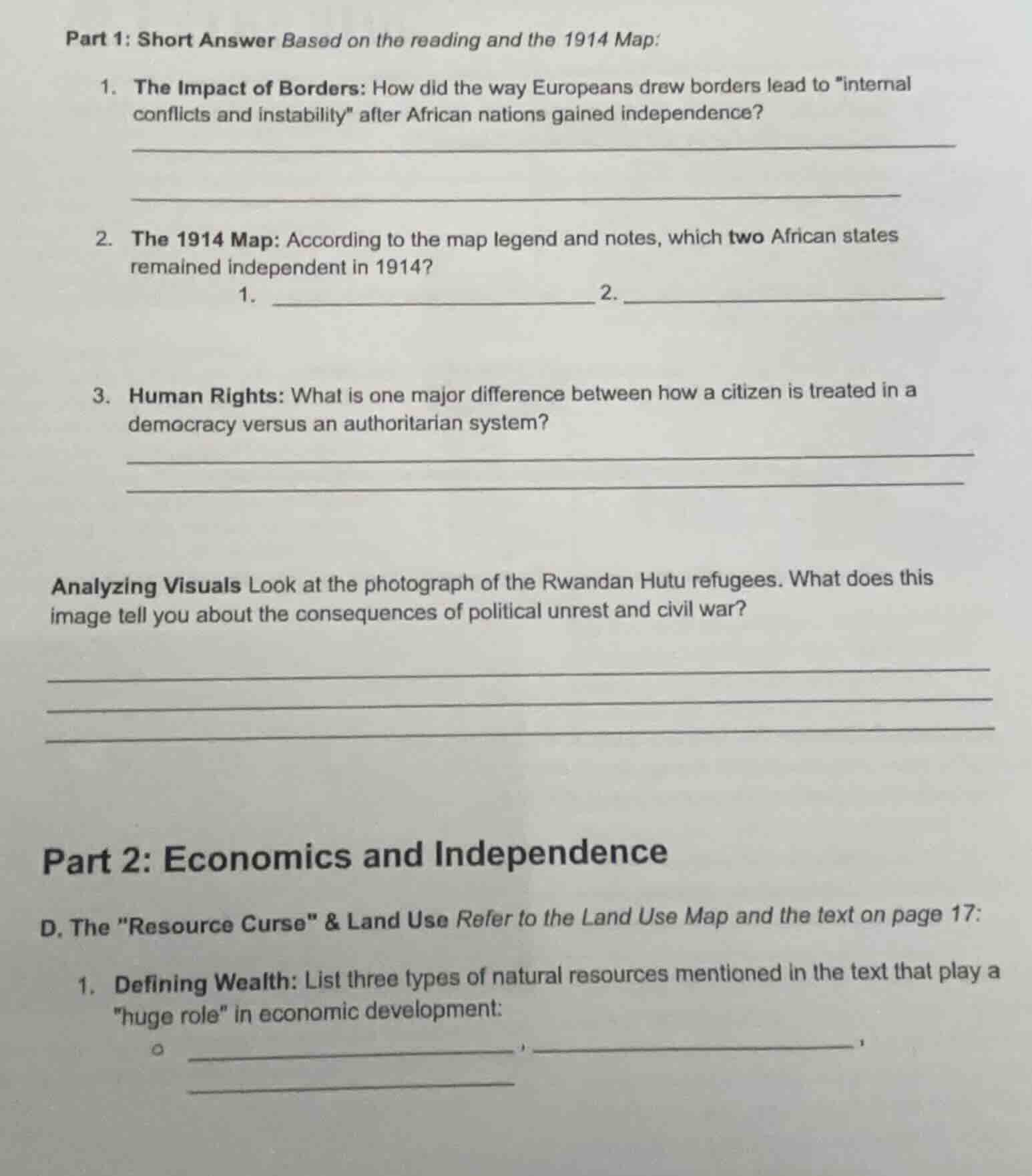
part 1: short answer based on the reading and the 1914 map: 1. the impact of borders: how did the way europeans drew borders lead to \internal conflicts and instability\ after african nations gained independence? 2. the 1914 map: according to the map legend and notes, which two african states remained independent in 1914? 1. 2. 3. human rights: what is one major difference between how a citizen is treated in a democracy versus an authoritarian system? analyzing visuals look at the photograph of the rwandan hutu refugees. what does this image tell you about the consequences of political unrest and civil war? part 2: economics and independence d. the
esource curse\ & land use refer to the land use map and the text on page 17: 1. defining wealth: list three types of natural resources mentioned in the text that play a \huge role\ in economic development:
Part 1: Short Answer Based on the reading and the 1914 Map
1. The Impact of Borders
Europeans drew African borders arbitrarily during colonization, ignoring ethnic, tribal, and cultural divisions. After independence, these borders forced diverse groups (with historical rivalries or different identities) into single nations. This led to power struggles, ethnic conflicts, and instability as groups fought for control or autonomy within the imposed boundaries.
In 1914, among African states, Ethiopia (Abyssinia) and Liberia remained independent. Ethiopia successfully resisted European colonization efforts, and Liberia was established by the American Colonization Society and maintained its independence.
In a democracy, citizens typically have the right to participate in governance (e.g., vote, run for office), freedom of speech, and due process. In an authoritarian system, the government has more control; citizens often have limited political participation, restricted civil liberties, and the state may suppress dissent. For example, in a democracy, citizens can freely criticize the government, while in an authoritarian system, such criticism may be punished.

Snap & solve any problem in the app
Get step-by-step solutions on Sovi AI
Photo-based solutions with guided steps
Explore more problems and detailed explanations
Europeans drew borders arbitrarily (ignoring ethnic/cultural divisions). Post - independence, these borders forced diverse, often rival groups into nations, sparking power struggles, ethnic conflicts, and instability.