QUESTION IMAGE
Question
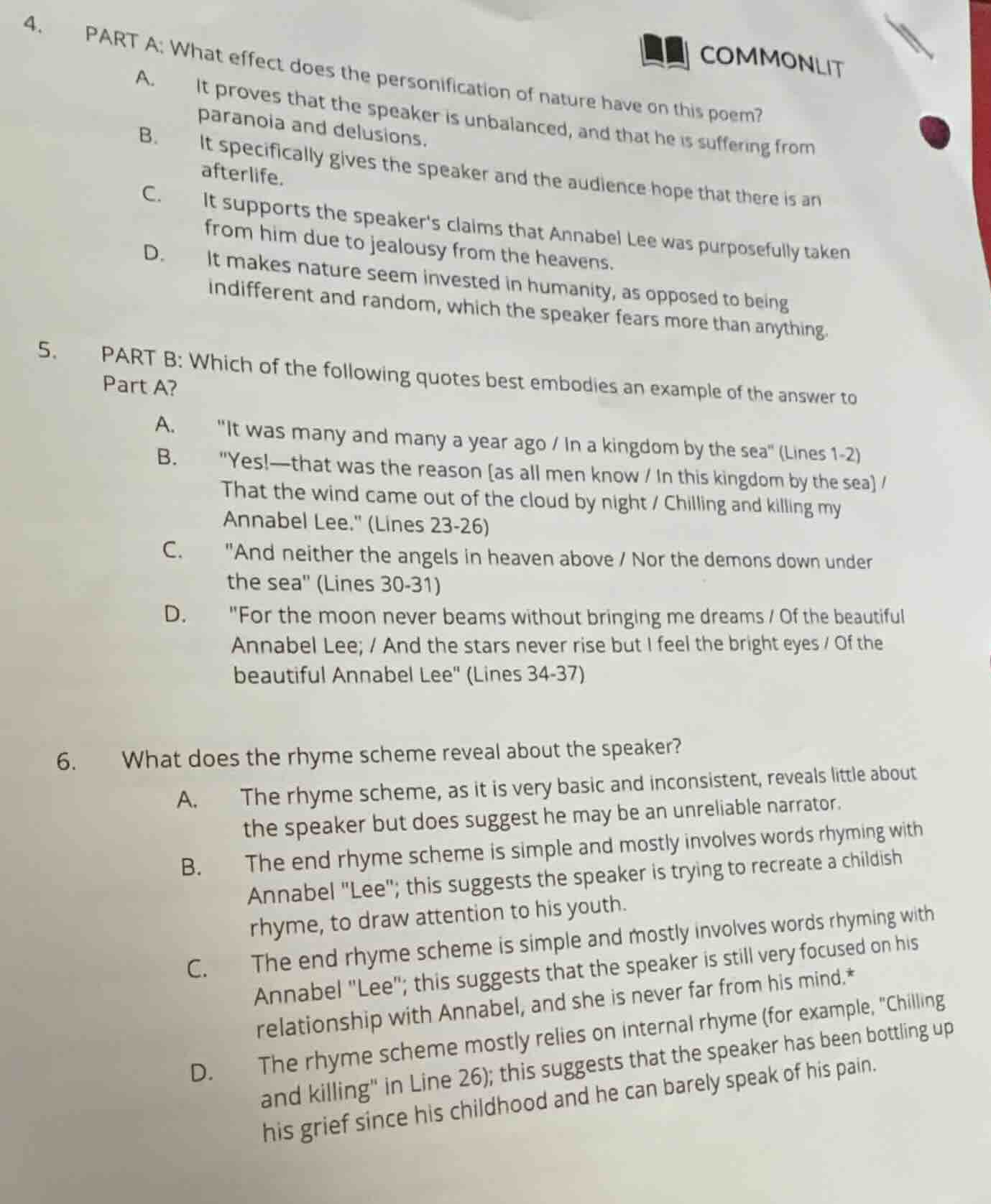
- part a: what effect does the personification of nature have on this poem?
a. it proves that the speaker is unbalanced, and that he is suffering from paranoia and delusions.
b. it specifically gives the speaker and the audience hope that there is an afterlife.
c. it supports the speakers claims that annabel lee was purposefully taken from him due to jealousy from the heavens.
d. it makes nature seem invested in humanity, as opposed to being indifferent and random, which the speaker fears more than anything.
- part b: which of the following quotes best embodies an example of the answer to part a?
a. \it was many and many a year ago / in a kingdom by the sea\ (lines 1-2)
b. \yes!—that was the reason as all men know / in this kingdom by the sea / that the wind came out of the cloud by night / chilling and killing my annabel lee.\ (lines 23-26)
c. \and neither the angels in heaven above / nor the demons down under the sea\ (lines 30-31)
d. \for the moon never beams without bringing me dreams / of the beautiful annabel lee; / and the stars never rise but i feel the bright eyes / of the beautiful annabel lee\ (lines 34-37)
- what does the rhyme scheme reveal about the speaker?
a. the rhyme scheme, as it is very basic and inconsistent, reveals little about the speaker but does suggest he may be an unreliable narrator.
b. the end rhyme scheme is simple and mostly involves words rhyming with annabel \lee\; this suggests the speaker is trying to recreate a childish rhyme, to draw attention to his youth.
c. the end rhyme scheme is simple and mostly involves words rhyming with annabel \lee\; this suggests that the speaker is still very focused on his relationship with annabel, and she is never far from his mind.*
d. the rhyme scheme mostly relies on internal rhyme (for example, \chilling and killing\ in line 26); this suggests that the speaker has been bottling up his grief since his childhood and he can barely speak of his pain.
These questions refer to Edgar Allan Poe's Annabel Lee.
- For Part A: The poem's personification of nature (moon, stars, wind) frames nature as tied to the speaker's grief and connection to Annabel Lee, making it invested in his human pain rather than indifferent. This aligns with option D.
- For Part B: The quote in option D uses personified moon and stars that link directly to the speaker's memories of Annabel Lee, embodying the personified nature tied to his experience from Part A.
- For Question 6: The poem's consistent end rhymes centered on "Lee" show the speaker's unwavering, all-consuming focus on Annabel Lee, which matches option C.

Snap & solve any problem in the app
Get step-by-step solutions on Sovi AI
Photo-based solutions with guided steps
Explore more problems and detailed explanations
- D. It makes nature seem invested in humanity, as opposed to being indifferent and random, which the speaker fears more than anything.
- D. "For the moon never beams without bringing me dreams / Of the beautiful Annabel Lee; / And the stars never rise but I feel the bright eyes / Of the beautiful Annabel Lee" (Lines 34-37)
- C. The end rhyme scheme is simple and mostly involves words rhyming with Annabel "Lee"; this suggests that the speaker is still very focused on his relationship with Annabel, and she is never far from his mind.*