QUESTION IMAGE
Question
the passage below describes a species of fish.
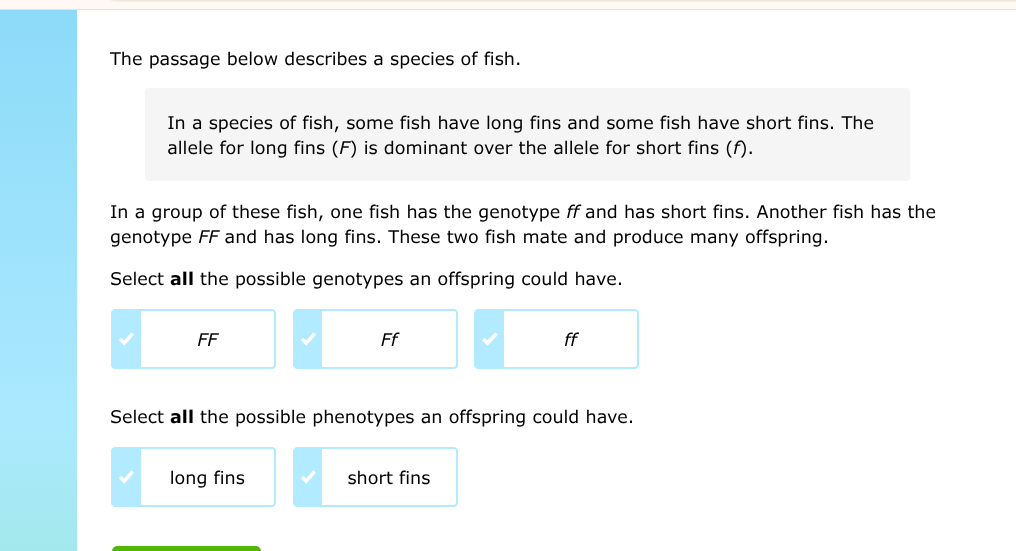
in a species of fish, some fish have long fins and some fish have short fins. the allele for long fins (f) is dominant over the allele for short fins (f).
in a group of these fish, one fish has the genotype ff and has short fins. another fish has the genotype ff and has long fins. these two fish mate and produce many offspring.
select all the possible genotypes an offspring could have.
ff ff ff
select all the possible phenotypes an offspring could have.
long fins short fins
To solve this, we analyze the cross between the two fish:
Step 1: Determine the gametes
- The fish with genotype \( FF \) can only produce gametes with the allele \( F \) (since it has two \( F \) alleles).
- The fish with genotype \( ff \) can only produce gametes with the allele \( f \) (since it has two \( f \) alleles).
Step 2: Predict the offspring genotypes
When we cross \( FF \) (gametes: \( F \)) with \( ff \) (gametes: \( f \)), every offspring will inherit one \( F \) from the first parent and one \( f \) from the second parent. Thus, the only possible genotype for the offspring is \( Ff \).
Step 3: Determine the phenotype from the genotype
The allele \( F \) (long fins) is dominant over \( f \) (short fins). For the genotype \( Ff \), the dominant allele \( F \) will be expressed, so the phenotype is long fins.
Correcting the Initial Mistakes
- Possible Genotypes: Only \( Ff \) is possible (not \( FF \) or \( ff \), because the parents can only pass \( F \) and \( f \) respectively).
- Possible Phenotypes: Only \( \text{long fins} \) is possible (since \( Ff \) shows the dominant trait, long fins; short fins would require \( ff \), which is impossible here).
Final Answers
- Possible Genotypes: \( \boldsymbol{Ff} \) (only this option is correct).
- Possible Phenotypes: \( \boldsymbol{\text{long fins}} \) (only this option is correct).

Snap & solve any problem in the app
Get step-by-step solutions on Sovi AI
Photo-based solutions with guided steps
Explore more problems and detailed explanations
To solve this, we analyze the cross between the two fish:
Step 1: Determine the gametes
- The fish with genotype \( FF \) can only produce gametes with the allele \( F \) (since it has two \( F \) alleles).
- The fish with genotype \( ff \) can only produce gametes with the allele \( f \) (since it has two \( f \) alleles).
Step 2: Predict the offspring genotypes
When we cross \( FF \) (gametes: \( F \)) with \( ff \) (gametes: \( f \)), every offspring will inherit one \( F \) from the first parent and one \( f \) from the second parent. Thus, the only possible genotype for the offspring is \( Ff \).
Step 3: Determine the phenotype from the genotype
The allele \( F \) (long fins) is dominant over \( f \) (short fins). For the genotype \( Ff \), the dominant allele \( F \) will be expressed, so the phenotype is long fins.
Correcting the Initial Mistakes
- Possible Genotypes: Only \( Ff \) is possible (not \( FF \) or \( ff \), because the parents can only pass \( F \) and \( f \) respectively).
- Possible Phenotypes: Only \( \text{long fins} \) is possible (since \( Ff \) shows the dominant trait, long fins; short fins would require \( ff \), which is impossible here).
Final Answers
- Possible Genotypes: \( \boldsymbol{Ff} \) (only this option is correct).
- Possible Phenotypes: \( \boldsymbol{\text{long fins}} \) (only this option is correct).