QUESTION IMAGE
Question
this passage describes wing width in fruit flies.
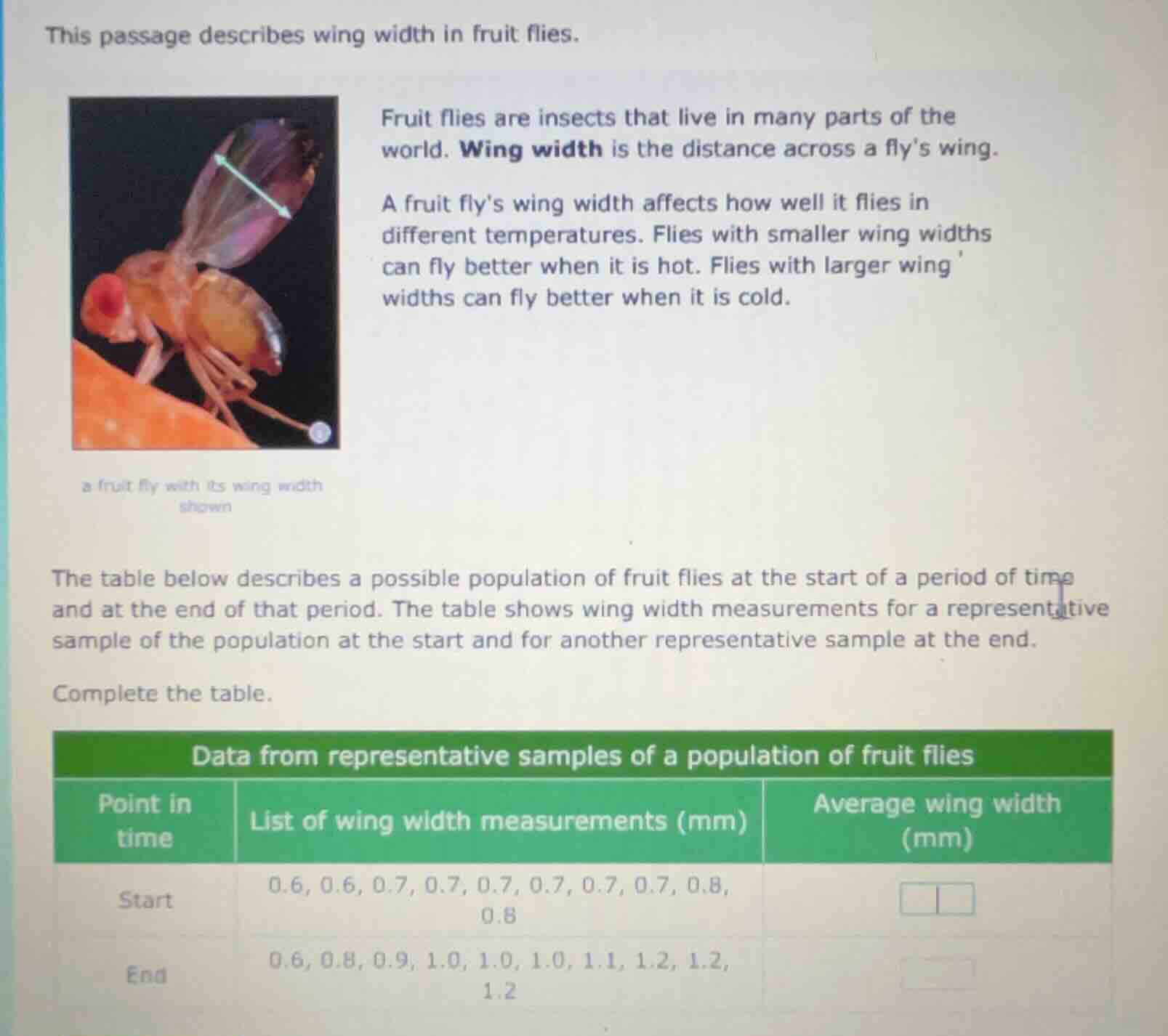
fruit flies are insects that live in many parts of the world. wing width is the distance across a fly’s wing.
a fruit fly’s wing width affects how well it flies in different temperatures. flies with smaller wing widths can fly better when it is hot. flies with larger wing widths can fly better when it is cold.
the table below describes a possible population of fruit flies at the start of a period of time and at the end of that period. the table shows wing width measurements for a representative sample of the population at the start and for another representative sample at the end.
complete the table.
data from representative samples of a population of fruit flies
| point in time | list of wing width measurements (mm) | average wing width (mm) |
|---|---|---|
| end | 0.6, 0.8, 0.9, 1.0, 1.0, 1.0, 1.1, 1.2, 1.2, 1.2 |
Step1: Count start sample size
Count of values: $n_1 = 10$
Step2: Sum start wing widths
$\sum x_1 = 0.6+0.6+0.7+0.7+0.7+0.7+0.7+0.7+0.8+0.8 = 7.0$
Step3: Calculate start average
$\text{Average}_1 = \frac{\sum x_1}{n_1} = \frac{7.0}{10} = 0.7$
Step4: Count end sample size
Count of values: $n_2 = 10$
Step5: Sum end wing widths
$\sum x_2 = 0.6+0.8+0.9+1.0+1.0+1.0+1.1+1.2+1.2+1.2 = 10.0$
Step6: Calculate end average
$\text{Average}_2 = \frac{\sum x_2}{n_2} = \frac{10.0}{10} = 1.0$

Snap & solve any problem in the app
Get step-by-step solutions on Sovi AI
Photo-based solutions with guided steps
Explore more problems and detailed explanations
Start average wing width: $0.7$ mm
End average wing width: $1.0$ mm