QUESTION IMAGE
Question
passage 2
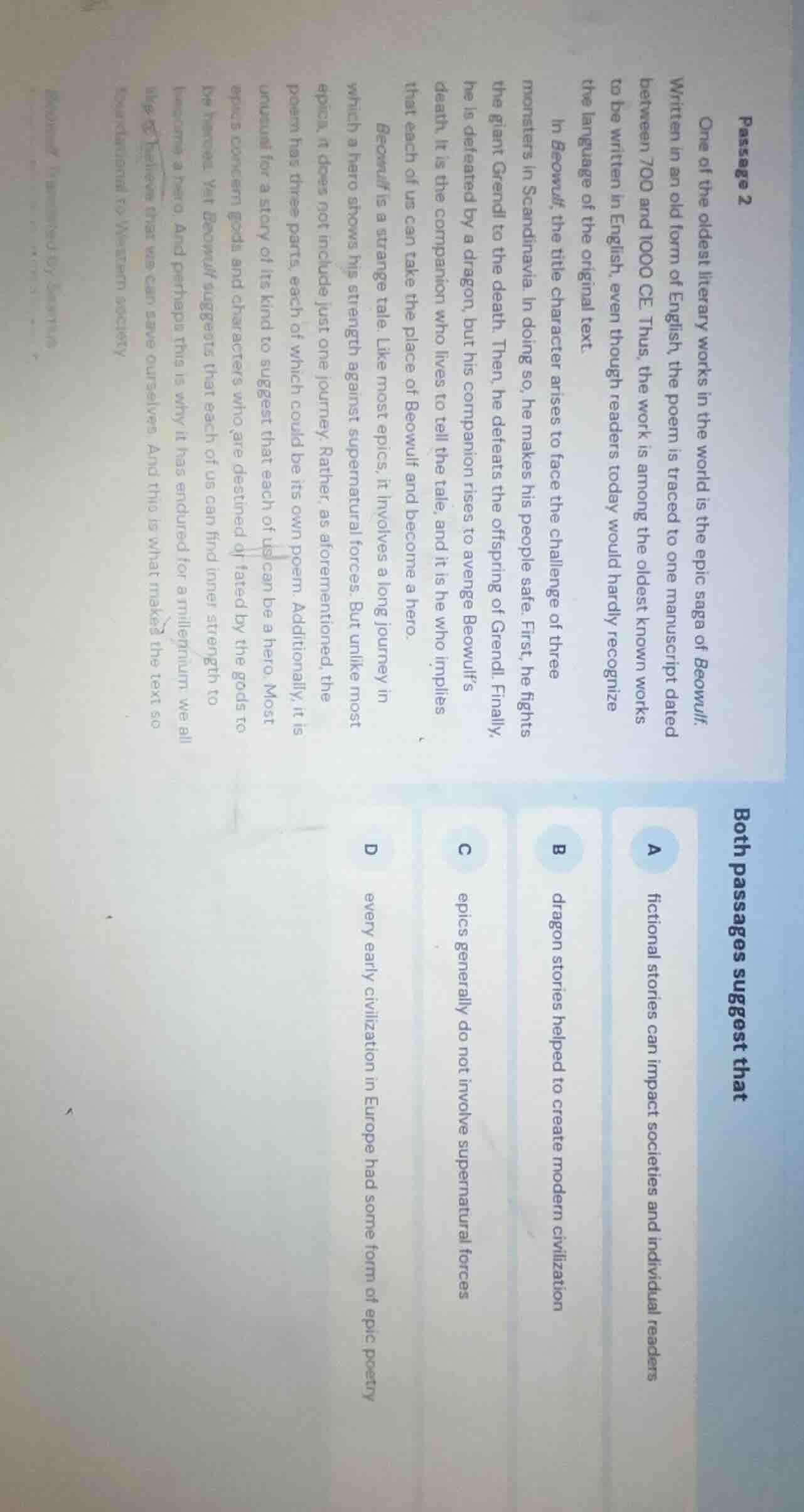
one of the oldest literary works in the world is the epic saga of beowulf. written in an old form of english, the poem is traced to one manuscript dated between 700 and 1000 ce. thus, the work is among the oldest known works to be written in english, even though readers today would hardly recognize the language of the original text.
in beowulf, the title character arises to face the challenge of three monsters in scandinavia. in doing so, he makes his people safe. first, he fights the giant grendl to the death. then, he defeats the offspring of grendl. finally, he is defeated by a dragon, but his companion rises to avenge beowulf’s death. it is the companion who lives to tell the tale, and it is he who implies that each of us can take the place of beowulf and become a hero.
beowulf is a strange tale. like most epics, it involves a long journey in which a hero shows his strength against supernatural forces. but unlike most epics, it does not include just one journey. as aforementioned, the poem has three parts, each of which could be its own poem. additionally, it is unusual for a story of its kind to suggest that each of us can be a hero. most epics concern gods and characters who are destined or fated by the gods to be heroes. yet beowulf suggests that each of us can find inner strength to become a hero. and perhaps this is why it has endured for a millennium: we all like to believe that we can save ourselves. and this is what makes the text so foundational to western society.
both passages suggest that
a fictional stories can impact societies and individual readers
b dragon stories helped to create modern civilization
c epics generally do not involve supernatural forces
d every early civilization in europe had some form of epic poetry
To solve this, we analyze each option:
- Option A: The passage about Beowulf states it has endured for a millennium and we can see ourselves in it, implying fictional stories (like epics) impact societies and individuals. This aligns with the idea that fictional stories have such an impact.
- Option B: The passage does not discuss dragon stories creating modern civilization.
- Option C: Beowulf involves supernatural forces (monsters, dragon), so epics do involve them, making this incorrect.
- Option D: The passage only talks about Beowulf (one epic) and not every early European civilization having epics.

Snap & solve any problem in the app
Get step-by-step solutions on Sovi AI
Photo-based solutions with guided steps
Explore more problems and detailed explanations
A. fictional stories can impact societies and individual readers