QUESTION IMAGE
Question
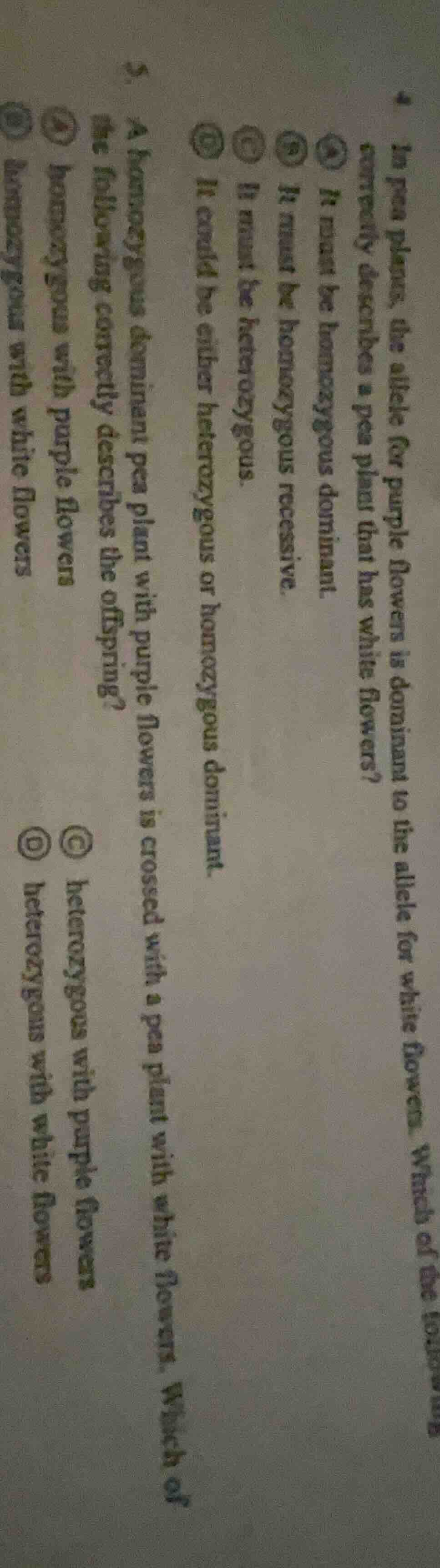
- in pea plants, the allele for purple flowers is dominant to the allele for white flowers. which of the following correctly describes a pea plant that has white flowers? a. it must be homozygous dominant. b. it must be homozygous recessive. c. it must be heterozygous. d. it could be either heterozygous or homozygous dominant. 5. a homozygous dominant pea plant with purple flowers is crossed with a pea plant with white flowers. which of the following correctly describes the offspring? a. homozygous with purple flowers b. homozygous with white flowers c. heterozygous with purple flowers d. heterozygous with white flowers
Question 4 (Pea plant allele for purple/white flowers)
To determine the genotype of a pea plant with white flowers (recessive trait), we use the principle of Mendelian genetics. A recessive trait (white flowers) is only expressed when the genotype is homozygous recessive (since the dominant allele would mask it if present). The allele for purple is dominant (let's say \( P \)) and white is recessive (\( p \)). For a plant to have white flowers, it must have two recessive alleles (\( pp \)), which is homozygous recessive. Let's analyze the options:
- Option A: Homozygous dominant (\( PP \)) would result in purple flowers, not white. Eliminate.
- Option B: Homozygous recessive (\( pp \)) is correct because white is recessive and requires two \( p \) alleles.
- Option C: Heterozygous (\( Pp \)) would show the dominant trait (purple flowers) because the dominant allele masks the recessive one. Eliminate.
- Option D: "It could be either heterozygous or homozygous dominant" is incorrect because both of these genotypes (\( Pp \) or \( PP \)) would produce purple flowers, not white. Eliminate.
Let's define the alleles: Purple is dominant (\( P \)), so a homozygous dominant purple plant has the genotype \( PP \). A white - flowered plant, as established earlier, has the genotype \( pp \) (homozygous recessive). When we cross \( PP \) (purple, homozygous dominant) with \( pp \) (white, homozygous recessive), we use a Punnett square. The gametes from the \( PP \) plant are all \( P \), and the gametes from the \( pp \) plant are all \( p \). So all the offspring will have the genotype \( Pp \). Now let's analyze the options for offspring:
- Option A: "Homozygous with purple flowers" (\( PP \)): The offspring have \( Pp \), not \( PP \). Eliminate.
- Option B: "Homozygous with white flowers" (\( pp \)): Offspring have \( Pp \), and white flowers are \( pp \). Eliminate.
- Option C: "Heterozygous with purple flowers": The genotype \( Pp \) is heterozygous, and since \( P \) (purple) is dominant, the flowers will be purple. This is correct.
- Option D: "Heterozygous with white flowers": \( Pp \) shows the dominant trait (purple), not white. Eliminate.

Snap & solve any problem in the app
Get step-by-step solutions on Sovi AI
Photo-based solutions with guided steps
Explore more problems and detailed explanations
B. It must be homozygous recessive