QUESTION IMAGE
Question
pear assessment
6d5 exit ticket
created by kristine ingbernan
1
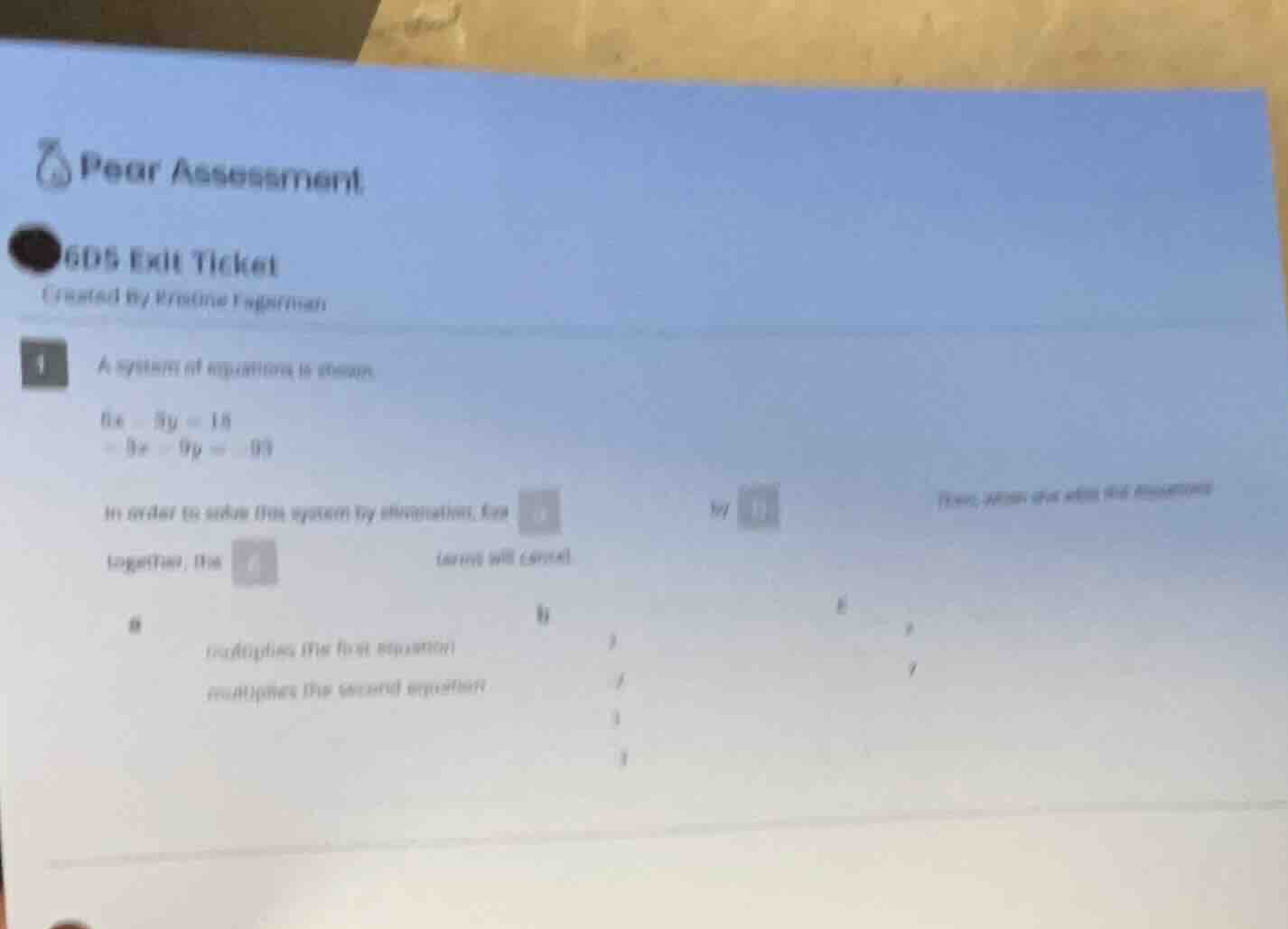
a system of equations is shown.
6x - 3y = 15
-3x + 9y = -15
in order to solve this system by elimination, first a by b. then, when you add the equations together, the c term will cancel.
a
- multiplies the first equation
- multiplies the second equation
b
3
2
1
-1
c
x
y
Step1: Analyze the equations
We have the system:
\(6x - 3y = 15\)
\(-3x - 9y = -18\)
To solve by elimination, we want to make the coefficients of one variable opposites or equal. Let's focus on the \(x\) or \(y\) terms. Let's look at the \(x\) coefficients: \(6\) and \(-3\). If we multiply the second equation by \(2\), the \(x\)-coefficient becomes \(-6\), which is the opposite of \(6\) in the first equation.
Step2: Multiply the second equation
Multiply the second equation \(-3x - 9y = -18\) by \(2\):
\(2\times(-3x - 9y)=2\times(-18)\)
\(-6x - 18y = -36\)
Now our system is:
\(6x - 3y = 15\)
\(-6x - 18y = -36\)
If we add these two equations, the \(x\) terms will cancel:
\((6x - 3y)+(-6x - 18y)=15+(-36)\)
\(6x - 3y - 6x - 18y = 15 - 36\)
\(-21y = -21\)
\(y = 1\)
Then substitute \(y = 1\) back into the first equation \(6x - 3(1)=15\)
\(6x - 3 = 15\)
\(6x = 18\)
\(x = 3\)
But the question is about what to multiply to eliminate. Let's check the \(y\) terms: first equation has \(-3y\), second has \(-9y\). If we multiply the first equation by \(3\), we get \(18x - 9y = 45\), and the second equation is \(-3x - 9y = -18\). Then subtracting would eliminate \(y\). But the options: let's see the first blank (A: multiplies the first equation, B: multiplies the second equation), second blank (the number), third blank (the term that cancels).
Wait, the original equations: \(6x - 3y = 15\) and \(-3x - 9y = -18\). Let's look at the \(x\) coefficients: \(6\) and \(-3\). If we multiply the second equation by \(2\), we get \(-6x - 18y = -36\), then adding the first equation (\(6x - 3y = 15\)) will eliminate \(x\) (since \(6x + (-6x)=0\)). So:
First blank: B? Wait no, A is multiplies the first equation, B is multiplies the second equation. Wait, to eliminate \(x\), we need \(6x\) and \(-6x\). So multiply the second equation (which has \(-3x\)) by \(2\) to get \(-6x\). So the first blank: B (multiplies the second equation), second blank: \(2\), third blank: \(x\) (since \(6x + (-6x)=0\)).
Let's check the options:
A: multiplies the first equation
B: multiplies the second equation
Numbers: 2, -2, 3, -3
Terms: x, y
So:
To solve by elimination, we can [B: multiplies the second equation] by [2], then, when we add the equations, the [x] terms will cancel.
Let's verify:
Second equation: \(-3x - 9y = -18\) multiplied by 2: \(-6x - 18y = -36\)
First equation: \(6x - 3y = 15\)
Add them: \(6x - 3y -6x -18y = 15 -36\) → \(-21y = -21\) → \(y=1\). Wait, no, the \(x\) terms cancel (6x -6x=0). So the term that cancels is \(x\).
So the answers:
First blank: B (multiplies the second equation)
Second blank: 2
Third blank: x
But let's check the original problem's options again (from the image):
A: multiplies the first equation
B: multiplies the second equation
Numbers: 2, -2, 3, -3
Terms: x, y
So putting it together:
In order to solve this system by elimination, you [B: multiplies the second equation] by [2]. Then, when you add the equations together, the [x] terms will cancel.
Let's check another way: if we multiply the first equation by 3: \(18x -9y = 45\), second equation: \(-3x -9y = -18\). Subtract the second from the first: \(21x = 63\) → \(x=3\), then \(y=1\). But that eliminates \(y\) (since -9y - (-9y)=0? No, -9y - (-9y)=0? Wait, first equation after multiplying by 3: 18x -9y=45, second: -3x -9y=-18. Subtract: (18x -9y) - (-3x -9y)=45 - (-18) → 21x=63 → x=3. So that eliminates \(y\) (because -9y - (-9y)=0). But the options for the term that cancels: x or y.
Wait, the original problem's equations: \(6x - 3y = 15\) and \(-3x - 9y…

Snap & solve any problem in the app
Get step-by-step solutions on Sovi AI
Photo-based solutions with guided steps
Explore more problems and detailed explanations
First blank: B. multiplies the second equation
Second blank: 2
Third blank: x