QUESTION IMAGE
Question
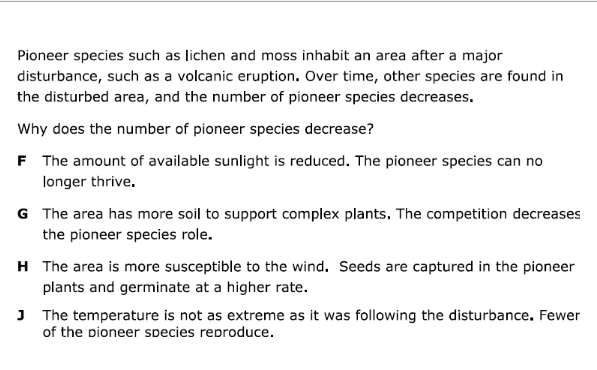
pioneer species such as lichen and moss inhabit an area after a major
disturbance, such as a volcanic eruption. over time, other species are found in
the disturbed area, and the number of pioneer species decreases.
why does the number of pioneer species decrease?
f the amount of available sunlight is reduced. the pioneer species can no
longer thrive.
g the area has more soil to support complex plants. the competition decreases
the pioneer species role.
h the area is more susceptible to the wind. seeds are captured in the pioneer
plants and germinate at a higher rate.
j the temperature is not as extreme as it was following the disturbance. fewer
of the pioneer species reproduce.
To determine why pioneer species (like lichen and moss) decrease after a disturbance (e.g., volcanic eruption), we analyze each option:
- Option F: Pioneer species like lichen/moss are often adapted to harsh, sun - exposed environments (e.g., bare rock after a volcano). As other plants grow, they may shade the pioneer species. Since these pioneer species rely on ample sunlight, reduced sunlight would make it hard for them to thrive, leading to a decrease. This is consistent with ecological succession (the process of change in species over time in an ecosystem).
- Option G: After a disturbance, initially, there is little soil. Over time, as pioneer species break down rock and add organic matter, soil accumulates. However, pioneer species are adapted to low - soil or no - soil conditions. The increase in soil supports more complex plants, but pioneer species don't “lose their role” due to less competition. In fact, the competition from new plants (that are better adapted to the now - soil - rich environment) increases, pushing out pioneers. So this option's reasoning is incorrect.
- Option H: Wind - blown seeds germinating at a higher rate on pioneer plants would likely increase the number of other species, but it doesn't explain why pioneer species themselves decrease. Pioneer species' decline is not directly related to seed capture on them; it's more about their inability to compete in the changing environment. So this option is incorrect.
- Option J: Pioneer species are adapted to extreme temperatures (e.g., the hot, barren conditions after a volcano). As the environment stabilizes and temperatures become less extreme, it becomes more suitable for other species. But pioneer species' reproduction isn't primarily limited by extreme post - disturbance temperatures in a way that a reduction in temperature would cause fewer to reproduce. Their decline is more about competition and changing environmental conditions (like soil development and light availability) rather than temperature - driven reproduction decrease. So this option is incorrect.

Snap & solve any problem in the app
Get step-by-step solutions on Sovi AI
Photo-based solutions with guided steps
Explore more problems and detailed explanations
F. The amount of available sunlight is reduced. The pioneer species can no longer thrive.