QUESTION IMAGE
Question
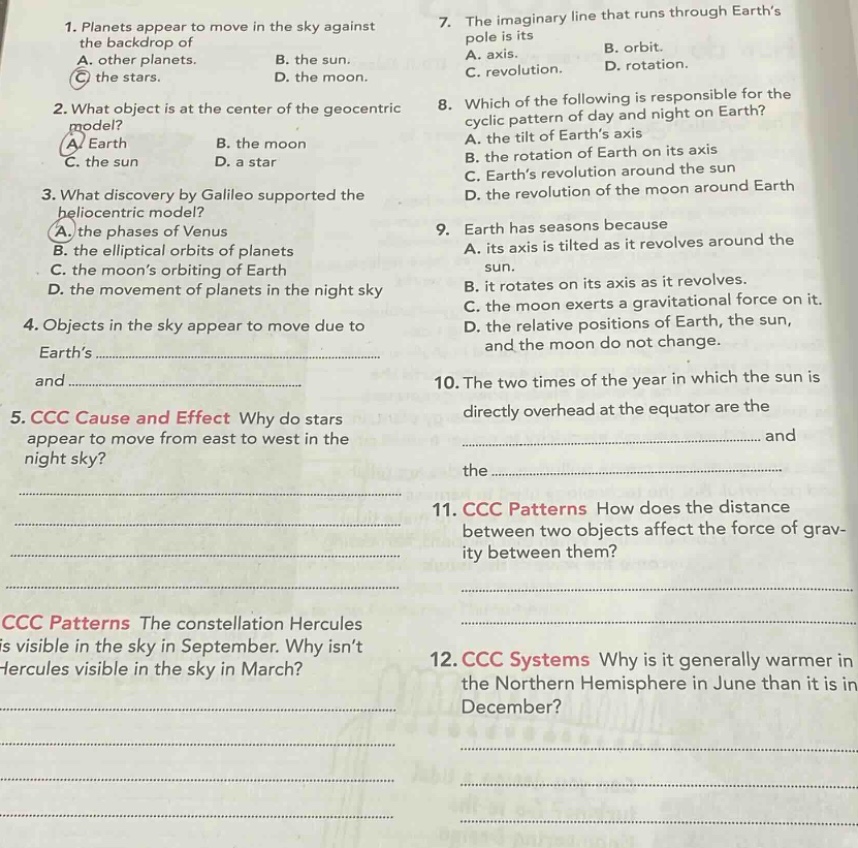
- planets appear to move in the sky against the backdrop of a. other planets. b. the sun. c. the stars. d. the moon. 2. what object is at the center of the geocentric model? a. earth b. the moon c. the sun d. a star 3. what discovery by galileo supported the heliocentric model? a. the phases of venus b. the elliptical orbits of planets c. the moon’s orbiting of earth d. the movement of planets in the night sky 4. objects in the sky appear to move due to earth’s ________________ and ______________ 5. ccc cause and effect why do stars appear to move from east to west in the night sky? ______________ ______________ ______________ ccc patterns the constellation hercules is visible in the sky in september. why isn’t hercules visible in the sky in march? ______________ ______________ ______________ 7. the imaginary line that runs through earth’s pole is its a. axis. b. orbit. c. revolution. d. rotation. 8. which of the following is responsible for the cyclic pattern of day and night on earth? a. the tilt of earth’s axis b. the rotation of earth on its axis c. earth’s revolution around the sun d. the revolution of the moon around earth 9. earth has seasons because a. its axis is tilted as it revolves around the sun. b. it rotates on its axis as it revolves. c. the moon exerts a gravitational force on it. d. the relative positions of earth, the sun, and the moon do not change. 10. the two times of the year in which the sun is directly overhead at the equator are the ______________ and the ______________ 11. ccc patterns how does the distance between two objects affect the force of gravity between them? ______________ ______________ 12. ccc systems why is it generally warmer in the northern hemisphere in june than it is in december? ______________ ________________
Brief Explanations
- Planets move against the fixed background of distant stars.
- The geocentric model places Earth at the universe's center.
- Galileo observed Venus's full phases, proving it orbits the sun, supporting heliocentrism.
- Earth's rotation causes daily sky motion, revolution causes annual shifts.
- Earth spins eastward, making celestial objects appear to move west.
CCC Patterns: As Earth orbits the sun, different constellations become visible in our night sky.
- Earth's axis is the imaginary line through its poles.
- Earth's rotation on its axis creates the 24-hour day-night cycle.
- Axial tilt combined with orbital revolution creates seasonal sunlight differences.
- Equinoxes are the two annual dates when the sun is directly over the equator.
- Newton's law of universal gravitation states gravitational force is inversely proportional to the square of the distance between two objects.
- Axial tilt means the Northern Hemisphere receives more intense, longer sunlight in June, and less in December.

Snap & solve any problem in the app
Get step-by-step solutions on Sovi AI
Photo-based solutions with guided steps
Explore more problems and detailed explanations
- C. the stars.
- A. Earth
- A. the phases of Venus
- rotation; revolution
- Earth's west-to-east rotation
CCC Patterns: Earth's orbit shifts our night sky view
- A. axis.
- B. the rotation of Earth on its axis
- A. its axis is tilted as it revolves around the sun.
- vernal equinox; autumnal equinox
- Gravitational force decreases as distance increases, and increases as distance decreases (follows an inverse-square law: $F \propto \frac{1}{r^2}$ where $F$ is gravitational force and $r$ is distance between objects)
- The Northern Hemisphere tilts toward the sun in June, receiving more direct sunlight and longer days; it tilts away in December, receiving less direct sunlight and shorter days.