QUESTION IMAGE
Question
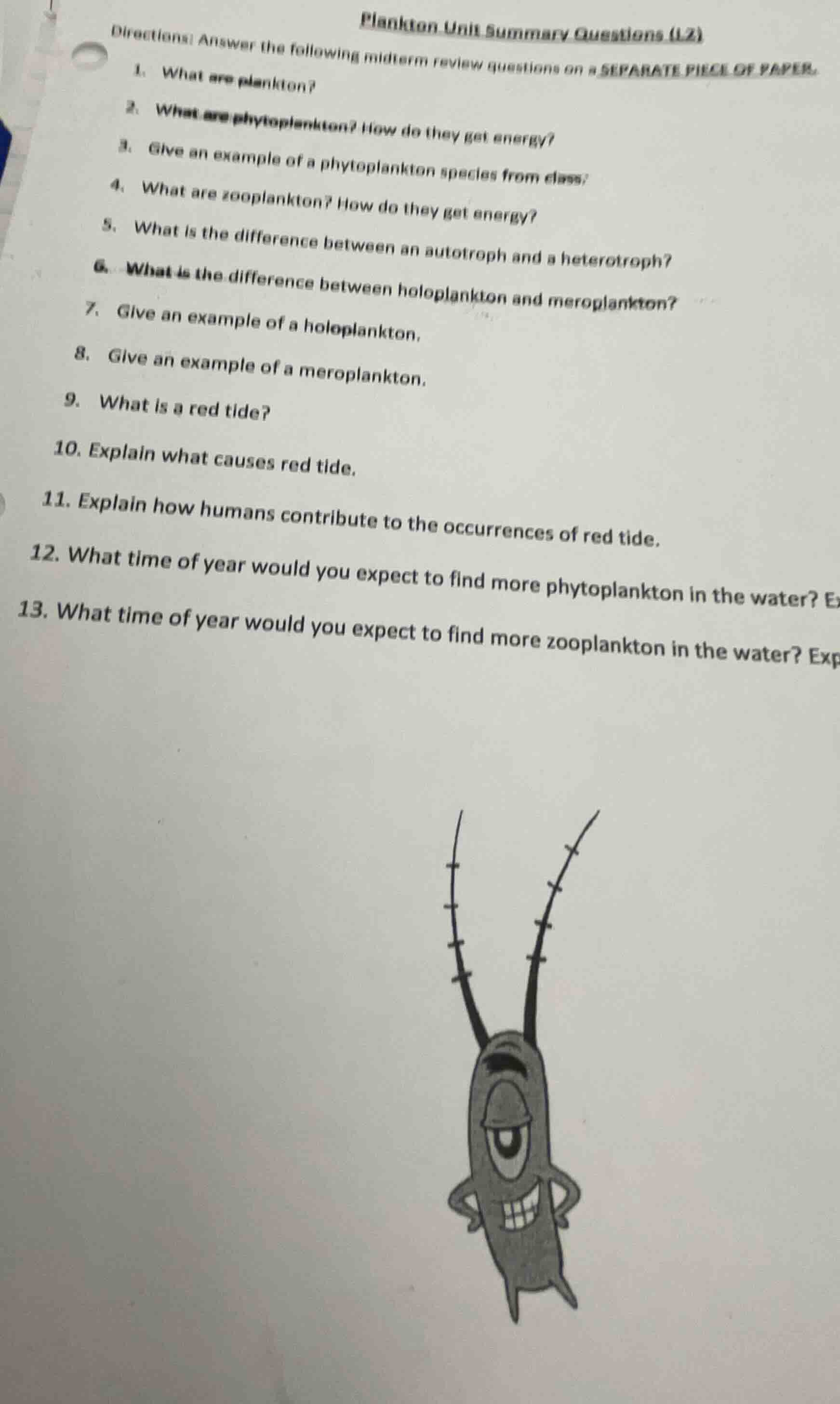
plankton unit summary questions (l2)
directions: answer the following midterm review questions on a separate piece of paper.
- what are plankton?
- what are phytoplankton? how do they get energy?
- give an example of a phytoplankton species from class.
- what are zooplankton? how do they get energy?
- what is the difference between an autotroph and a heterotroph?
- what is the difference between holoplankton and meroplankton?
- give an example of a holoplankton.
- give an example of a meroplankton.
- what is a red tide?
- explain what causes red tide.
- explain how humans contribute to the occurrences of red tide.
- what time of year would you expect to find more phytoplankton in the water? e
- what time of year would you expect to find more zooplankton in the water? exp
To answer these questions, we'll go through each one with relevant biological concepts:
1. What are plankton?
Plankton are small organisms that live in water (marine or freshwater) and cannot swim against the current. They are divided into phytoplankton (plant - like) and zooplankton (animal - like) and form the base of many aquatic food webs.
2. What are phytoplankton? How do they get energy?
Phytoplankton are microscopic, plant - like plankton. They are autotrophs, which means they get energy through photosynthesis. In photosynthesis, they use sunlight, carbon dioxide, and water to produce glucose (a form of chemical energy) and oxygen. The chemical equation for photosynthesis is $6CO_2 + 6H_2O\xrightarrow{sunlight}C_6H_{12}O_6+6O_2$.
3. Give an example of a phytoplankton species from class.
One common example of phytoplankton is Prochlorococcus. It is one of the most abundant photosynthetic organisms on Earth and plays a crucial role in the ocean's carbon cycle and food web.
4. What are zooplankton? How do they get energy?
Zooplankton are microscopic, animal - like plankton. They are heterotrophs, so they get energy by consuming other organisms. This can include eating phytoplankton, other zooplankton, or organic matter. For example, a copepod (a type of zooplankton) will feed on phytoplankton cells.
5. What is the difference between an autotroph and a heterotroph?
Autotrophs are organisms that can produce their own food. They use energy from an external source (like the sun for photosynthetic autotrophs or inorganic chemical reactions for chemosynthetic autotrophs) to convert inorganic substances into organic compounds. Heterotrophs, on the other hand, cannot produce their own food. They obtain energy by consuming organic matter from other organisms (either living or dead).
6. What is the difference between holoplankton and meroplankton?
Holoplankton are organisms that spend their entire life cycle as plankton. For example, many species of copepods and some types of jellyfish are holoplankton. Meroplankton are organisms that are planktonic only for part of their life cycle. The rest of their life cycle is spent in a non - planktonic (usually benthic or nektonic) stage. For example, the larvae of many marine invertebrates like sea urchins or crabs are meroplankton.
7. Give an example of a holoplankton.
As mentioned before, Calanus finmarchicus (a type of copepod) is an example of holoplankton. It remains in the planktonic state throughout its entire life, from egg to adult.
8. Give an example of a meroplankton.
The larvae of the blue crab (Callinectes sapidus) are meroplankton. The eggs of the blue crab hatch into larvae that are planktonic. As they develop, they will eventually settle to the bottom and become benthic adults.
9. What is a red tide?
A red tide is a phenomenon where there is a large - scale bloom (rapid increase in population) of certain types of phytoplankton, usually dinoflagellates. These blooms can discolor the water (often making it appear red, hence the name) and can have negative impacts on marine life, human health, and local economies. The discoloration occurs because the high concentration of these pigmented phytoplankton in the water.
10. Explain what causes red tide.
Red tides are caused by the rapid growth (bloom) of phytoplankton, mainly dinoflagellates (although some diatoms can also cause red - like discolorations in some cases). Several factors can contribute to these blooms, including:
- Nutrient availability: An increase in nutrients such as…

Snap & solve any problem in the app
Get step-by-step solutions on Sovi AI
Photo-based solutions with guided steps
Explore more problems and detailed explanations
To answer these questions, we'll go through each one with relevant biological concepts:
1. What are plankton?
Plankton are small organisms that live in water (marine or freshwater) and cannot swim against the current. They are divided into phytoplankton (plant - like) and zooplankton (animal - like) and form the base of many aquatic food webs.
2. What are phytoplankton? How do they get energy?
Phytoplankton are microscopic, plant - like plankton. They are autotrophs, which means they get energy through photosynthesis. In photosynthesis, they use sunlight, carbon dioxide, and water to produce glucose (a form of chemical energy) and oxygen. The chemical equation for photosynthesis is $6CO_2 + 6H_2O\xrightarrow{sunlight}C_6H_{12}O_6+6O_2$.
3. Give an example of a phytoplankton species from class.
One common example of phytoplankton is Prochlorococcus. It is one of the most abundant photosynthetic organisms on Earth and plays a crucial role in the ocean's carbon cycle and food web.
4. What are zooplankton? How do they get energy?
Zooplankton are microscopic, animal - like plankton. They are heterotrophs, so they get energy by consuming other organisms. This can include eating phytoplankton, other zooplankton, or organic matter. For example, a copepod (a type of zooplankton) will feed on phytoplankton cells.
5. What is the difference between an autotroph and a heterotroph?
Autotrophs are organisms that can produce their own food. They use energy from an external source (like the sun for photosynthetic autotrophs or inorganic chemical reactions for chemosynthetic autotrophs) to convert inorganic substances into organic compounds. Heterotrophs, on the other hand, cannot produce their own food. They obtain energy by consuming organic matter from other organisms (either living or dead).
6. What is the difference between holoplankton and meroplankton?
Holoplankton are organisms that spend their entire life cycle as plankton. For example, many species of copepods and some types of jellyfish are holoplankton. Meroplankton are organisms that are planktonic only for part of their life cycle. The rest of their life cycle is spent in a non - planktonic (usually benthic or nektonic) stage. For example, the larvae of many marine invertebrates like sea urchins or crabs are meroplankton.
7. Give an example of a holoplankton.
As mentioned before, Calanus finmarchicus (a type of copepod) is an example of holoplankton. It remains in the planktonic state throughout its entire life, from egg to adult.
8. Give an example of a meroplankton.
The larvae of the blue crab (Callinectes sapidus) are meroplankton. The eggs of the blue crab hatch into larvae that are planktonic. As they develop, they will eventually settle to the bottom and become benthic adults.
9. What is a red tide?
A red tide is a phenomenon where there is a large - scale bloom (rapid increase in population) of certain types of phytoplankton, usually dinoflagellates. These blooms can discolor the water (often making it appear red, hence the name) and can have negative impacts on marine life, human health, and local economies. The discoloration occurs because the high concentration of these pigmented phytoplankton in the water.
10. Explain what causes red tide.
Red tides are caused by the rapid growth (bloom) of phytoplankton, mainly dinoflagellates (although some diatoms can also cause red - like discolorations in some cases). Several factors can contribute to these blooms, including:
- Nutrient availability: An increase in nutrients such as nitrogen and phosphorus (often from agricultural runoff, sewage discharge, or upwelling of nutrient - rich water) can provide the necessary "fertilizer" for the phytoplankton to grow rapidly.
- Water temperature: Warmer water temperatures, especially in the range that is optimal for the growth of the specific phytoplankton species, can promote their reproduction.
- Salinity: Specific salinity levels that are favorable for the growth of the bloom - forming species can also play a role.
- Ocean currents: Currents can transport the phytoplankton to areas where conditions are suitable for a bloom, or can concentrate them in a particular area.
11. Explain how humans contribute to the occurrences of red tide.
Humans contribute to red tides in several ways:
- Nutrient pollution: Runoff from agricultural fields (carrying fertilizers rich in nitrogen and phosphorus), sewage discharge (which also contains nutrients), and industrial waste can increase the nutrient levels in coastal waters. This excess of nutrients provides the necessary resources for phytoplankton to bloom.
- Coastal development: The destruction of natural coastal habitats like mangroves and salt marshes can disrupt the natural balance of the ecosystem. These habitats can act as filters for nutrients and sediments, and their removal can lead to more nutrients being available in the water column for phytoplankton growth.
- Shipping: Ballast water discharge from ships can introduce non - native phytoplankton species to new areas. If these species are capable of blooming and the local conditions are suitable, they can cause red tides in areas where they are not native.
12. What time of year would you expect to find more phytoplankton in the water? Explain.
In most temperate regions, you would expect to find more phytoplankton in the spring. This is because:
- In the winter, the water column is often well - mixed due to strong winds and cooler temperatures. This mixing brings nutrients from the deeper parts of the water column to the surface, but the low light levels and cold temperatures limit phytoplankton growth.
- As spring arrives, the temperature increases, and the days get longer (more light). The combination of the nutrients that were mixed up in the winter and the increased light and temperature creates ideal conditions for phytoplankton to grow through photosynthesis. The increased light allows for more efficient photosynthesis, and the warmer temperatures speed up metabolic processes in the phytoplankton.
13. What time of year would you expect to find more zooplankton in the water? Explain.
You would expect to find more zooplankton in the late spring to summer, following the peak in phytoplankton abundance. This is because zooplankton are heterotrophs that feed on phytoplankton (among other things). The increase in phytoplankton in the spring provides a large food source for the zooplankton. As the phytoplankton population grows, the zooplankton (which have a lag in their population growth as they respond to the food availability) will start to reproduce more rapidly, leading to a peak in their population a few weeks to months after the phytoplankton peak. Also, the warmer temperatures in summer can increase the metabolic rates and reproductive rates of many zooplankton species, further contributing to a higher population density.