QUESTION IMAGE
Question
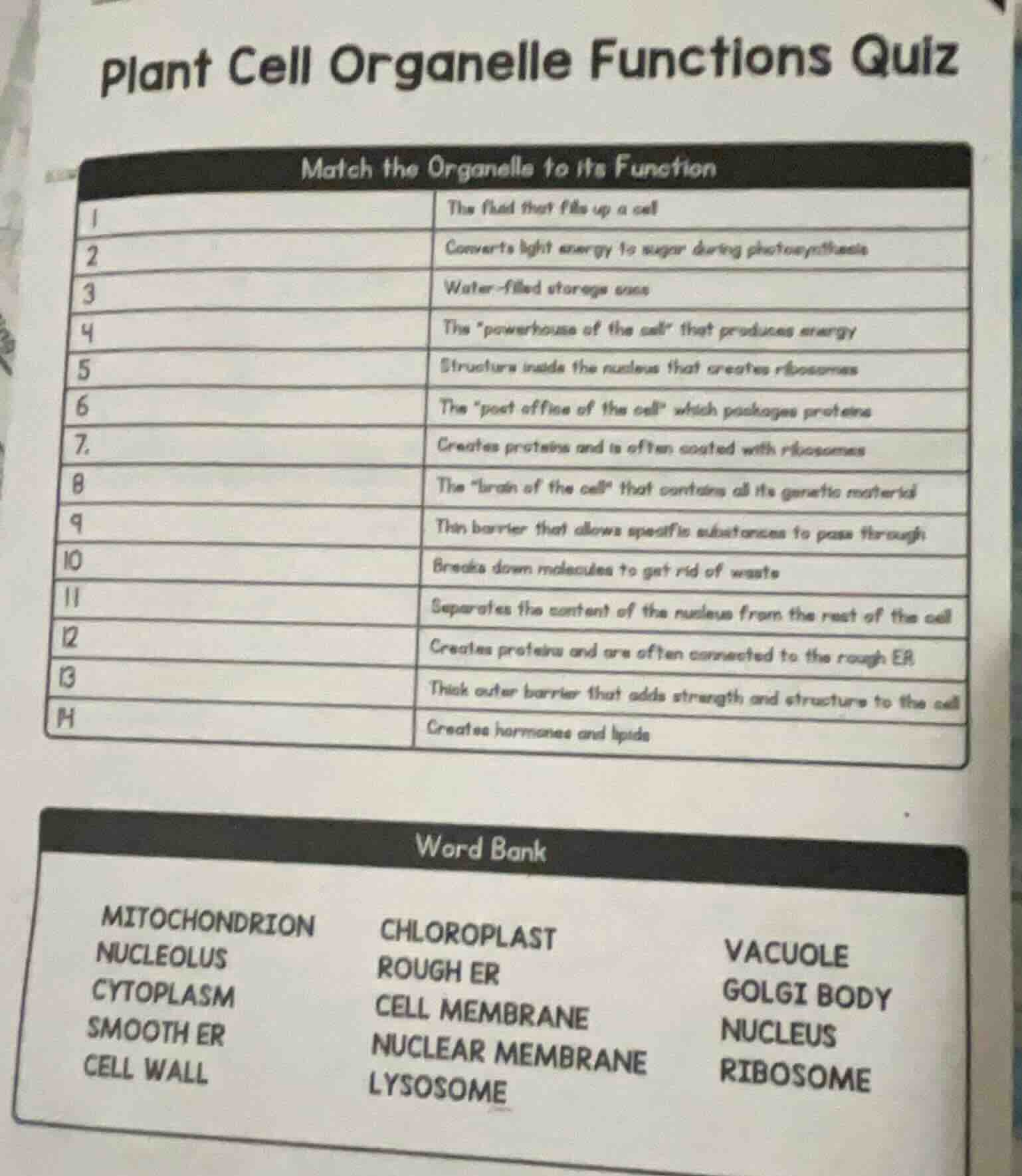
plant cell organelle functions quiz
match the organelle to its function
1\tthe fluid that fills up a cell
2\tconverts light energy to sugar during photosynthesis
3\twater - filled storage sacs
4\tthe powerhouse of the cell that produces energy
5\tstructure inside the nucleus that creates ribosomes
6\tthe post office of the cell which packages proteins
7.\tcreates proteins and is often coated with ribosomes
8\tthe brain of the cell that contains all its genetic material
9\tthe barrier that allows specific substances to pass through
10\tbreaks down molecules to get rid of waste
11\tseparates the content of the nucleus from the rest of the cell
12\tcreates proteins and are often connected to the rough er
13\tthick outer barrier that adds strength and structure to the cell
14\tcreates hormones and lipids
word bank
mitochondrion\tchloroplast\tvacuole
nucleolus\trough er\tgolgi body
cytoplasm\tcell membrane\tnucleus
smooth er\tnuclear membrane\tribosome
cell wall\tlysosome
To solve this plant cell organelle - function matching problem, we analyze each organelle - function pair based on our knowledge of plant cell biology:
1. Function: The fluid that fills up a cell
The cytoplasm is the gel - like fluid that fills the interior of a cell, holding the organelles. So we match this function with CYTOPLASM.
2. Function: Converts light energy to sugar during photosynthesis
Chloroplasts contain chlorophyll and are the site of photosynthesis, where light energy is converted into chemical energy (sugar). So we match this function with CHLOROPLAST.
3. Function: Water - filled storage sacs
Vacuoles in plant cells are large, water - filled sacs that store various substances like water, nutrients, and waste products. So we match this function with VACUOLE.
4. Function: The “powerhouse of the cell” that produces energy
Mitochondria are known as the powerhouse of the cell because they carry out cellular respiration to produce ATP (energy). So we match this function with MITOCHONDRION.
5. Function: Structure inside the nucleus that creates ribosomes
The nucleolus is a structure within the nucleus and its main function is to produce ribosomal RNA and assemble ribosomes. So we match this function with NUCLEOLUS.
6. Function: The “post office of the cell” which packages proteins
The Golgi body (or Golgi apparatus) modifies, sorts, and packages proteins and lipids for transport within the cell or for secretion outside the cell. So we match this function with GOLGI BODY.
7. Function: Creates proteins and is often coated with ribosomes
The rough endoplasmic reticulum (Rough ER) has ribosomes attached to its surface, and these ribosomes synthesize proteins. So we match this function with ROUGH ER.
8. Function: The “brain of the cell” that contains all its genetic material
The nucleus contains the cell's DNA (genetic material) and controls the cell's activities, so it is like the brain of the cell. So we match this function with NUCLEUS.
9. Function: The barrier that allows specific substances to pass through
The cell membrane is a selectively permeable barrier that regulates the entry and exit of substances into and out of the cell. So we match this function with CELL MEMBRANE.
10. Function: Breaks down molecules to get rid of waste
Lysosomes contain digestive enzymes that break down waste materials, old organelles, and foreign substances in the cell. So we match this function with LYSOSOME.
11. Function: Separates the content of the nucleus from the rest of the cell
The nuclear membrane (nuclear envelope) is a double - membrane structure that encloses the nucleus and separates its contents from the cytoplasm. So we match this function with NUCLEAR MEMBRANE.
12. Function: Creates proteins and are often connected to the rough ER
Ribosomes are the sites of protein synthesis. They can be free in the cytoplasm or attached to the rough ER, and they are often connected to the rough ER as the proteins made by ribosomes on the rough ER are further processed there. So we match this function with RIBOSOME.
13. Function: Thick outer barrier that adds strength and structure to the cell
The cell wall is a rigid, thick structure outside the cell membrane in plant cells. It provides support, strength, and protection to the cell. So we match this function with CELL WALL.
14. Function: Creates hormones and lipids
The smooth endoplasmic reticulum (Smooth ER) is involved in the synthesis of lipids, including hormones (like steroid hormones). So we match this function with SMO…

Snap & solve any problem in the app
Get step-by-step solutions on Sovi AI
Photo-based solutions with guided steps
Explore more problems and detailed explanations
To solve this plant cell organelle - function matching problem, we analyze each organelle - function pair based on our knowledge of plant cell biology:
1. Function: The fluid that fills up a cell
The cytoplasm is the gel - like fluid that fills the interior of a cell, holding the organelles. So we match this function with CYTOPLASM.
2. Function: Converts light energy to sugar during photosynthesis
Chloroplasts contain chlorophyll and are the site of photosynthesis, where light energy is converted into chemical energy (sugar). So we match this function with CHLOROPLAST.
3. Function: Water - filled storage sacs
Vacuoles in plant cells are large, water - filled sacs that store various substances like water, nutrients, and waste products. So we match this function with VACUOLE.
4. Function: The “powerhouse of the cell” that produces energy
Mitochondria are known as the powerhouse of the cell because they carry out cellular respiration to produce ATP (energy). So we match this function with MITOCHONDRION.
5. Function: Structure inside the nucleus that creates ribosomes
The nucleolus is a structure within the nucleus and its main function is to produce ribosomal RNA and assemble ribosomes. So we match this function with NUCLEOLUS.
6. Function: The “post office of the cell” which packages proteins
The Golgi body (or Golgi apparatus) modifies, sorts, and packages proteins and lipids for transport within the cell or for secretion outside the cell. So we match this function with GOLGI BODY.
7. Function: Creates proteins and is often coated with ribosomes
The rough endoplasmic reticulum (Rough ER) has ribosomes attached to its surface, and these ribosomes synthesize proteins. So we match this function with ROUGH ER.
8. Function: The “brain of the cell” that contains all its genetic material
The nucleus contains the cell's DNA (genetic material) and controls the cell's activities, so it is like the brain of the cell. So we match this function with NUCLEUS.
9. Function: The barrier that allows specific substances to pass through
The cell membrane is a selectively permeable barrier that regulates the entry and exit of substances into and out of the cell. So we match this function with CELL MEMBRANE.
10. Function: Breaks down molecules to get rid of waste
Lysosomes contain digestive enzymes that break down waste materials, old organelles, and foreign substances in the cell. So we match this function with LYSOSOME.
11. Function: Separates the content of the nucleus from the rest of the cell
The nuclear membrane (nuclear envelope) is a double - membrane structure that encloses the nucleus and separates its contents from the cytoplasm. So we match this function with NUCLEAR MEMBRANE.
12. Function: Creates proteins and are often connected to the rough ER
Ribosomes are the sites of protein synthesis. They can be free in the cytoplasm or attached to the rough ER, and they are often connected to the rough ER as the proteins made by ribosomes on the rough ER are further processed there. So we match this function with RIBOSOME.
13. Function: Thick outer barrier that adds strength and structure to the cell
The cell wall is a rigid, thick structure outside the cell membrane in plant cells. It provides support, strength, and protection to the cell. So we match this function with CELL WALL.
14. Function: Creates hormones and lipids
The smooth endoplasmic reticulum (Smooth ER) is involved in the synthesis of lipids, including hormones (like steroid hormones). So we match this function with SMOOTH ER.
Final Matches:
- CYTOPLASM
- CHLOROPLAST
- VACUOLE
- MITOCHONDRION
- NUCLEOLUS
- GOLGI BODY
- ROUGH ER
- NUCLEUS
- CELL MEMBRANE
- LYSOSOME
- NUCLEAR MEMBRANE
- RIBOSOME
- CELL WALL
- SMOOTH ER