QUESTION IMAGE
Question
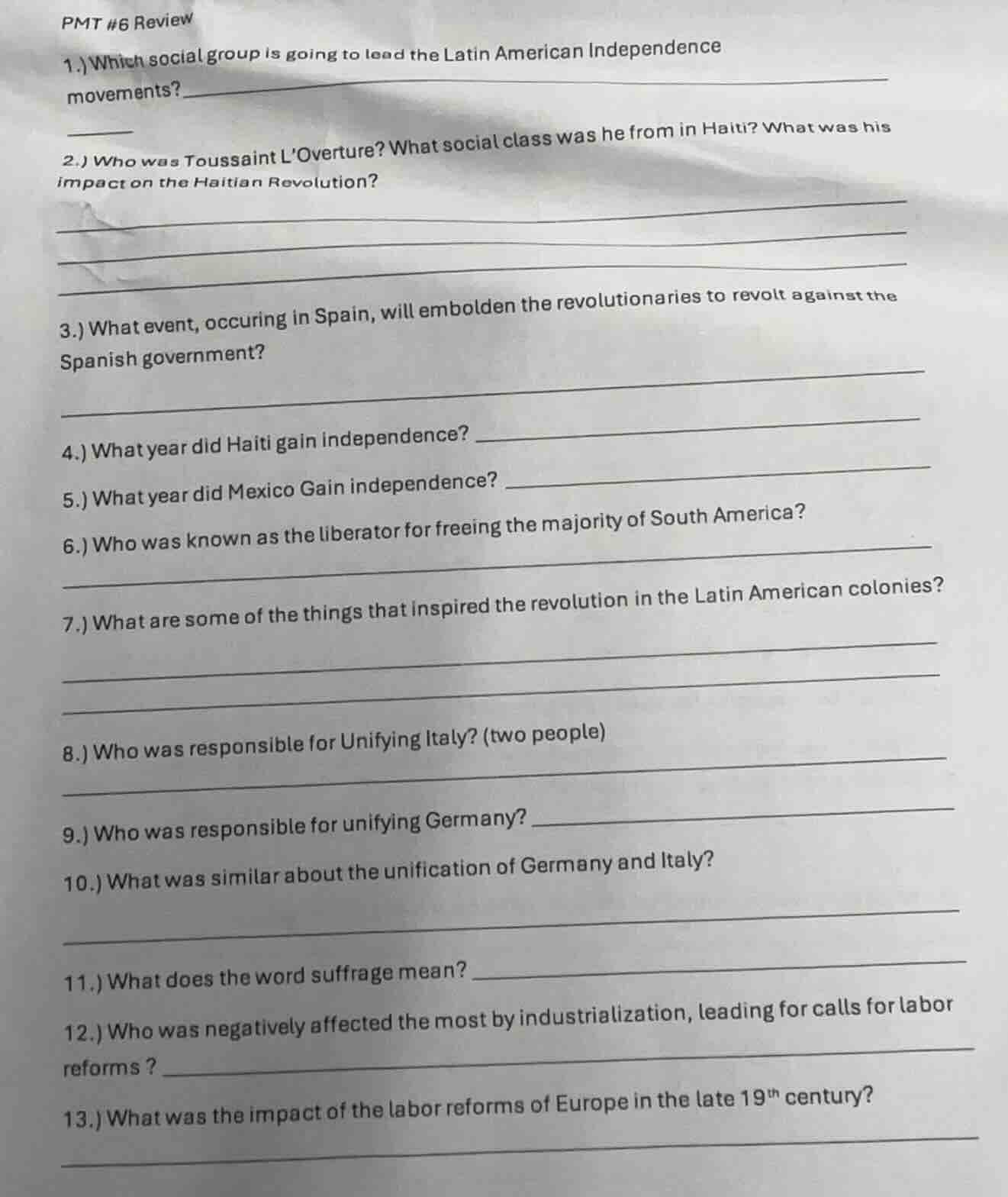
pmt #6 review
1.) which social group is going to lead the latin american independence movements?
2.) who was toussaint loverture? what social class was he from in haiti? what was his impact on the haitian revolution?
3.) what event, occuring in spain, will embolden the revolutionaries to revolt against the spanish government?
4.) what year did haiti gain independence?
5.) what year did mexico gain independence?
6.) who was known as the liberator for freeing the majority of south america?
7.) what are some of the things that inspired the revolution in the latin american colonies?
8.) who was responsible for unifying italy? (two people)
9.) who was responsible for unifying germany?
10.) what was similar about the unification of germany and italy?
11.) what does the word suffrage mean?
12.) who was negatively affected the most by industrialization, leading for calls for labor reforms?
13.) what was the impact of the labor reforms of europe in the late 19th century?
- Identified the leading group for Latin American independence, drawing on colonial social structures.
- Defined Toussaint L'Ouverture, his social class, and his revolutionary impact.
- Cited the key Spanish event that weakened royal control over colonies.
- Provided the verified year of Haitian independence.
- Provided the verified year of Mexican independence.
- Named the primary liberator of most of South America.
- Listed core ideological and historical inspirations for Latin American revolutions.
- Named the two central figures in Italian unification.
- Named the central figure in German unification.
- Highlighted a key shared trait of German and Italian unification.
- Defined the term "suffrage" in a political context.
- Identified the group most harmed by early industrialization.
- Summarized the core impact of late 19th-century European labor reforms.

Snap & solve any problem in the app
Get step-by-step solutions on Sovi AI
Photo-based solutions with guided steps
Explore more problems and detailed explanations
- The creole (criollo) class
- Toussaint L'Ouverture was a Haitian revolutionary leader; he was born into enslavement (enslaved social class in Haiti); he led the initial successful slave uprising, unified rebel forces, established a self-governing Haiti, and laid the groundwork for Haiti's eventual independence.
- The Peninsular War (1807-1814, when Napoleon invaded and occupied Spain, overthrowing the Spanish monarch)
- 1804
- 1821
- Simón Bolívar
- The American Revolution, the French Revolution, Enlightenment ideas of liberty/equality, and unfair colonial economic and political policies
- Camillo di Cavour and Giuseppe Garibaldi
- Otto von Bismarck
- Both were unified through a combination of diplomatic maneuvering and military force, led by a dominant regional state (Prussia for Germany, Piedmont-Sardinia for Italy), and excluded some ethnic communities from the final unified nation.
- The right to vote in political elections
- Factory workers (especially unskilled laborers, women, and child workers)
- Labor reforms improved working conditions, limited child labor, established shorter workdays, and laid the foundation for modern labor rights and social welfare systems.