QUESTION IMAGE
Question
pollution & our planet knowledge check
name: melina martinez date: 1-14-2026
- key vocabulary
match the correct term to its definition based on the lesson vocabulary.
word bank: ecosystem services, pollution, contaminant, smog
| definition | word |
|---|---|
| 2. benefits nature provides to humans, such as clean air and water. | services |
| 3. a fog - like mix of smoke and pollutants in the air, common in urban areas. | smog |
| 4. a specific toxic substance that pollutes air, water, or soil. | contaminant |
- visual identification
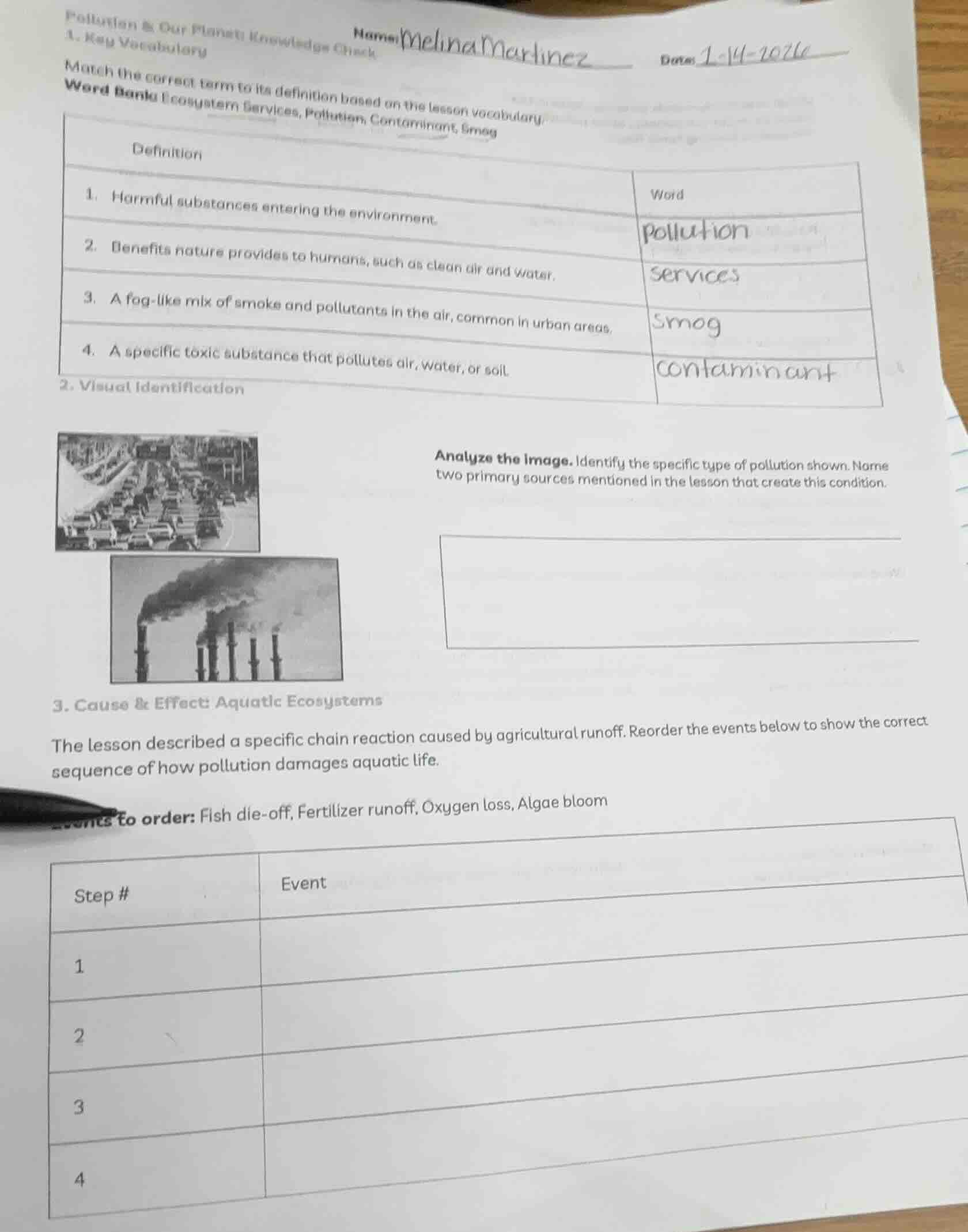
image of a busy street with many cars and an image of factory chimneys emitting smoke
analyze the image. identify the specific type of pollution shown. name two primary sources mentioned in the lesson that create this condition.
- cause & effect: aquatic ecosystems
the lesson described a specific chain reaction caused by agricultural runoff. reorder the events below to show the correct sequence of how pollution damages aquatic life.
events to order: fish die - off, fertilizer runoff, oxygen loss, algae bloom
| step # | event |
|---|---|
| 2 | |
| 3 | |
| 4 |
1. Key Vocabulary (already filled, but verifying):
- 1. Harmful substances entering the environment: Pollution (correct, as pollution is the introduction of harmful substances into the environment).
- 2. Benefits nature provides to humans: Ecosystem Services (note: the original filled "Services" might be a shorthand, but the full term is Ecosystem Services).
- 3. Fog - like mix of smoke and pollutants: Smog (correct, smog is a type of air pollution with smoke and fog - like appearance in urban areas).
- 4. Specific toxic substance that pollutes: Contaminant (correct, a contaminant is a specific pollutant).
2. Visual Identification:
The top image shows a traffic jam, and the bottom image shows factory chimneys emitting smoke. The pollution type here is air pollution (specifically, the bottom image shows industrial air pollution, and the top could be related to vehicle - related air pollution). Primary sources:
- For the factory - related pollution: Industrial emissions (factories burning fossil fuels or releasing pollutants during production).
- For the vehicle - related pollution: Vehicle exhaust (cars, trucks, etc., releasing pollutants like carbon monoxide, nitrogen oxides).
3. Cause & Effect: Aquatic Ecosystems
To reorder the events:
- Step 1: Fertilizer runoff (this is the initial cause, as agricultural runoff with fertilizers enters water bodies).
- Step 2: Algae bloom (fertilizers contain nutrients like nitrogen and phosphorus, which cause algae to grow rapidly).
- Step 3: Oxygen loss (as algae die and decompose, bacteria use up oxygen in the water during decomposition).
- Step 4: Fish die - off (with less oxygen in the water, fish and other aquatic organisms cannot survive).
So the table should be filled as:
| Step # | Event |
|---|---|
| 2 | Algae bloom |
| 3 | Oxygen loss |
| 4 | Fish die - off |

Snap & solve any problem in the app
Get step-by-step solutions on Sovi AI
Photo-based solutions with guided steps
Explore more problems and detailed explanations
1. Key Vocabulary (already filled, but verifying):
- 1. Harmful substances entering the environment: Pollution (correct, as pollution is the introduction of harmful substances into the environment).
- 2. Benefits nature provides to humans: Ecosystem Services (note: the original filled "Services" might be a shorthand, but the full term is Ecosystem Services).
- 3. Fog - like mix of smoke and pollutants: Smog (correct, smog is a type of air pollution with smoke and fog - like appearance in urban areas).
- 4. Specific toxic substance that pollutes: Contaminant (correct, a contaminant is a specific pollutant).
2. Visual Identification:
The top image shows a traffic jam, and the bottom image shows factory chimneys emitting smoke. The pollution type here is air pollution (specifically, the bottom image shows industrial air pollution, and the top could be related to vehicle - related air pollution). Primary sources:
- For the factory - related pollution: Industrial emissions (factories burning fossil fuels or releasing pollutants during production).
- For the vehicle - related pollution: Vehicle exhaust (cars, trucks, etc., releasing pollutants like carbon monoxide, nitrogen oxides).
3. Cause & Effect: Aquatic Ecosystems
To reorder the events:
- Step 1: Fertilizer runoff (this is the initial cause, as agricultural runoff with fertilizers enters water bodies).
- Step 2: Algae bloom (fertilizers contain nutrients like nitrogen and phosphorus, which cause algae to grow rapidly).
- Step 3: Oxygen loss (as algae die and decompose, bacteria use up oxygen in the water during decomposition).
- Step 4: Fish die - off (with less oxygen in the water, fish and other aquatic organisms cannot survive).
So the table should be filled as:
| Step # | Event |
|---|---|
| 2 | Algae bloom |
| 3 | Oxygen loss |
| 4 | Fish die - off |