QUESTION IMAGE
Question
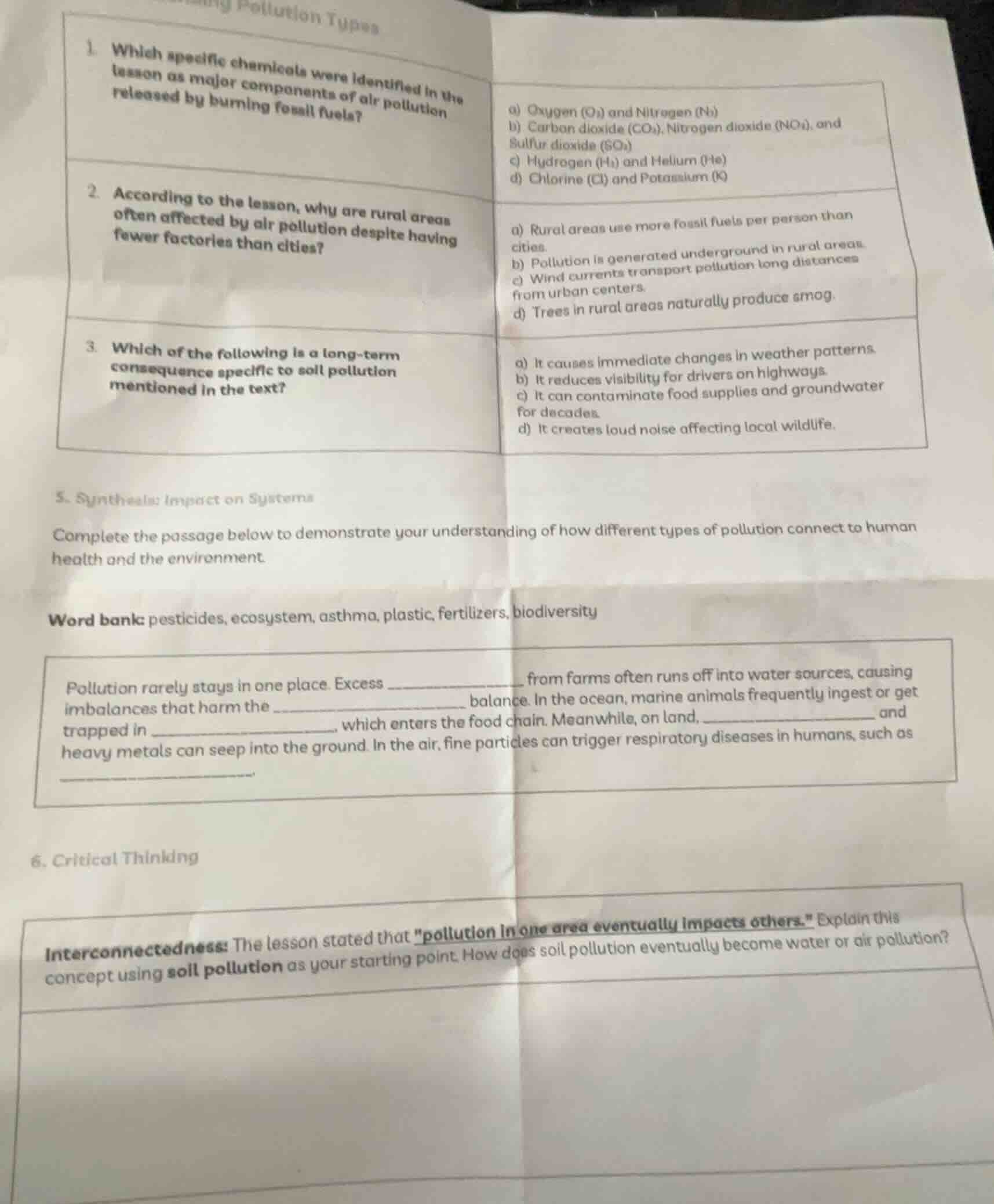
pollution types
- which specific chemicals were identified in the lesson as major components of air pollution released by burning fossil fuels?
a) oxygen (o₂) and nitrogen (n₂)
b) carbon dioxide (co₂), nitrogen dioxide (no₂), and sulfur dioxide (so₂)
c) hydrogen (h₂) and helium (he)
d) chlorine (cl) and potassium (k)
- according to the lesson, why are rural areas often affected by air pollution despite having fewer factories than cities?
a) rural areas use more fossil fuels per person than cities.
b) pollution is generated underground in rural areas.
c) wind currents transport pollution long distances from urban centers.
d) trees in rural areas naturally produce smog.
- which of the following is a long - term consequence specific to soil pollution mentioned in the text?
a) it causes immediate changes in weather patterns.
b) it reduces visibility for drivers on highways.
c) it can contaminate food supplies and groundwater for decades.
d) it creates loud noise affecting local wildlife.
- synthesize impact on systems
complete the passage below to demonstrate your understanding of how different types of pollution connect to human health and the environment.
word bank: pesticides, ecosystem, asthma, plastic, fertilizers, biodiversity
pollution rarely stays in one place. excess ______ from farms often runs off into water sources, causing imbalances that harm the ____ balance. in the ocean, marine animals frequently ingest or get trapped in ____, which enters the food chain. meanwhile, on land, ____ and heavy metals can seep into the ground. in the air, fine particles can trigger respiratory diseases in humans, such as ______.
- critical thinking
interconnectedness: the lesson stated that \pollution in one area eventually impacts others.\ explain this concept using soil pollution as your starting point. how does soil pollution eventually become water or air pollution?
Question 1
Burning fossil fuels releases greenhouse gases and pollutants. Oxygen and nitrogen are major air components, not pollutants from fossil fuel burning. Hydrogen and helium are not major pollutants here. Chlorine and potassium are not typical fossil fuel pollutants. Carbon dioxide, nitrogen dioxide, and sulfur dioxide are known pollutants from fossil fuel combustion.
Rural areas have fewer factories, so option a is wrong. Pollution isn't generated underground in rural areas (option b is wrong). Trees don't produce smog (option d is wrong). Wind can carry pollution from urban to rural areas, so option c is correct.
Soil pollution's long - term effects: Immediate weather changes (a) are not soil - pollution related. Reduced visibility (b) is air - pollution related. Loud noise (d) is noise pollution. Contaminating food and groundwater for decades is a long - term soil pollution consequence, so option c is correct.

Snap & solve any problem in the app
Get step-by-step solutions on Sovi AI
Photo-based solutions with guided steps
Explore more problems and detailed explanations
b) Carbon dioxide ($\ce{CO_2}$), Nitrogen dioxide ($\ce{NO_2}$), and Sulfur dioxide ($\ce{SO_2}$)