QUESTION IMAGE
Question
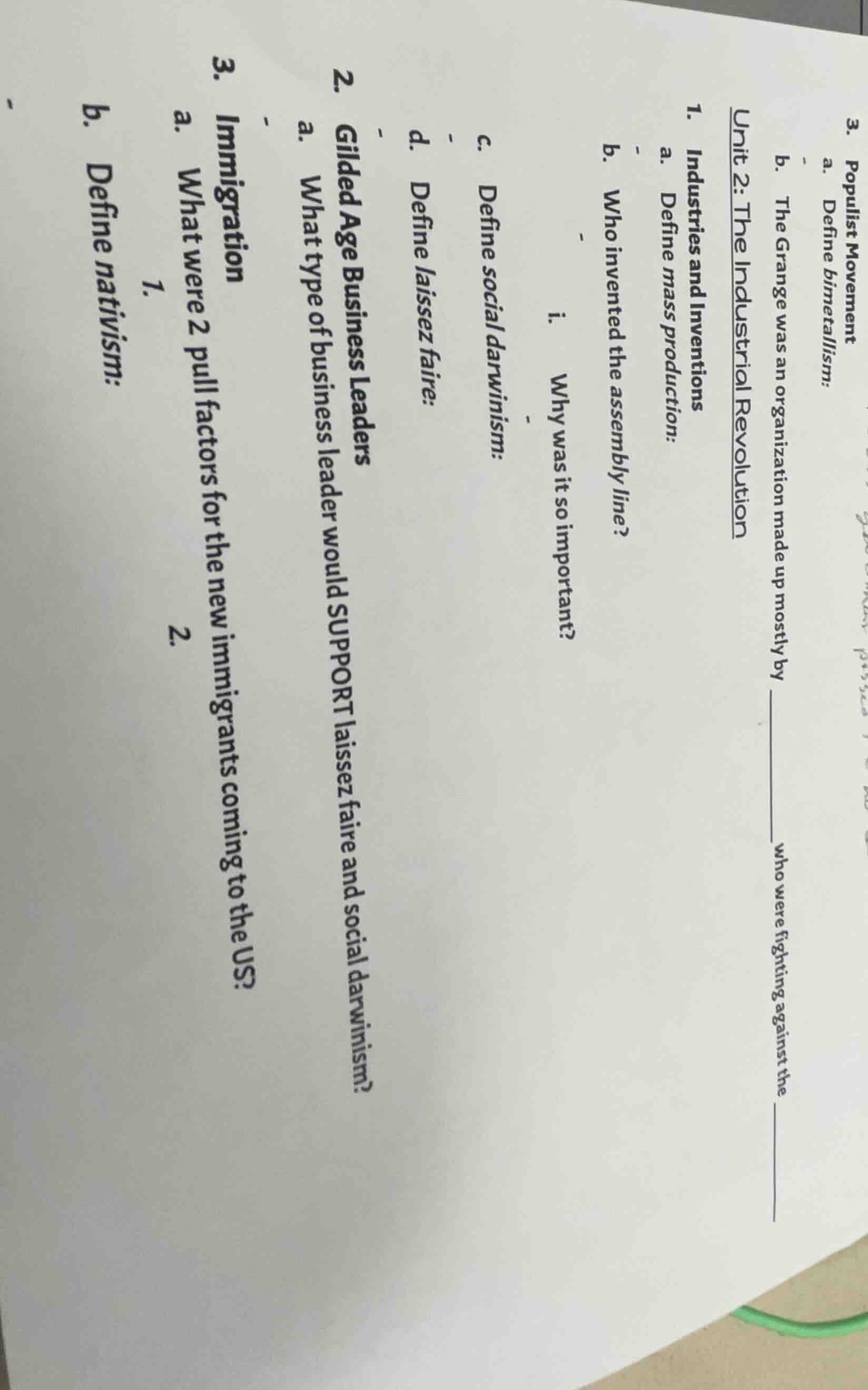
- populist movement
a. define bimetallism:
b. the grange was an organization made up mostly by ____ who were fighting against the ____
unit 2: the industrial revolution
- industries and inventions
a. define mass production:
b. who invented the assembly line?
i. why was it so important?
c. define social darwinism:
d. define laissez faire:
- gilded age business leaders
a. what type of business leader would support laissez faire and social darwinism?
- immigration
1.
a. what were 2 pull factors for the new immigrants coming to the us?
2.
b. define nativism:
3. Populist Movement
a. Bimetallism is a monetary system where a country's currency is backed by and can be exchanged for both gold and silver at fixed legal ratios.
b. The Grange was an organization made up mostly by farmers who were fighting against the railroad and grain elevator companies (and unfair economic practices by these corporate entities).
1. Industries and Inventions
a. Mass production is a manufacturing method that uses standardized parts and efficient processes to produce large quantities of goods at low cost.
b. Henry Ford invented the modern assembly line for automobile production.
i. The assembly line drastically reduced production time and labor costs, making consumer goods (like cars) more affordable and accessible; it also revolutionized manufacturing globally by enabling large-scale, efficient production.
c. Social darwinism is the application of Charles Darwin's "survival of the fittest" theory to human societies, arguing that wealthy, powerful groups are "naturally" superior and that government intervention to help the poor is counterproductive.
d. Laissez faire is an economic and political ideology that advocates for minimal government intervention in the economy, letting free markets and private businesses operate without regulation.
2. Gilded Age Business Leaders
a. Robber barons (business leaders who prioritized profit over worker welfare and used unethical, exploitative tactics) would support laissez faire and social darwinism. Laissez faire allowed them to operate without regulations that would limit their power or profits, while social darwinism provided a pseudo-moral justification for their wealth and the poverty of workers, framing their success as "natural superiority."
3. Immigration
a. Two pull factors for new immigrants to the US:
- Economic opportunity: Abundant jobs in growing factories, mines, and agriculture that paid more than work in their home countries.
- Political/religious freedom: Escape from political persecution, war, or religious discrimination in their native nations.
b. Nativism is a political ideology and movement that favors native-born citizens over immigrants, often advocating for restrictions on immigration and discriminatory policies against immigrant groups.

Snap & solve any problem in the app
Get step-by-step solutions on Sovi AI
Photo-based solutions with guided steps
Explore more problems and detailed explanations
3. Populist Movement
a. Bimetallism is a monetary system backing currency with fixed gold/silver ratios, allowing exchange for either metal.
b. farmers; railroad and grain elevator companies
1. Industries and Inventions
a. Mass production is large-scale, low-cost manufacturing via standardized parts and efficient workflows.
b. Henry Ford
i. It cut production time/costs, making goods affordable, and revolutionized global manufacturing.
c. Social darwinism applies "survival of the fittest" to societies, justifying wealth inequality and opposing aid for the poor.
d. Laissez faire is a policy of minimal government interference in free markets and business.
2. Gilded Age Business Leaders
a. Robber barons (exploitative, profit-focused business leaders) would support these ideas.
3. Immigration
a. 1. Economic opportunity (higher-paying jobs)
- Political/religious freedom (escape persecution)
b. Nativism is favoring native-born citizens over immigrants, often with anti-immigrant policies.