QUESTION IMAGE
Question
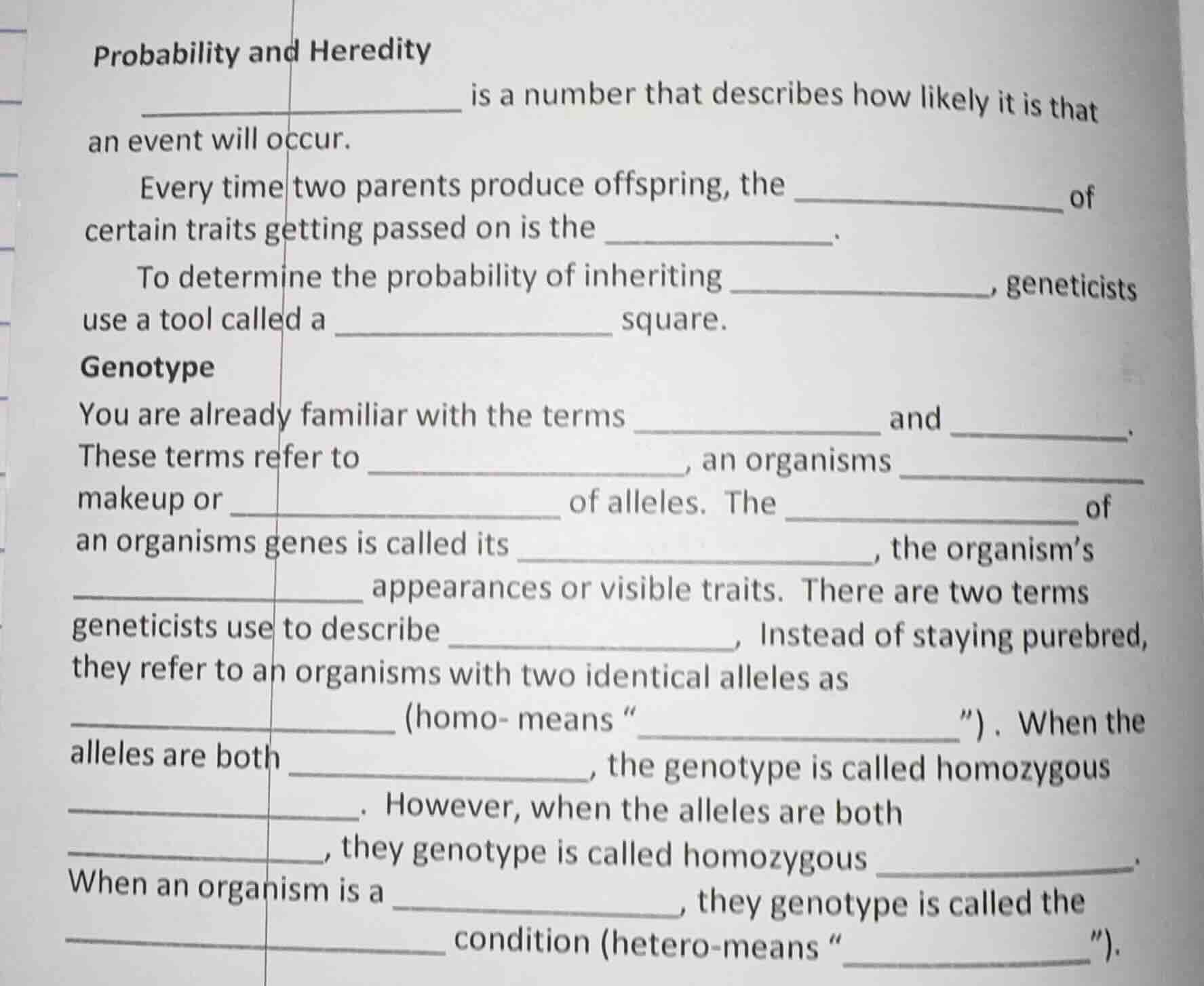
probability and heredity
__________ is a number that describes how likely it is that an event will occur.
every time two parents produce offspring, the ________ of certain traits getting passed on is the ________.
to determine the probability of inheriting ________, geneticists use a tool called a ________ square.
genotype
you are already familiar with the terms ________ and ______. these terms refer to ______, an organisms ______ makeup or ______ of alleles. the ______ of an organisms genes is called its ______, the organism’s ______ appearances or visible traits. there are two terms geneticists use to describe ______, instead of staying purebred, they refer to an organisms with two identical alleles as ______ (homo- means “______”). when the alleles are both ______, the genotype is called homozygous ______. however, when the alleles are both ______, they genotype is called homozygous ______. when an organism is a ______, they genotype is called the ______ condition (hetero-means “________”).
Filling the Blanks (Probability and Heredity Section)
First Paragraph:
- The first blank: Probability (by definition, probability quantifies the likelihood of an event).
- Second sentence:
- First blank: chance (describes the likelihood of traits being passed).
- Second blank: probability (reiterates the concept of likelihood in heredity).
Second Paragraph:
- First blank: a particular trait (geneticists calculate probability for specific inherited traits).
- Second blank: Punnett (Punnett square is the standard tool for genetic probability analysis).
Genotype Section:
- First two blanks: dominant and recessive (basic allele types familiar in genetics).
- Third blank: genotype (defines the term for allele combination).
- Fourth blank: genetic (describes the "makeup" as genetic in nature).
- Fifth blank: combination (genotype is the combination of alleles).
- Sixth blank: expression (how genes are expressed).
- Seventh blank: phenotype (phenotype is the visible trait from gene expression).
- Eighth blank: physical (phenotype relates to physical appearance).
- Ninth blank: genotypes (refers to the types of allele combinations).
- Tenth blank: homozygous (organism with two identical alleles).
- Eleventh blank: same (meaning of "homo-").
- Twelfth blank: dominant (one allele type for homozygous).
- Thirteenth blank: dominant (completes homozygous dominant).
- Fourteenth blank: recessive (other allele type for homozygous).
- Fifteenth blank: recessive (completes homozygous recessive).
- Sixteenth blank: hybrid (organism with mixed alleles).
- Seventeenth blank: heterozygous (condition for mixed alleles).
- Eighteenth blank: different (meaning of "hetero-").
Final Answers (Key Blanks):
- Probability
- chance; probability
- a particular trait; Punnett
- dominant; recessive; genotype; genetic; combination; expression; phenotype; physical; genotypes; homozygous; same; dominant; dominant; recessive; recessive; hybrid; heterozygous; different
(Note: For clarity, the most critical blanks (e.g., core concepts) are highlighted here. The full text’s blanks follow standard genetics terminology as above.)

Snap & solve any problem in the app
Get step-by-step solutions on Sovi AI
Photo-based solutions with guided steps
Explore more problems and detailed explanations
Filling the Blanks (Probability and Heredity Section)
First Paragraph:
- The first blank: Probability (by definition, probability quantifies the likelihood of an event).
- Second sentence:
- First blank: chance (describes the likelihood of traits being passed).
- Second blank: probability (reiterates the concept of likelihood in heredity).
Second Paragraph:
- First blank: a particular trait (geneticists calculate probability for specific inherited traits).
- Second blank: Punnett (Punnett square is the standard tool for genetic probability analysis).
Genotype Section:
- First two blanks: dominant and recessive (basic allele types familiar in genetics).
- Third blank: genotype (defines the term for allele combination).
- Fourth blank: genetic (describes the "makeup" as genetic in nature).
- Fifth blank: combination (genotype is the combination of alleles).
- Sixth blank: expression (how genes are expressed).
- Seventh blank: phenotype (phenotype is the visible trait from gene expression).
- Eighth blank: physical (phenotype relates to physical appearance).
- Ninth blank: genotypes (refers to the types of allele combinations).
- Tenth blank: homozygous (organism with two identical alleles).
- Eleventh blank: same (meaning of "homo-").
- Twelfth blank: dominant (one allele type for homozygous).
- Thirteenth blank: dominant (completes homozygous dominant).
- Fourteenth blank: recessive (other allele type for homozygous).
- Fifteenth blank: recessive (completes homozygous recessive).
- Sixteenth blank: hybrid (organism with mixed alleles).
- Seventeenth blank: heterozygous (condition for mixed alleles).
- Eighteenth blank: different (meaning of "hetero-").
Final Answers (Key Blanks):
- Probability
- chance; probability
- a particular trait; Punnett
- dominant; recessive; genotype; genetic; combination; expression; phenotype; physical; genotypes; homozygous; same; dominant; dominant; recessive; recessive; hybrid; heterozygous; different
(Note: For clarity, the most critical blanks (e.g., core concepts) are highlighted here. The full text’s blanks follow standard genetics terminology as above.)