QUESTION IMAGE
Question
properties and order of operations formative assessment
for each situation, two expressions are set equal to one another. determine if the
situation is true or false. for false statements, rewrite one of the expressions to make
the situation true.
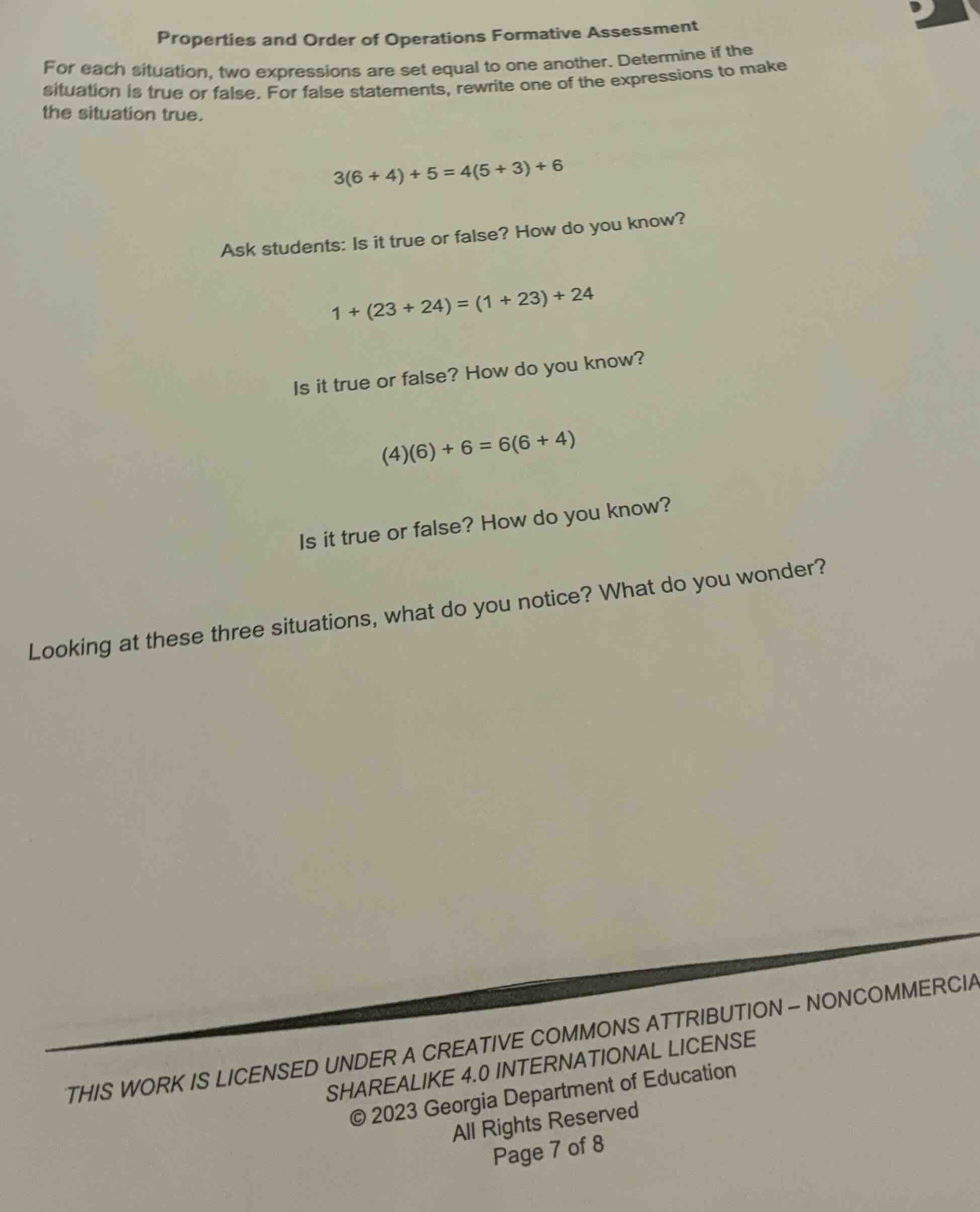
( 3(6 + 4) + 5 = 4(5 + 3) + 6 )
ask students: is it true or false? how do you know?
( 1 + (23 + 24) = (1 + 23) + 24 )
is it true or false? how do you know?
( (4)(6) + 6 = 6(6 + 4) )
is it true or false? how do you know?
looking at these three situations, what do you notice? what do you wonder?
this work is licensed under a creative commons attribution – noncommercia
sharealike 4.0 international license
© 2023 georgia department of education
all rights reserved
page 7 of 8
Step1: Evaluate left side of first equation
$3(6+4)+5 = 3(10)+5 = 30+5 = 35$
Step2: Evaluate right side of first equation
$4(5+3)+6 = 4(8)+6 = 32+6 = 38$
Step3: Compare first equation results
$35
eq 38$, so false. Adjust to make true: $3(6+4)+8 = 4(5+3)+6$ (or other valid rewrite)
Step4: Evaluate left side of second equation
$1+(23+24) = 1+47 = 48$
Step5: Evaluate right side of second equation
$(1+23)+24 = 24+24 = 48$
Step6: Compare second equation results
$48 = 48$, so true (Associative Property of Addition)
Step7: Evaluate left side of third equation
$(4)(6)+6 = 24+6 = 30$
Step8: Evaluate right side of third equation
$6(6+4) = 6(10) = 60$
Step9: Compare third equation results
$30
eq 60$, so false. Adjust to make true: $(4)(6)+6 = 6(1+4)$ (or other valid rewrite)
Step10: Analyze patterns across equations
Notice: True equation uses associative property; false equations have mismatched arithmetic results. Wonder: How properties guarantee equality, or how small changes affect truth value.

Snap & solve any problem in the app
Get step-by-step solutions on Sovi AI
Photo-based solutions with guided steps
Explore more problems and detailed explanations
- $3(6 + 4) + 5 = 4(5 + 3) + 6$: False. Left side = 35, right side = 38. A valid rewrite to make it true: $3(6 + 4) + 8 = 4(5 + 3) + 6$
- $1 + (23 + 24) = (1 + 23) + 24$: True. Both sides equal 48, this follows the Associative Property of Addition (grouping of addends does not change the sum).
- $(4)(6) + 6 = 6(6 + 4)$: False. Left side = 30, right side = 60. A valid rewrite to make it true: $(4)(6) + 6 = 6(1 + 4)$
- Notice: The only true statement uses a fundamental addition property, while the false ones have unequal calculated values on each side. Wonder: How mathematical properties can quickly confirm equality without full calculation, or how to systematically adjust false equations to make them true while preserving structure.