QUESTION IMAGE
Question
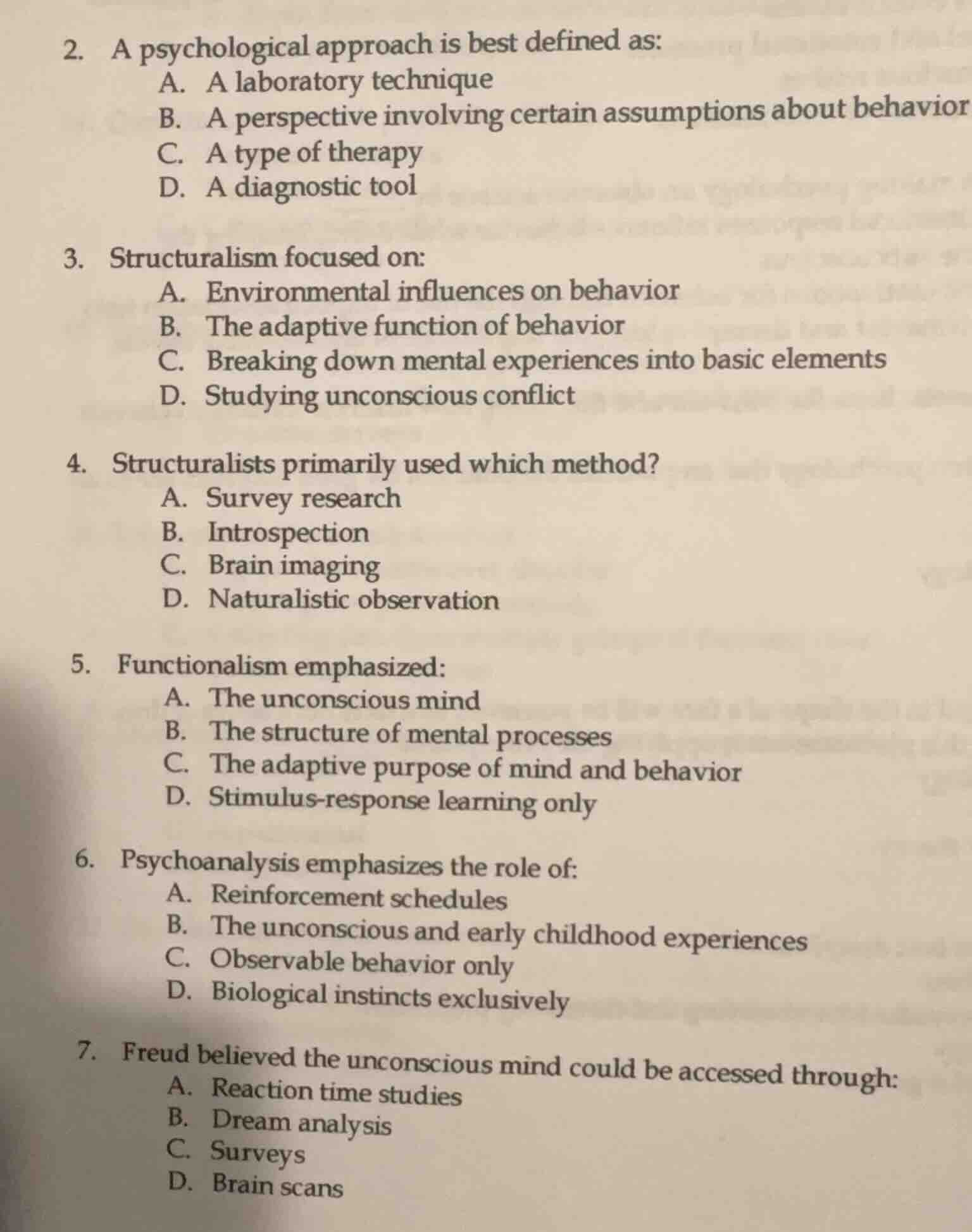
- a psychological approach is best defined as:
a. a laboratory technique
b. a perspective involving certain assumptions about behavior
c. a type of therapy
d. a diagnostic tool
- structuralism focused on:
a. environmental influences on behavior
b. the adaptive function of behavior
c. breaking down mental experiences into basic elements
d. studying unconscious conflict
- structuralists primarily used which method?
a. survey research
b. introspection
c. brain imaging
d. naturalistic observation
- functionalism emphasized:
a. the unconscious mind
b. the structure of mental processes
c. the adaptive purpose of mind and behavior
d. stimulus - response learning only
- psychoanalysis emphasizes the role of:
a. reinforcement schedules
b. the unconscious and early childhood experiences
c. observable behavior only
d. biological instincts exclusively
- freud believed the unconscious mind could be accessed through:
a. reaction time studies
b. dream analysis
c. surveys
d. brain scans
- A psychological approach is a framework with assumptions about behavior, not just a tool, therapy, or lab technique.
- Structuralism's core goal was to decompose mental experiences into fundamental components.
- Introspection (systematic self-observation) was the primary method of structuralists.
- Functionalism focused on how mental processes and behaviors help organisms adapt to their environments.
- Psychoanalysis, founded by Freud, centers on unconscious drives and early childhood experiences shaping behavior.
- Freud proposed dream analysis as a key method to access the unconscious mind, as dreams reveal hidden thoughts.

Snap & solve any problem in the app
Get step-by-step solutions on Sovi AI
Photo-based solutions with guided steps
Explore more problems and detailed explanations
- B. A perspective involving certain assumptions about behavior
- C. Breaking down mental experiences into basic elements
- B. Introspection
- C. The adaptive purpose of mind and behavior
- B. The unconscious and early childhood experiences
- B. Dream analysis