QUESTION IMAGE
Question
pulation distribution
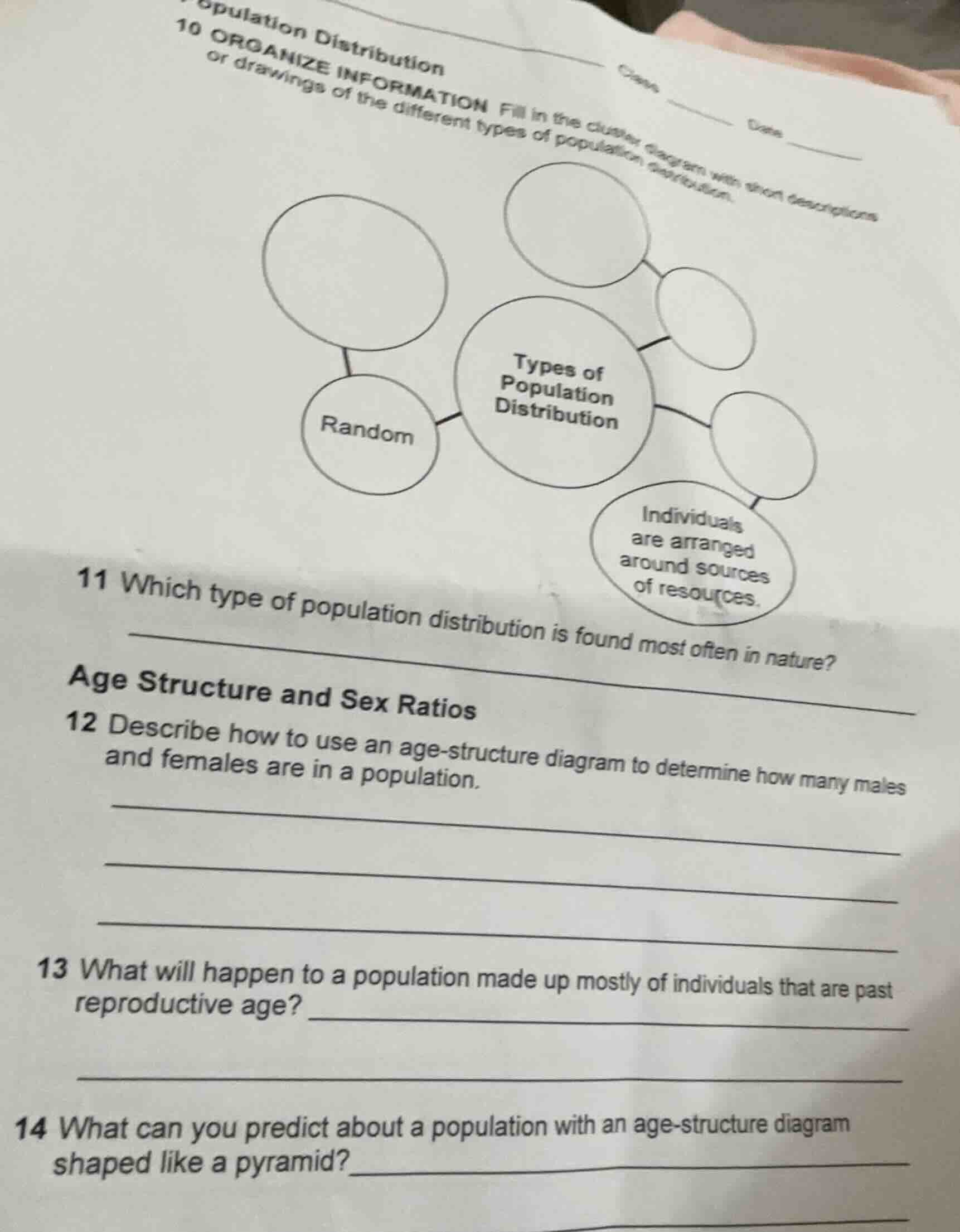
10 organize information fill in the cluster diagram with short descriptions or drawings of the different types of population distribution.
11 which type of population distribution is found most often in nature?
age structure and sex ratios
12 describe how to use an age - structure diagram to determine how many males and females are in a population.
13 what will happen to a population made up mostly of individuals that are past reproductive age?
14 what can you predict about a population with an age - structure diagram shaped like a pyramid?
For Question 10:
The three main types of population distribution are Random, Uniform, and Clumped. Random distribution has individuals spaced with no pattern; Uniform has evenly spaced individuals; Clumped has individuals grouped around resources.
For Question 11:
Clumped distribution is most common in nature because resources (food, water, shelter) are rarely evenly spread, so organisms cluster near these resources.
For Question 12:
Age-structure diagrams split populations by age groups, with males on one side and females on the other. Count or compare the size of the male and female segments for each age group to determine their numbers.
For Question 13:
A population with mostly post-reproductive individuals will decline over time, as there are few young individuals to replace the aging, dying members.
For Question 14:
A pyramid-shaped age-structure diagram means the population has a large number of young individuals, so it will experience rapid growth as those young individuals reach reproductive age.

Snap & solve any problem in the app
Get step-by-step solutions on Sovi AI
Photo-based solutions with guided steps
Explore more problems and detailed explanations
10.
- Random: Individuals have no regular spacing pattern.
- Uniform: Individuals are evenly spaced.
- Clumped: Individuals are arranged around sources of resources.
- Clumped distribution
- Use the diagram's split (males on one side, females on the other, grouped by age) to count or compare the size of male and female segments for each age group.
- The population size will decrease over time.
- The population will experience rapid growth in the future.