QUESTION IMAGE
Question
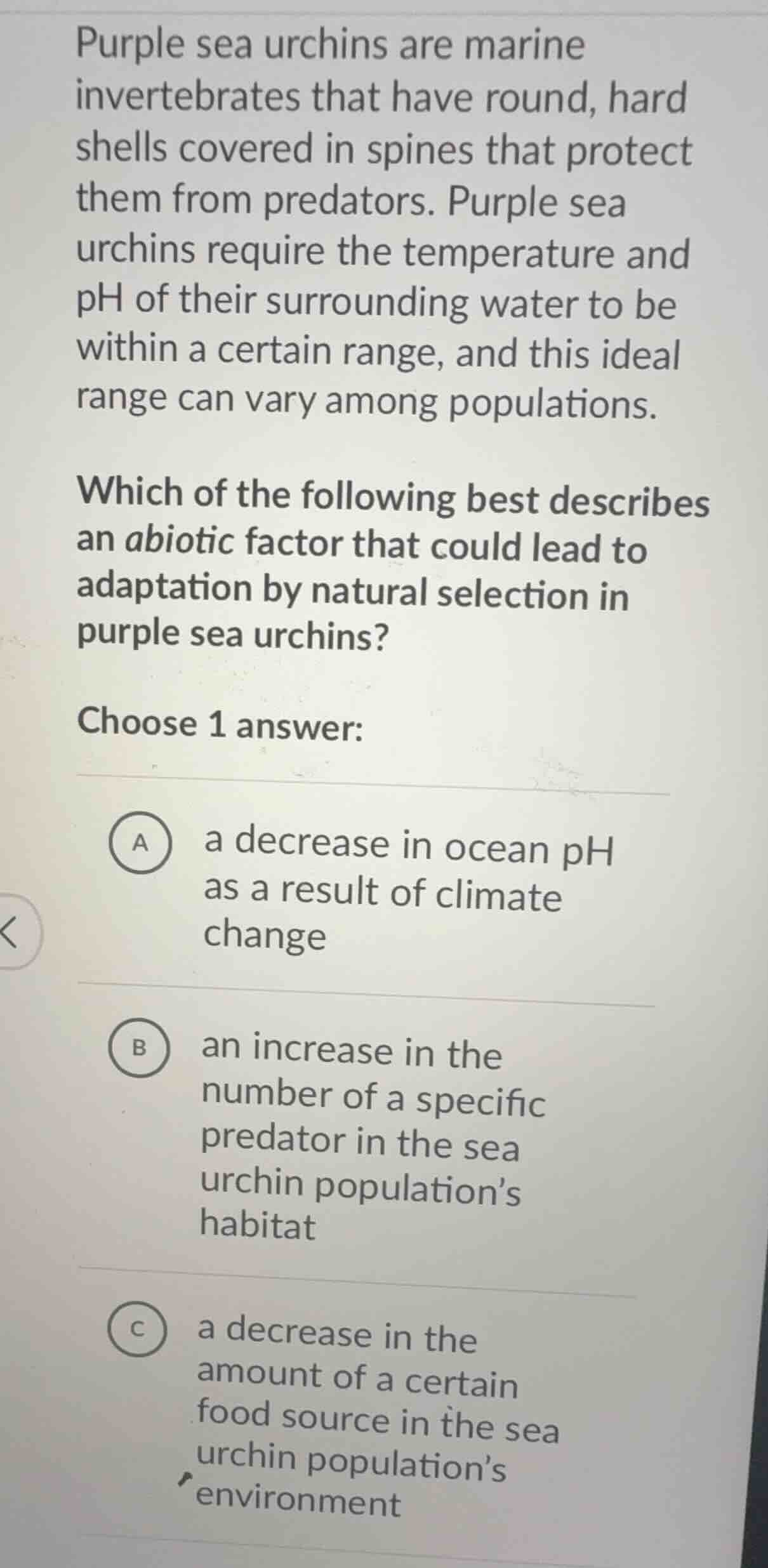
purple sea urchins are marine invertebrates that have round, hard shells covered in spines that protect them from predators. purple sea urchins require the temperature and ph of their surrounding water to be within a certain range, and this ideal range can vary among populations. which of the following best describes an abiotic factor that could lead to adaptation by natural selection in purple sea urchins? choose 1 answer: a a decrease in ocean ph as a result of climate change b an increase in the number of a specific predator in the sea urchin population’s habitat c a decrease in the amount of a certain food source in the sea urchin population’s environment
- First, recall the definition of an abiotic factor: non - living components of an ecosystem (like temperature, pH, water availability, etc.). Biotic factors are living or once - living components (like predators, food sources which are organisms or products of organisms).
- Analyze Option A: Ocean pH is a non - living (abiotic) component of the sea urchin's environment. A decrease in ocean pH due to climate change is an abiotic change. If the pH goes out of the ideal range for purple sea urchins, those with genetic traits that allow them to survive better in the new pH range will be more likely to reproduce (natural selection), leading to adaptation.
- Analyze Option B: A predator is a living organism, so an increase in the number of predators is a biotic factor, not abiotic.
- Analyze Option C: A food source (even if it's a decrease) is related to living organisms (the food source is likely a plant or animal), so it is a biotic factor, not abiotic.

Snap & solve any problem in the app
Get step-by-step solutions on Sovi AI
Photo-based solutions with guided steps
Explore more problems and detailed explanations
A. a decrease in ocean pH as a result of climate change