QUESTION IMAGE
Question
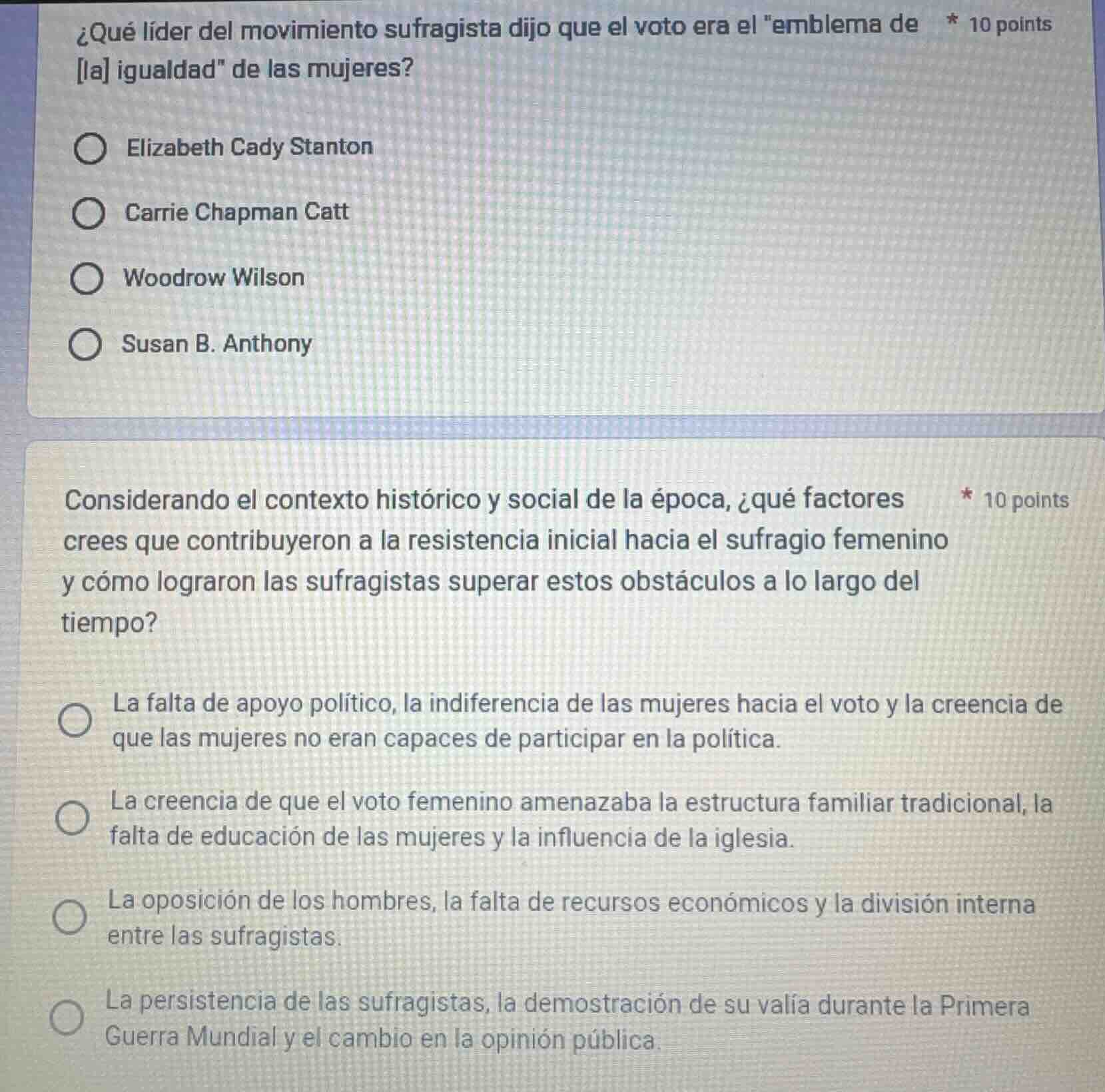
¿qué líder del movimiento sufragista dijo que el voto era el \emblema de la igualdad\ de las mujeres?
- 10 points
elizabeth cady stanton
carrie chapman catt
woodrow wilson
susan b. anthony
considerando el contexto histórico y social de la época, ¿qué factores crees que contribuyeron a la resistencia inicial hacia el sufragio femenino y cómo lograron las sufragistas superar estos obstáculos a lo largo del tiempo?
- 10 points
la falta de apoyo político, la indiferencia de las mujeres hacia el voto y la creencia de que las mujeres no eran capaces de participar en la política.
la creencia de que el voto femenino amenazaba la estructura familiar tradicional, la falta de educación de las mujeres y la influencia de la iglesia.
la oposición de los hombres, la falta de recursos económicos y la división interna entre las sufragistas.
la persistencia de las sufragistas, la demostración de su valía durante la primera guerra mundial y el cambio en la opinión pública.
First Question (Multiple Choice)
To answer this, we recall the suffragist leaders' quotes. Elizabeth Cady Stanton was a key suffragist, and the quote about the vote being the "emblem of equality" for women is attributed to her. Carrie Chapman Catt focused on organizing, Woodrow Wilson was a U.S. president (not a suffragist leader in the same way), and Susan B. Anthony was more known for her activism like voting illegally.
We analyze each option:
- First option: "Indifference of women" is inaccurate as many women fought for suffrage.
- Second option: "Lack of women's education" was a factor, but the main resistance factors included traditional family structure concerns, church influence, and the idea women couldn't participate in politics. However, the option's framing: the resistance factors here (threat to family, lack of education, church influence) and how suffragists overcame? Wait, no—wait, the question is about factors contributing to initial resistance and how they overcame. Wait, no, the options are for the factors and overcoming? Wait, no, the second question's options: let's re - examine. Wait, the second question is a multiple - choice about factors of resistance and how they overcame? Wait, no, the options are presented as possible answers. Wait, the correct analysis: The second option: "La creencia de que el voto femenino amenazaba la estructura familiar tradicional, la falta de educación de las mujeres y la influencia de la iglesia" — traditional gender roles saw women as family - centered, lack of education limited women's political voice, and the church often upheld traditional gender norms, all contributing to resistance. And over time, suffragists educated women, challenged church - based arguments, and showed women's capability. Wait, no, wait the options are for the factors of resistance and the way to overcome? Wait, no, the question is "¿qué factores crees que contribuyeron a la resistencia inicial hacia el sufragio femenino y cómo lograron las sufragistas superar estos obstáculos a lo largo del tiempo?" and the options are the possible answers. Wait, the second option's factors (threat to family, lack of education, church influence) are valid resistance factors, and the way to overcome: educating women, challenging religious - based opposition, and demonstrating women's competence. But wait, let's check the other options:
- Third option: "Opposition of men" is too broad, "lack of economic resources" was not the main resistance factor, and "division among suffragists" was a factor but not the main initial resistance.
- Fourth option: "Persistence of suffragists, their valor in WWI, and public opinion change" are the ways they overcame, not the initial resistance factors.
- First option: "Indifference of women" is wrong.
So the correct option is the second one: "La creencia de que el voto femenino amenazaba la estructura familiar tradicional, la falta de educación de las mujeres y la influencia de la iglesia"

Snap & solve any problem in the app
Get step-by-step solutions on Sovi AI
Photo-based solutions with guided steps
Explore more problems and detailed explanations
A. Elizabeth Cady Stanton