QUESTION IMAGE
Question
question 5 of 10
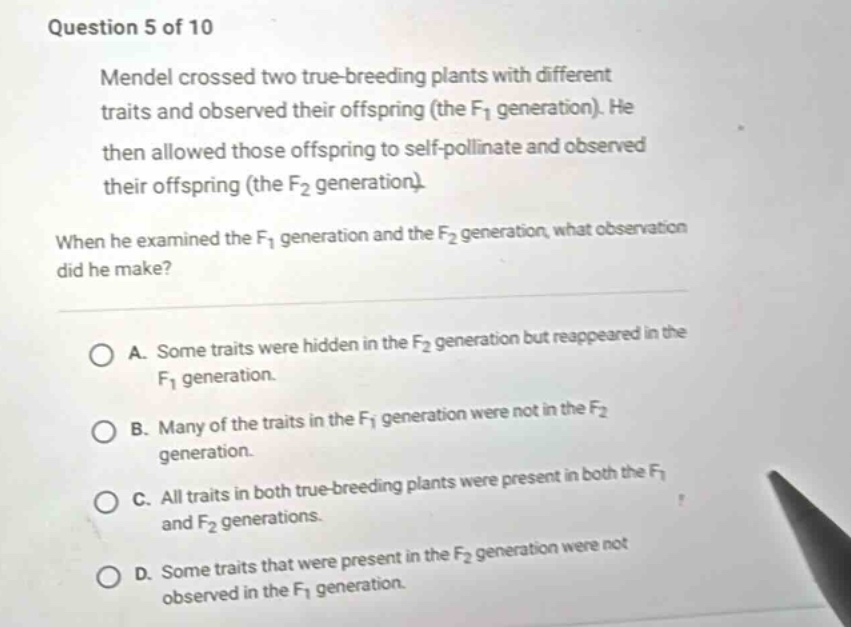
mendel crossed two true - breeding plants with different
traits and observed their offspring (the f₁ generation). he
then allowed those offspring to self - pollinate and observed
their offspring (the f₂ generation).
when he examined the f₁ generation and the f₂ generation, what observation
did he make?
a. some traits were hidden in the f₂ generation but reappeared in the
f₁ generation.
b. many of the traits in the f₁ generation were not in the f₂
generation.
c. all traits in both true - breeding plants were present in both the f₁
and f₂ generations.
d. some traits that were present in the f₂ generation were not
observed in the f₁ generation.
Mendel's experiments: True - breeding parents (P generation) with different traits (e.g., tall and short pea plants) are crossed. The F₁ generation shows only the dominant trait (all tall, if tall is dominant). When F₁ self - pollinates, in the F₂ generation, the recessive trait (short) reappears.
- Option A: Traits hidden in F₁ would reappear in F₂, but A says hidden in F₂ and reappear in F₁, which is wrong.
- Option B: Traits from F₁ are in F₂ (with new combinations), so B is wrong.
- Option C: Recessive traits from parents are not in F₁, so C is wrong.
- Option D: Recessive traits (present in F₂) were not seen in F₁ (since F₁ shows dominant trait), so D matches the observation.

Snap & solve any problem in the app
Get step-by-step solutions on Sovi AI
Photo-based solutions with guided steps
Explore more problems and detailed explanations
D. Some traits that were present in the \( F_2 \) generation were not observed in the \( F_1 \) generation.