QUESTION IMAGE
Question
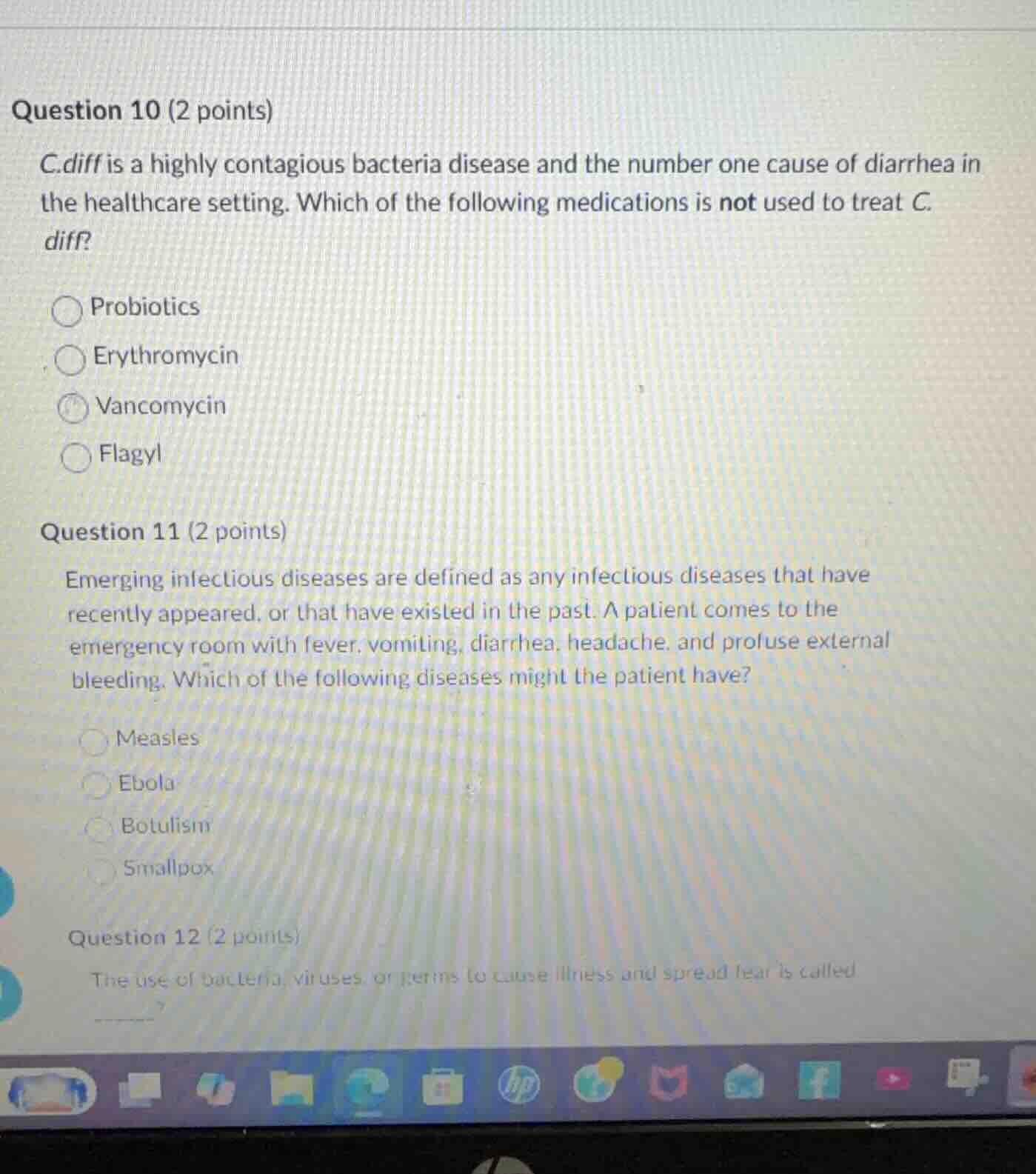
question 10 (2 points)
c.diff is a highly contagious bacteria disease and the number one cause of diarrhea in the healthcare setting. which of the following medications is not used to treat c. diff?
probiotics
erythromycin
vancomycin
flagyl
question 11 (2 points)
emerging infectious diseases are defined as any infectious diseases that have recently appeared, or that have existed in the past. a patient comes to the emergency room with fever, vomiting, diarrhea, headache, and profuse external bleeding. which of the following diseases might the patient have?
measles
ebola
botulism
smallpox
question 12 (2 points)
the use of bacteria, viruses, or germs to cause illness and spread fear is called ______?
Question 10
To determine which medication is not used to treat C. diff (Clostridioides difficile), we analyze each option:
- Probiotics: Sometimes used adjunctively to restore gut flora after C. diff treatment.
- Erythromycin: A macrolide antibiotic, primarily used for respiratory/skin infections, not C. diff.
- Vancomycin: A common antibiotic for treating C. diff.
- Flagyl (Metronidazole): Also used to treat C. diff.
So Erythromycin is not used for C. diff.
We match the symptoms (fever, vomiting, diarrhea, headache, profuse external bleeding) to the diseases:
- Measles: Causes rash, fever, cough, not external bleeding.
- Ebola: Causes fever, vomiting, diarrhea, and severe bleeding (internal/external) as a symptom.
- Botulism: Causes muscle weakness, paralysis, not bleeding.
- Smallpox: Causes rash, fever, not bleeding.
So the patient might have Ebola.
The use of bacteria, viruses, or germs to cause illness and spread fear is called bioterrorism (the intentional release of biological agents to harm people/instill fear).

Snap & solve any problem in the app
Get step-by-step solutions on Sovi AI
Photo-based solutions with guided steps
Explore more problems and detailed explanations
B. Erythromycin (assuming options are labeled A - D as A. Probiotics, B. Erythromycin, C. Vancomycin, D. Flagyl)