QUESTION IMAGE
Question
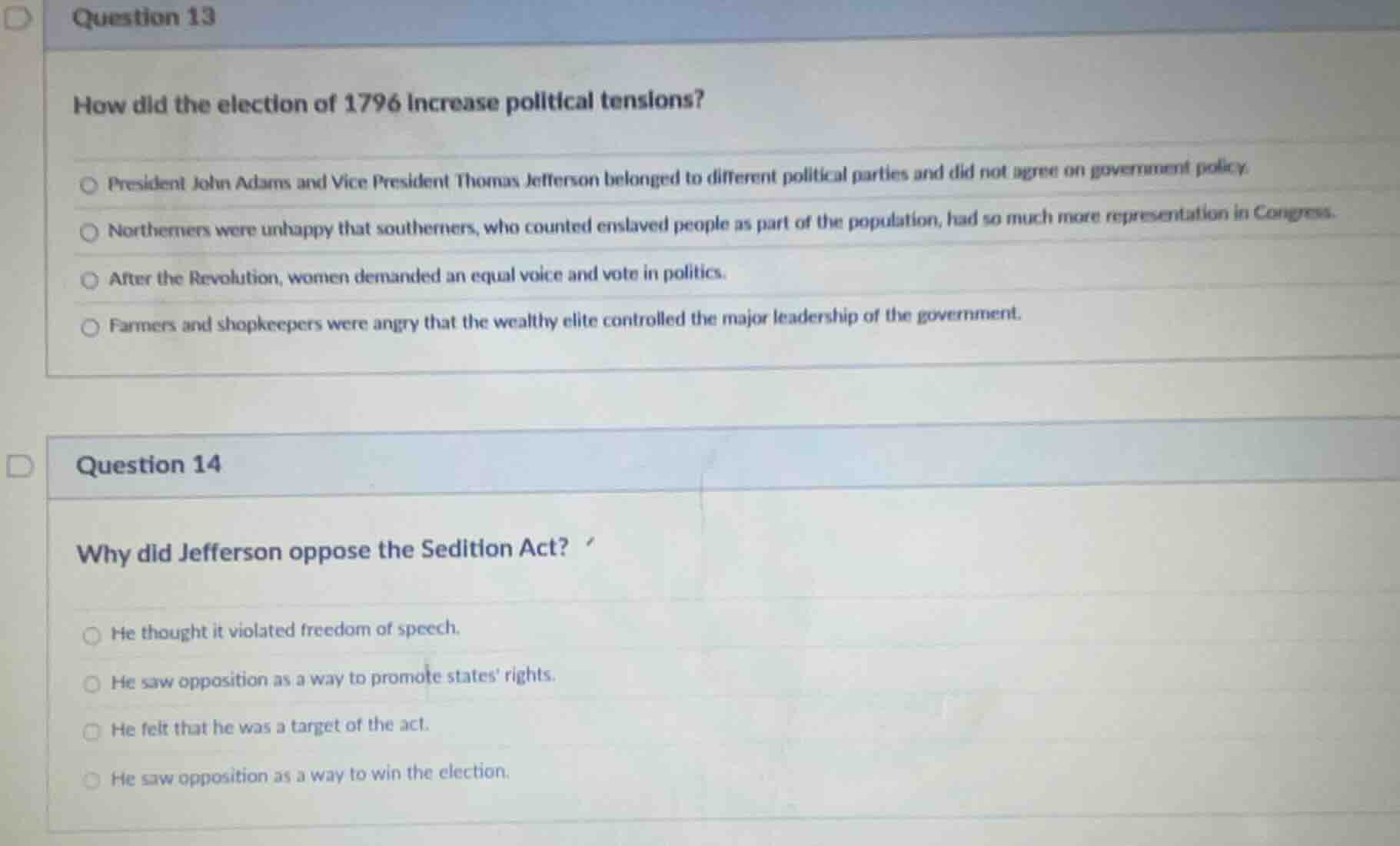
question 13
how did the election of 1796 increase political tensions?
- president john adams and vice president thomas jefferson belonged to different political parties and did not agree on government policy.
- northerners were unhappy that southerners, who counted enslaved people as part of the population, had so much more representation in congress.
- after the revolution, women demanded an equal voice and vote in politics.
- farmers and shopkeepers were angry that the wealthy elite controlled the major leadership of the government.
question 14
why did jefferson oppose the sedition act?
- he thought it violated freedom of speech.
- he saw opposition as a way to promote states rights.
- he felt that he was a target of the act.
- he saw opposition as a way to win the election.
Response
Question 13
Brief Explanations
To determine the answer, we analyze each option:
- The 1796 election resulted in John Adams (Federalist) as President and Thomas Jefferson (Democratic - Republican) as Vice - President. Their different party affiliations and policy disagreements led to political tensions.
- The issue of northerners being unhappy about southern representation due to enslaved people's counting was related to the Three - Fifths Compromise and not the 1796 election's political tensions.
- Women's demand for political voice was not a direct result of the 1796 election.
- Anger of farmers and shopkeepers about the wealthy elite's control was a more general political concern and not specific to the 1796 election's outcome.
Brief Explanations
To find the answer, we evaluate each option:
- The Sedition Act restricted speech critical of the government. Jefferson, a proponent of civil liberties, believed it violated the First Amendment's freedom of speech.
- Jefferson's opposition to the Sedition Act was not mainly about promoting states' rights through opposition.
- There is no evidence that Jefferson felt he was a target of the act.
- Jefferson's opposition was not a strategy to win an election.

Snap & solve any problem in the app
Get step-by-step solutions on Sovi AI
Photo-based solutions with guided steps
Explore more problems and detailed explanations
A. President John Adams and Vice President Thomas Jefferson belonged to different political parties and did not agree on government policy.