QUESTION IMAGE
Question
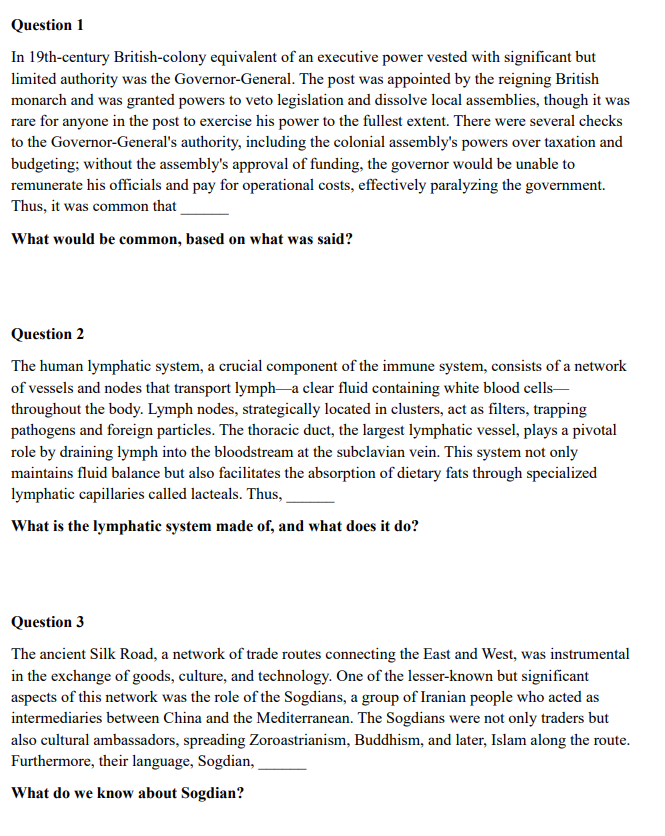
question 1
in 19th - century british - colony equivalent of an executive power vested with significant but limited authority was the governor - general. the post was appointed by the reigning british monarch and was granted powers to veto legislation and dissolve local assemblies, though it was rare for anyone in the post to exercise his power to the fullest extent. there were several checks to the governor - generals authority, including the colonial assemblys powers over taxation and budgeting; without the assemblys approval of funding, the governor would be unable to remunerate his officials and pay for operational costs, effectively paralyzing the government.
thus, it was common that ______
what would be common, based on what was said?
question 2
the human lymphatic system, a crucial component of the immune system, consists of a network of vessels and nodes that transport lymph—a clear fluid containing white blood cells—throughout the body. lymph nodes, strategically located in clusters, act as filters, trapping pathogens and foreign particles. the thoracic duct, the largest lymphatic vessel, plays a pivotal role by draining lymph into the bloodstream at the subclavian vein. this system not only maintains fluid balance but also facilitates the absorption of dietary fats through specialized lymphatic capillaries called lacteals. thus, ______
what is the lymphatic system made of, and what does it do?
question 3
the ancient silk road, a network of trade routes connecting the east and west, was instrumental in the exchange of goods, culture, and technology. one of the lesser - known but significant aspects of this network was the role of the sogdians, a group of iranian people who acted as intermediaries between china and the mediterranean. the sogdians were not only traders but also cultural ambassadors, spreading zoroastrianism, buddhism, and later, islam along the route.
furthermore, their language, sogdian, ______
what do we know about sogdian?
Question 1
The text explains the Governor - General's power and the checks on it, like the colonial assembly's control over funding. So it's common that the Governor - General would have to cooperate with the colonial assembly. Because without the assembly's approval for funding, the governor can't pay officials or operational costs, so cooperation was necessary.
The lymphatic system is made of a network of vessels and nodes. It transports lymph (containing white blood cells) throughout the body, lymph nodes filter pathogens and foreign particles, the thoracic duct drains lymph into the bloodstream, it maintains fluid balance, and it facilitates the absorption of dietary fats through lacteals.
From the text, we know that Sogdian was the language of the Sogdians, who were intermediaries between China and the Mediterranean, traders, and cultural ambassadors. The text implies that Sogdian was likely used in the trade and cultural exchange along the Silk Road, as the Sogdians spread religions (Zoroastrianism, Buddhism, Islam) along the route and were active in the Silk Road network.

Snap & solve any problem in the app
Get step-by-step solutions on Sovi AI
Photo-based solutions with guided steps
Explore more problems and detailed explanations
The Governor - General would cooperate with the colonial assembly (as the assembly's approval for funding was necessary for the governor to run the government, so cooperation was common).