QUESTION IMAGE
Question
question #5
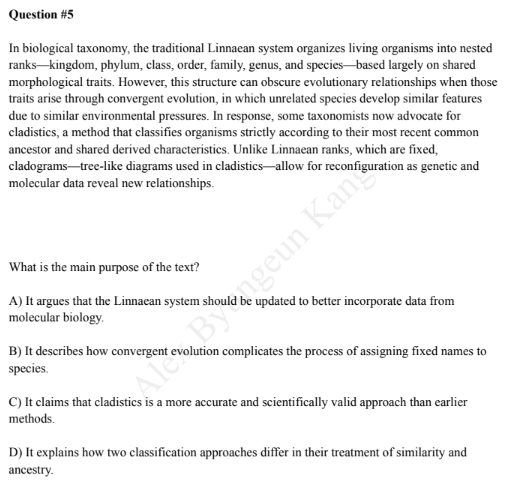
in biological taxonomy, the traditional linnaean system organizes living organisms into nested ranks—kingdom, phylum, class, order, family, genus, and species—based largely on shared morphological traits. however, this structure can obscure evolutionary relationships when those traits arise through convergent evolution, in which unrelated species develop similar features due to similar environmental pressures. in response, some taxonomists now advocate for cladistics, a method that classifies organisms strictly according to their most recent common ancestor and shared derived characteristics. unlike linnaean ranks, which are fixed, cladograms—tree - like diagrams used in cladistics—allow for reconfiguration as genetic and molecular data reveal new relationships.
what is the main purpose of the text?
a) it argues that the linnaean system should be updated to better incorporate data from molecular biology.
b) it describes how convergent evolution complicates the process of assigning fixed names to species.
c) it claims that cladistics is a more accurate and scientifically valid approach than earlier methods.
d) it explains how two classification approaches differ in their treatment of similarity and ancestry.
The text first describes the Linnaean system (fixed ranks based on shared traits, which can obscure evolution due to convergent evolution) and then cladisics (classifying by recent common ancestors and derived traits, with reconfigurable cladograms). It focuses on contrasting these two approaches' handling of similarity (shared traits vs. derived traits) and ancestry (obscured vs. central), which matches option D. Options A, B, and C are incorrect: A makes an argument not present, B only covers a complication of Linnaean system not the main purpose, C claims superiority not stated in the text.

Snap & solve any problem in the app
Get step-by-step solutions on Sovi AI
Photo-based solutions with guided steps
Explore more problems and detailed explanations
D) It explains how two classification approaches differ in their treatment of similarity and ancestry.