QUESTION IMAGE
Question
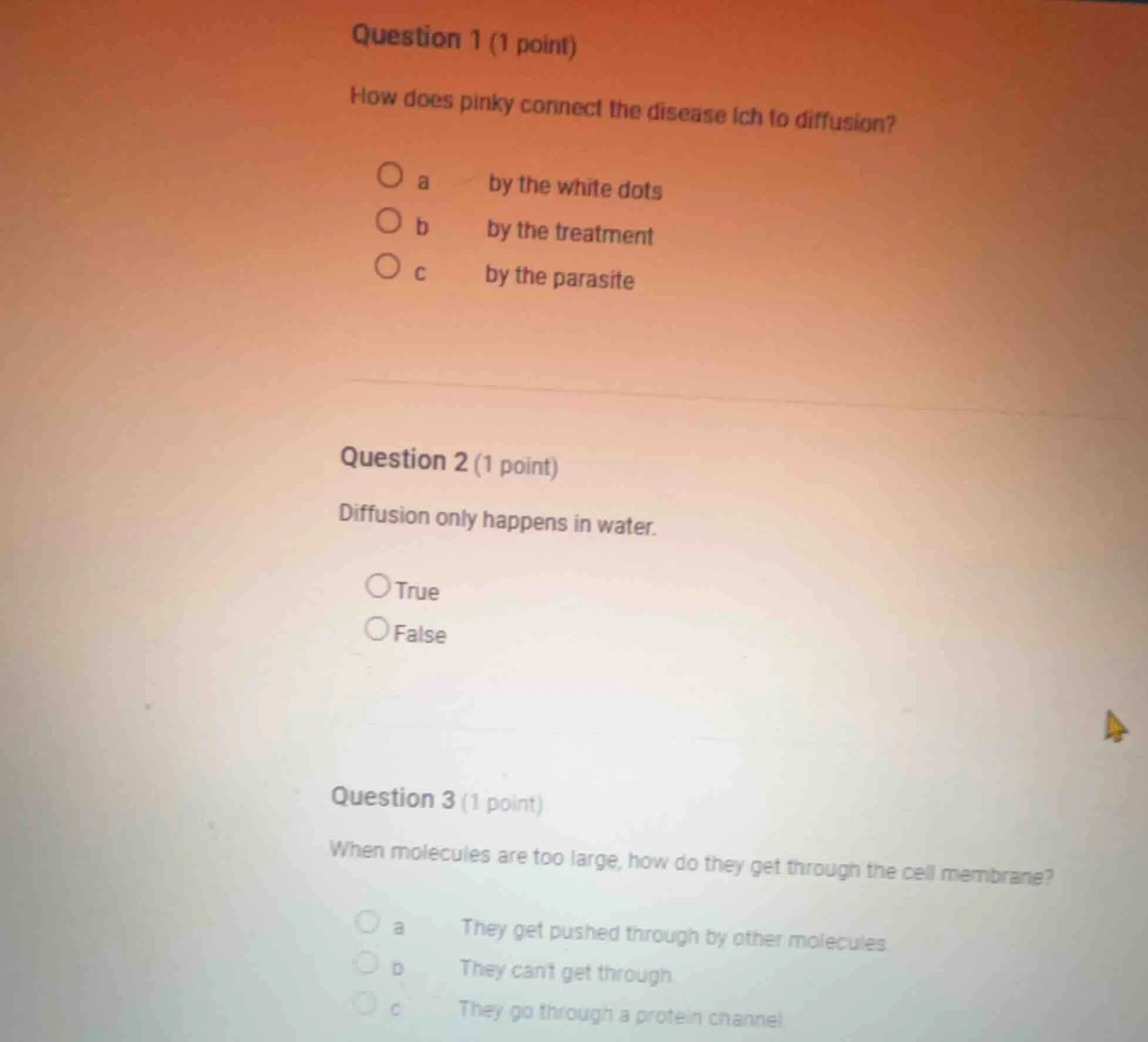
question 1 (1 point)
how does pinky connect the disease ich to diffusion?
a by the white dots
b by the treatment
c by the parasite
question 2 (1 point)
diffusion only happens in water.
true
false
question 3 (1 point)
when molecules are too large, how do they get through the cell membrane?
a they get pushed through by other molecules.
b they cant get through.
c they go through a protein channel.
Question 1
To determine the connection between the disease Ich (Ichthyophthirius, a parasitic disease) and diffusion via "pinky" (likely a context - specific term related to the parasite's spread or the mechanism of treatment/disease process), the parasite's spread or the way substances related to the disease move (diffusion - related) is considered. The parasite is the causal agent of Ich, and its spread or the movement of related molecules could be linked to diffusion. Option a (white dots) is a symptom, option b (treatment) is about curing, not the connection to diffusion. So the parasite (option c) is the relevant factor for the connection.
Diffusion is the movement of particles from an area of high concentration to low concentration. It can occur in gases (e.g., perfume spreading in air), liquids (e.g., dye in water), and even across semi - permeable membranes in solids (e.g., oxygen diffusing through a plastic film in some cases). So it is not restricted to only water. Thus, the statement "Diffusion only happens in water" is false.
Large molecules cannot pass through the cell membrane freely. Protein channels are integral membrane proteins that form pores or channels. These channels allow large molecules (like some ions, glucose in some cases) to pass through the cell membrane via facilitated diffusion. Option a is incorrect as molecules don't get "pushed" through by other molecules in this way. Option b is incorrect as large molecules can get through via protein channels. So large molecules go through a protein channel.

Snap & solve any problem in the app
Get step-by-step solutions on Sovi AI
Photo-based solutions with guided steps
Explore more problems and detailed explanations
c. by the parasite