QUESTION IMAGE
Question
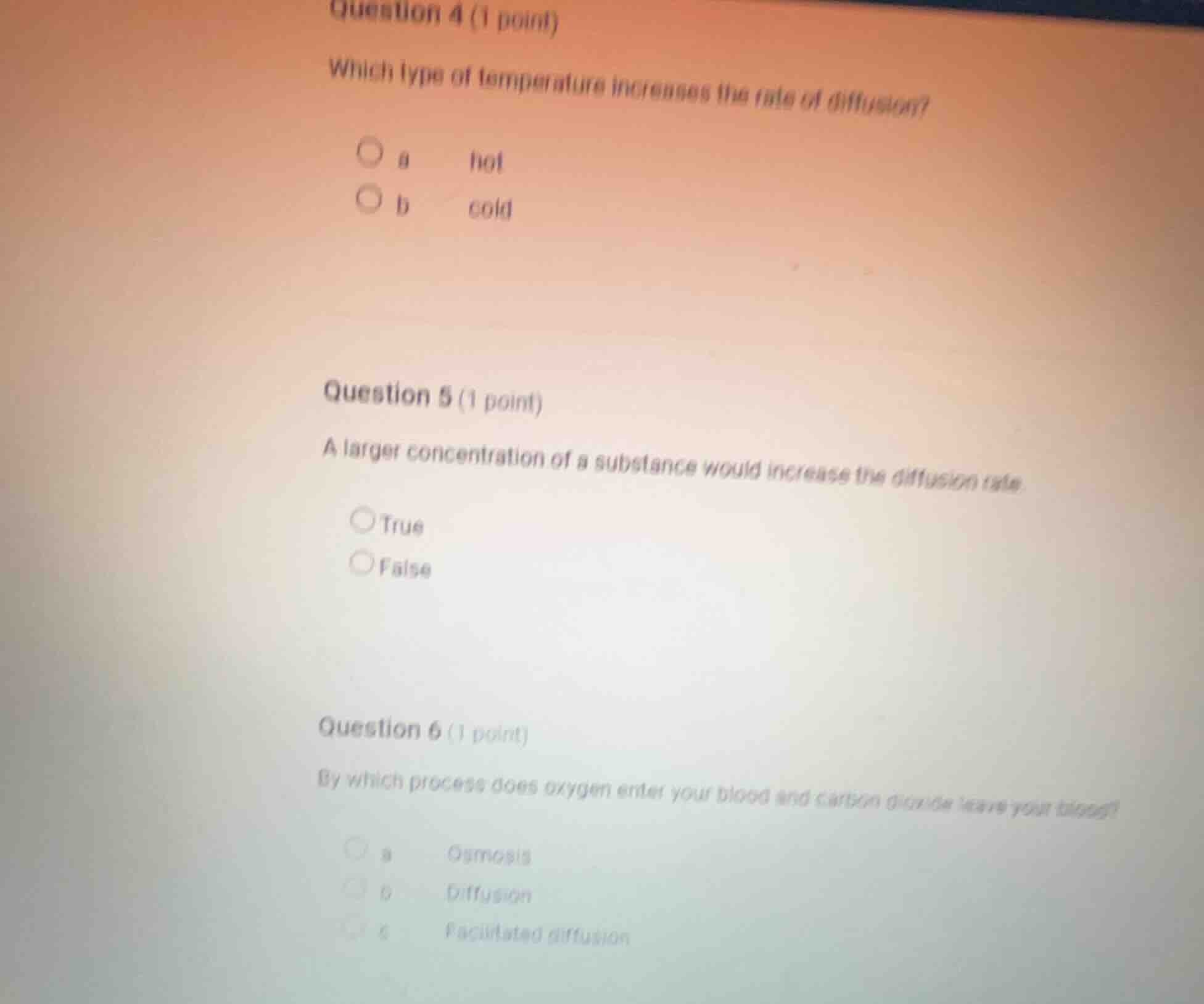
question 4 (1 point)
which type of temperature increases the rate of diffusion?
a hot
b cold
question 5 (1 point)
a larger concentration of a substance would increase the diffusion rate.
true
false
question 6 (1 point)
by which process does oxygen enter your blood and carbon dioxide leave your blood?
a osmosis
b diffusion
c facilitated diffusion
Question 4
Diffusion is the movement of particles from an area of high concentration to low concentration. Higher temperature (hot) gives particles more kinetic energy, so they move faster, increasing diffusion rate. Cold temperature slows particle movement, decreasing diffusion rate.
Diffusion rate is affected by concentration gradient. A larger concentration of a substance creates a steeper concentration gradient, which means particles move more quickly from high to low concentration, thus increasing the diffusion rate.
- Osmosis is the diffusion of water across a semipermeable membrane.
- Diffusion is the movement of particles (like gases) from high to low concentration. Oxygen enters blood (from lungs, higher O₂ concentration) and carbon dioxide leaves (to lungs, lower CO₂ concentration) via diffusion.
- Facilitated diffusion requires a protein channel and is for specific molecules, not gases like O₂/CO₂ here.

Snap & solve any problem in the app
Get step-by-step solutions on Sovi AI
Photo-based solutions with guided steps
Explore more problems and detailed explanations
a. hot